


Setting off on an off-grid journey with your RV can create lasting memories. It allows you to break away from your everyday routines and fully embrace the natural surroundings.
Yet, to ensure an optimal experience, having an off-grid solar battery to support your appliances during periods when your solar system isn't actively generating power, like during the night, is crucial. However, the real challenge lies in selecting the most suitable battery for your off-grid setup.
This article delves into the different kinds of RV batteries that are worth considering for your off-grid solar system. Additionally, it sheds light on why LiTime RV batteries stand out as the ideal choice for dry camping.
- Part 1: The Purposes of RV Leisure Batteries
- Part 2: Types of RV Deep Cycle Batteries & Why Lithium The Best
- 2.1 Lead-Acid Battery
- 2.2 Gel Batteries
- 2.3 Lithium-Ion Batteries
- 2.4 AGM VS Lithium RV Batteries: Full Comparison
- Part 3: Considerations When Selecting an RV Battery
- Part 4: 6 Best Lithium Batteries for RV
- Part 5: Why Choose LiTime's RV Batteries?
The Purposes of RV Leisure Batteries
Leisure batteries, often used in recreational vehicles (RVs), are designed to provide a steady supply of power for appliances and devices when the vehicle is not running. These batteries are different from car batteries, which are primarily designed to provide a burst of energy to start the engine.
RV leisure batteries are deep-cycle batteries, meaning they are built to provide a steady amount of power over an extended period. They are capable of being discharged and recharged multiple times without significantly affecting their lifespan or performance. This makes them ideal for powering appliances such as lights, refrigerators, televisions, and other electronic devices commonly found in RVs.

An RV battery serves multiple purposes, including:
- Powering Appliances: RV batteries are essential for running various appliances such as lights, water pumps, refrigerators, and entertainment systems when you are not connected to shore power.
- Storing Solar Power: In off-grid situations, RV batteries store the energy generated by solar panels for use during periods when sunlight is not available.
- Providing Backup Power: RV batteries can serve as a backup power source in case of emergencies or when shore power is unavailable.
- Operating Slide-Outs and Leveling Systems: Many modern RVs have slide-outs and leveling systems that are powered by the RV battery.
In essence, RV batteries are crucial for providing power to essential systems and appliances, making them indispensable for both off-grid adventures and regular RV use.
Types of RV Deep Cycle Batteries & Why Lithium The Best
There are several types of deep cycle batteries commonly used in RVs, each with its own advantages and disadvantages. The most common types include:
1. Lead-Acid Batteries:
- Flooded Lead-Acid: These are the traditional, most affordable, and widely used deep cycle batteries. They require regular maintenance and ventilation due to off-gassing of hydrogen during charging.
- AGM (Absorbent Glass Mat) Lead-Acid: These are sealed lead-acid batteries that require less maintenance and are more resistant to vibration and shock.
2. Gel Batteries:
Gel batteries are also sealed lead-acid batteries, but they use a gelified electrolyte. They are maintenance-free and can handle deep discharges well.
3. Lithium-Ion Batteries:
Lithium RV batteries are becoming increasingly popular in RVs due to their high energy density, longer lifespan, lighter weight, and faster charging capabilities. They also have a higher depth of discharge (DoD) compared to lead-acid batteries, meaning you can use more of their capacity without damaging them. Additionally, they require minimal maintenance and have a longer cycle life compared to lead-acid batteries.
AGM VS Lithium RV Batteries: Full Comparison
AGM is the most popular RV battery in the market, what’s the differences between AGM adn lithium? Let’s take a full comparison.
Depth of Discharge (DoD):
- AGM: Typically allows a depth of discharge of around 50%, exceeding which could damage the battery.
- Lithium: Offers a higher depth of discharge, over 80% and even 100% without harming the battery. Consequently, this means that a lithium battery of the same capacity provides twice the available energy compared to an AGM battery.
Lifespan:
- AGM: With life cycles around 200-500, the lifespan of AGM batteries can range from 2 to 3 years.
- Lithium: Lithium batteries often have a longer lifespan. For example, LiTime lithium batteries offer 4,000–15,000 cycles, delivering up to 10 years of service life.
Size and Weight:
- AGM: AGM batteries are generally heavier compared to lithium batteries. A 12V 100Ah AGM battery weighs around 63-70lbs.
- Lithium: Lithium batteries are renowned for their compact size and lighter weight. A LiTime 12V 100Ah Group 24 Lithium battery weighs only 21 lbs.
Energy Density:
- AGM: A Group 24 AGM battery has an energy density of around 19Wh/lbs.
- Lithium: A Group 24 lithium battery offers a higher energy density at 60.95Wh/lbs.
Charge Time and Efficiency:
- AGM: AGM batteries generally have longer charge times and lower charge efficiency compared to lithium batteries. It would take 7-12 hours to fully charge the battery.
- Lithium: Lithium batteries can be charged more quickly and with higher efficiency compared to AGM batteries. For example, to charge a 12 volt 100Ah lithium battery, the recommended charging Amp is 20A, taking around 5 hours to fully charge. Some lithium batteries like LiTime Group 24 smart lithium battery support 1C charging, taking around 1 hour to fully charge.
Maintenance:
- AGM: AGM batteries typically require minimal maintenance but may need occasional equalization charging and should be kept at full charge when not in use.
- Lithium: Lithium batteries require minimal maintenance and do not need regular equalization charging.
Environmentally Friendly:
Both AGM and lithium batteries are recyclable and offer environmentally friendly options, but lithium batteries have a slight advantage due to their higher energy density and longer lifespan, resulting in fewer batteries needing to be recycled over time.
Safety:
- AGM: AGM batteries are generally considered safe but can release hydrogen gas if overcharged or improperly maintained.
- Lithium: Lithium-ion batteries do not generate gas accumulation and contain no toxic liquids, allowing for their use without additional safety precautions. Furthermore, lithium batteries are equipped with a BMS (Battery Management System) to provide protection.
Bluetooth Technology:
Lithium batteries like LiTime Group 24 smart incorporate Bluetooth technology, enabling you to monitor your battery's status at any given time. This feature provides direct access to vital information, including remaining charge, voltage levels, temperature, and more, offering peace of mind and control over your power requirements.
Initial Cost:
Lithium-ion batteries entail a higher initial investment compared to AGM batteries. Although AGM batteries are more cost-effective upfront, when assessing the lifetime cost, lithium-ion batteries prove to be the superior choice due to their significantly longer lifespan and superior performance across various parameters.
| Characteristic | AGM Battery | Lithium Battery |
|---|---|---|
| Depth of Discharge (DoD) | Typically around 50% | Over 80% and even 100% without damage |
| Lifespan | 200-500 life cycles, 2-3 years | 4000-15000 life cycles, up to 10 years |
| Size and Weight | Heavier, e.g., 12V 100Ah: 63-70 lbs | Lighter, e.g., 12V 100Ah: 21 lbs |
| Energy Density | Around 7.23Wh/lbs | 60.95Wh/lbs |
| Charge Time and Efficiency | Longer charge times, lower efficiency | Faster charging, higher efficiency |
| Maintenance | Intensive, occasional equalization charging | Minimal, no regular equalization charging |
| Environmentally Friendly | Recyclable, significantly lower energy density | Recyclable, higher energy density, longer lifespan |
| Safety | Considered safe, may release hydrogen gas | No gas generation, no toxic liquids, with BMS |
| Bluetooth Technology | Typically not included | Included, enables real-time monitoring |
| Initial Cost | Lower initial cost | Higher initial cost, superior lifetime cost |
Considerations When Selecting an RV Battery
When choosing an RV battery, several key factors should be taken into account:
1. Longevity
The durability of a battery significantly affects its lifespan and performance. For instance, lithium batteries can endure up to 10 years and sustain approximately 4000-15000 cycles of charge and discharge. In contrast, lead acid batteries typically last about 2-3 years and can withstand around 200-500 cycles of charge and discharge.
2. Power Output
To determine the most suitable battery capacity for your needs, it's essential to calculate your daily energy consumption. This involves listing all power-consuming appliances and their wattage plus usage time..
After multiplying each power capacity by the estimated hours of usage for each appliance and factoring in an additional 10-20% for inefficiencies and losses during discharging cycles, you can divide the total daily energy consumption by the battery's voltage to ascertain the necessary capacity. This step ensures you acquire the appropriate battery capacity for your RV, particularly if you frequently travel to remote areas.
3. Rechargeability
Consider how effectively the battery retains a charge and the time it takes to recharge. Typically, lithium batteries maintain a charge for a longer duration than lead-acid batteries and require less time for recharging. These factors directly influence the optimization of the battery's performance.
4. Cost and Warranty
When shopping for an RV battery, it's important to align the selection with your budget. Lithium-ion batteries tend to be the most expensive, while flooded batteries are generally the most economical. Additionally, it's advisable to review the product warranty, as this reflects the manufacturer's confidence in the battery's durability.
For instance, LiTime Lithium batteries come with a 5-year warranty, indicating a high level of confidence in their longevity and performance.
6 Best Lithium Batteries for RV
1.LiTime 12V 100Ah Group 24 Lithium Smart Self-Heating Battery
Weight: 21bs
Recommendation: ★★★★★
The LiTime 12V 100Ah Group 24 Lithium Smart Self-Heating Battery is an excellent choice for RV enthusiasts, offering lightweight portability, advanced safety features, and reliable performance in various conditions.
Pros:
- Lightweight: Weighs only 21 lbs, making it easy to install and transport.
- Self-Heating Function: Ensures safe charging in freezing temperatures, ideal for winter camping.
- Bluetooth 5.0: Allows for convenient remote monitoring and control via the LiTime App.
- Advanced BMS: Offers over 20 protections, enhancing safety and reliability.
- High Cycle Life: Provides 4000+ cycles at 100% depth of discharge, ensuring longevity.
- Powerful Energy Storage: Delivers 1280Wh of energy and 1280W of output power, suitable for various applications.
- High Peak Discharge: Supports 500A 1s peak discharge current, accommodating larger surges.
.jpg)
Buy LiTime 12V Smart Self-Heating Battery
Cons:
- Lower Capacity: Compared to larger batteries, it may not meet the energy needs for extended use in larger RVs.
2. LiTime 12V 280Ah Bluetooth Battery
Weight: 57.7lbs
Recommendation: ★★★★★
The LiTime 12V 280Ah Bluetooth Battery is a high-capacity power solution perfect for serious RV travelers, off-grid living, and home energy storage, delivering exceptional power and longevity.
Pros:
- High Capacity: Offers a massive 280Ah, providing 3584Wh of energy for extended use.
- Powerful Performance: Delivers 2560W of continuous power with a 200A BMS to run demanding appliances.
- Bluetooth 5.0: Allows for real-time monitoring of battery status and remote control.
- Advanced BMS: Features a 200A BMS with over 20 protections for enhanced safety and battery health.
- Low-Temperature Protection: Automatically cuts off charging below freezing to prevent cell damage.
- Long Lifespan: Built with EV-grade LiFePO4 cells, offering 4000+ cycles at 100% depth of discharge.
- Expandable: Can be connected in up to a 4P4S configuration for a massive 57.344kWh energy system.
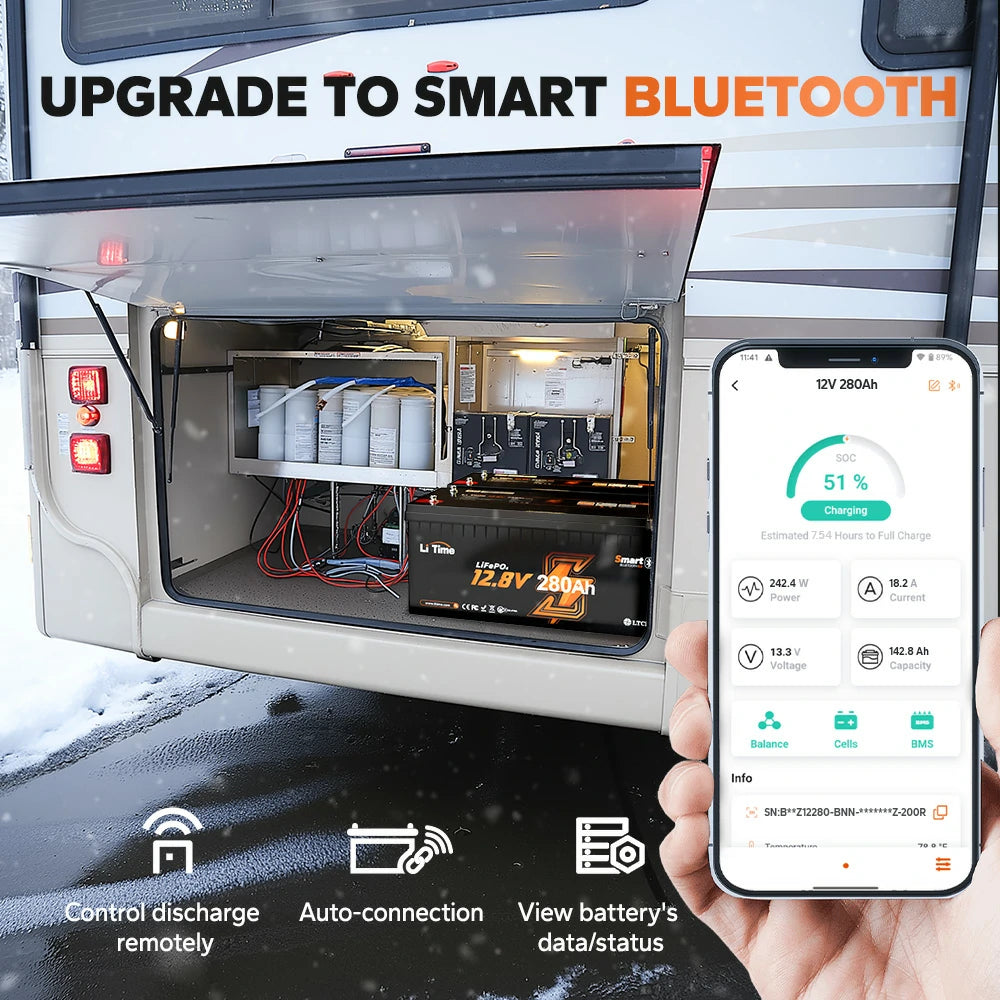
Buy 12v 280ah bluetooth battery
Cons:
- Larger size: Their bigger footprint may not fit every battery compartment or space-constrained setup.
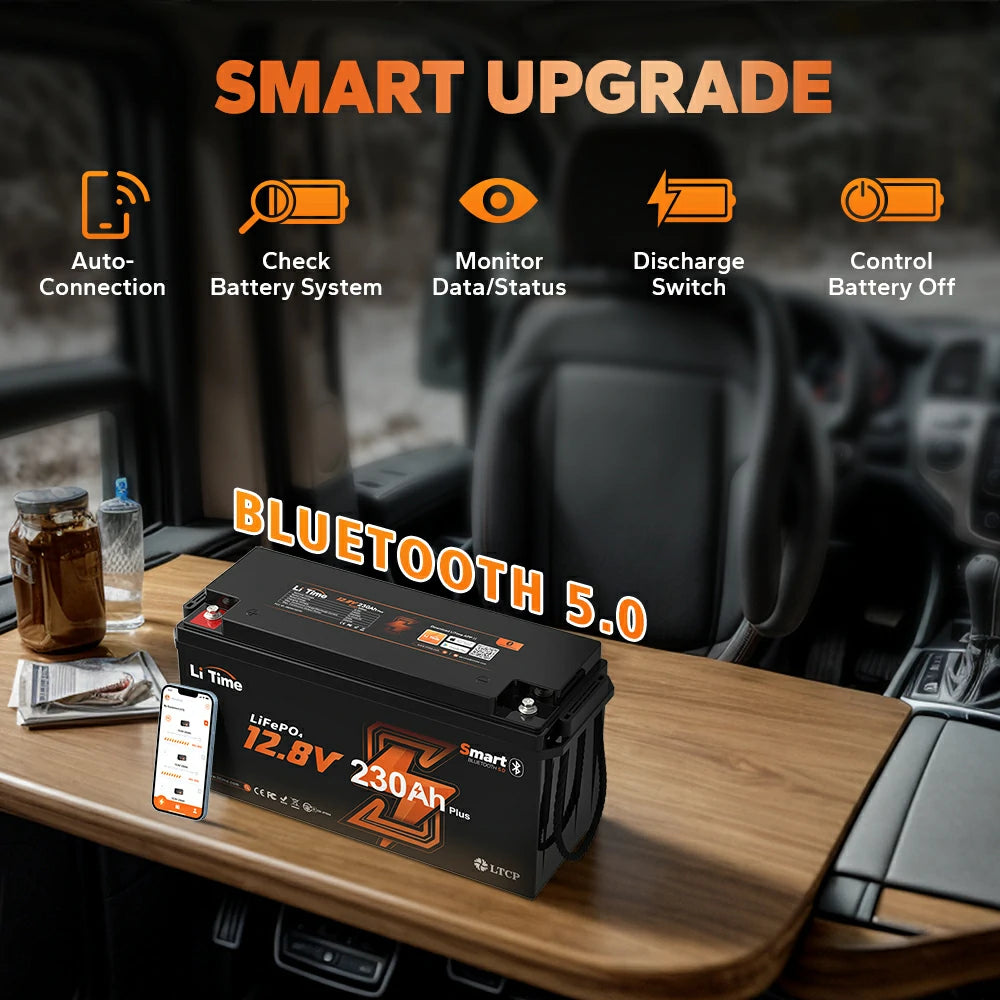
3. LiTime 12V 230Ah Deep Cycle Lithium Battery
Weight: 45.22 lbs
Recommendation: ★★★★★
This powerhouse delivers an impressive 2944Wh of energy and a robust 2560W of continuous power, making it the perfect choice for all your RV applications. With its high capacity and reliable performance, the LiTime 230Ah battery ensures you can enjoy your adventures without worrying about power limitations.
Pros:
- High Capacity: Delivers an impressive 2944Wh of energy and robust 2560W of continuous power, perfect for RV applications.
- Bluetooth Connectivity: Features smart Bluetooth 5.0 for easy remote monitoring and control.
- Temperature Protection: Charging and discharging protections at extreme temperatures ensure safe operation.
- Advanced BMS: 200A self-developed battery management system with over 20 protections for enhanced safety.
- IP65 Rating: Waterproof and dustproof, making it durable for outdoor use.
- High Output: Supports 200A max continuous current and 1000A 1s max surge discharge, handling larger power demands.
- Eco-Friendly: Utilizes EV-grade LiFePO4 cells that are non-toxic and reliable.
Cons:
- Higher cost: They’re typically more expensive than smaller batteries, which is an important consideration for budget-conscious buyers.
4. Battle Born Batteries 12V 100Ah Battery
The Battle Born 12V 100Ah LiFePO4 Deep Cycle Battery is a versatile and lightweight lithium battery designed for various applications, providing reliable power with a long lifespan.
Weight: 31 lbs
Recommendation: ★★★
Pros:
- High Capacity: Offers 100Ah with 100% usable power, ideal for RVs, boats, and off-grid systems.
- Durability: Built for rugged use with a long cycle life of 3,000-5,000 deep discharge cycles.
- Advanced BMS: Features a built-in battery management system for safety and efficiency.
- Versatile Installation: Can be wired in series or parallel and mounted in any orientation.

Cons:
- Expensive: More expensive than other alternatives, which may deter budget-conscious buyers.
- Heavier: Weighing at 31 lbs, heavier than other 12V 100Ah lithium batteries
- No bluetooth: Lacks smart monitoring features like Bluetooth connectivity for remote management.
5. Manly 12V 200Ah LiFePO4 Lithium Battery
The 12V 200Ah LiFePO4 Lithium Deep Cycle Battery from MANLY Battery is a robust and high-capacity solution designed for various applications, including marine, RV, and off-grid systems, offering reliable performance and longevity.
Weight: 49 lbs
Recommendation: ★★★★
Pros:
- High Capacity: Provides 200Ah with over 6,000 cycles, making it ideal for extended use in demanding environments.
- Advanced BMS: Includes a battery management system for protection against overcharge, over-discharge, and overheating, enhancing safety.
- Lightweight: Weighs approximately 22.3 kg (around 49 lbs), which is significantly lighter than traditional lead-acid batteries.
- Eco-Friendly: Made with Grade A+ LiFePO4 cells, free from harmful chemicals, and designed for long-term use with minimal environmental impact.

Cons:
- No Self-heating function: In cold winter day, customers should charge it in warm area.
- No Built-in Bluetooth Functionality: Lacks smart monitoring features like Bluetooth for remote performance tracking, which some users may find inconvenient.
6. Dakota Lithium 12v 100Ah Deep Cycle LiFePO4 Battery
The Dakota Lithium 12V 100Ah Deep Cycle LiFePO4 Battery is designed for high-performance applications such as marine use, RVs, and solar energy systems. This lightweight and robust lithium battery offers exceptional longevity and reliability, making it an ideal choice for powering a variety of devices.
Weight: 23 lbs
Recommendation: ★★★
Pros:
- High Cycle Life: Provides over 5,000 recharge cycles, significantly longer than traditional lead-acid batteries.
- Lightweight Design: Weighs only 23 lbs, making it easy to transport and install compared to heavier lead-acid options.
- Versatile Applications: Suitable for trolling motors, fish finders, and other marine electronics, as well as RV and solar setups.
- Optimal Performance: Functions well in extreme temperatures, with optimal performance down to -20°F.
- Eco-Friendly: Built with safe lithium iron phosphate (LiFePO4) technology, free from harmful chemicals.

Cons:
- Higher Initial Price: The upfront cost may be higher than that of other competitors, which could be a consideration for budget-conscious buyers.
- No Low-Temperature Charging off Protection: Does not offer low temperature charging cutoff protection, which could lead to potential battery damage in cold environments.
- No Built-in Smart Features: Lacks integrated smart monitoring functions like Bluetooth, which could enhance user experience for real-time monitoring.
Why Choose LiTime's RV Batteries?
Selecting LiTime's RV batteries offers a range of compelling advantages:
Best-Value
LiTime stands out as a provider of tech-driven and best Value RV batteries, ensuring high-quality and efficient power solutions at a wallet-friendly price point.
Versatility
LiTime offers RV batteries in a variety of capacities, spanning from 50Ah, 100Ah, 200Ah, to 560Ah, catering to diverse individual requirements.
Whether you seek extended boondocking adventures or shorter trips, LiTime has an RV battery with the perfect capacity for your needs.
Durability
The longevity of LiTime's lithium batteries is directly linked to their Depth of Discharge (DOD), ensuring extended operating hours and sustained performance.
Safety
Employing lithium iron phosphate, known for its safety and resilience, LiTime manufactures its lithium batteries using this material, providing enhanced durability and protection during usage.
Innovative Features
LiTime batteries boast an advanced and innovative design, tailored to withstand rugged environments and harsh weather conditions. Additionally, an optional rugged battery box crafted from polypropylene, complete with ventilation holes and a securing strap, ensures easy installation and protection for your RV battery.
Advanced Functionality
Featuring cutting-edge attributes such as a battery saving mode and Bluetooth capabilities, LiTime batteries offer the added benefit of accessing daily power reports, enhancing your overall experience.
Warranty and Support
LiTime offers a five-year warranty on lithium batteries, coupled with round-the-clock customer service to address any concerns or inquiries promptly.
Visit LiTime Youtube Reviews for more information about LiTime batteries.
Frequently Asked Questions (FAQs)
1.How long will a RV battery Last?
Typically, depending on your power usage, boondocking can be sustained for a period ranging from 2 to 4 days.
Normally, if you have a 100ah LiFePO4 lithium battery, it would last 1-3 days.
2.How to charge RV batteries?
There are 4 recommended ways to charge lithium RV batteries,
- LiFePO4 battery charger
- Solar Panel
- Generator
- Alternator
Read on The Best Ways to Charge Lithium LiFePO4 Batteries for more details.
3.What’s the difference between a car battery and an RV battery?
Car batteries are designed for starting the engine and providing short bursts of high power. They are usually referred to as "starting batteries" or "cranking batteries." RV batteries, on the other hand, are often deep cycle batteries designed to provide a steady amount of power over a longer period of time. They are built to withstand deep discharges and recharges, making them suitable for powering appliances and electronics in an RV.
4. How big of a lithium battery do I need for RV?
Choosing the right lithium battery for your RV depends entirely on your power consumption. As a general guideline:
- Smaller RVs and Campers: A 100–200Ah 12V battery is a common starting point.
- Larger Motorhomes & Fifth Wheels: These typically require 200–400Ah systems, which may be 12V or 24V.
To determine your specific needs, you'll want to calculate the total daily amp-hours (Ah) consumed by all your appliances and add a safety buffer.
5. Can my RV’s charging system charge a lithium (LiFePO4) battery?
Yes—most RVs can charge a lithium (LiFePO4) battery once the charging equipment is set correctly.
What you need for proper charging/conversion:
-
Converter/shore charger: Use a lithium-compatible unit so the battery can reach ~14.2–14.6V (absorption). Float can be 13.4–13.8V or disabled.
-
Alternator while driving: Add a DC-DC charger (size ≈ 0.2–0.5C of battery Ah; e.g., 20–50A for 100Ah) to regulate voltage/current and protect the alternator.
-
Solar: Pair panels with an MPPT controller set to a lithium profile.
-
Wiring & protection: Match cable gauge and fuse/breaker to current; verify polarity and torque.
-
Commissioning: Fully charge, confirm resting voltage, and test charging from shore, alternator, and solar.
Conclusion
In the pursuit of the best lithium battery for an RV, it's essential to consider factors such as capacity, lifespan, charging capabilities, and overall performance. By choosing high-quality LiTime recreational vehicle batteries that aligns with your specific power requirements and RV setup, you can enhance your travel experiences with reliable and sustainable energy storage. Whether it's for boondocking adventures or extended road trips, the right lithium battery can truly elevate your RV lifestyle.


