

No Noise. No Fumes. No Game‑Day Stress.

I’m preparing for:


The NO.1 LiFePO4 Battery Brand


FAQ
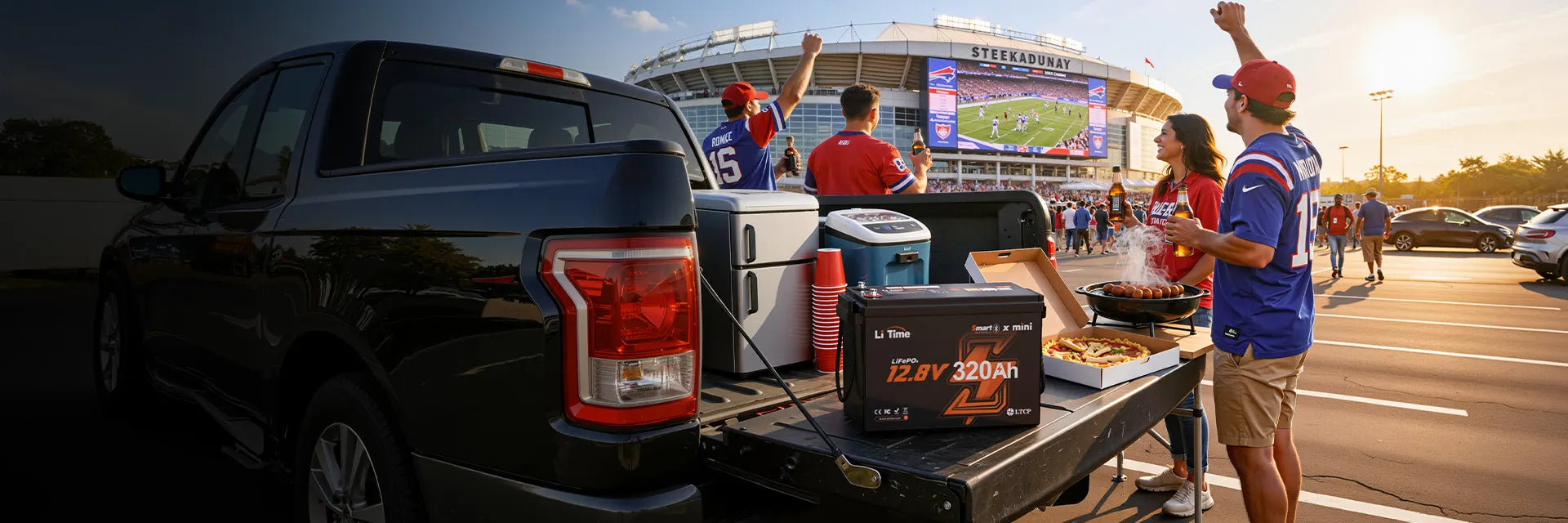
Tailgating is a pre‑game hangout in the parking lot—often around your vehicle’s tailgate—where fans cook, watch the game, and play music.
Choose based on what you’ll run at the same time, how long you need power, and whether temperatures may drop below freezing.
Not necessarily. For quiet, portable power and venue‑friendly use, a LiFePO4 battery + inverter kit can be a cleaner option than gas generators.
Use a pure sine wave inverter and size your battery based on your TV’s wattage and how many hours you want to run it.
Check the appliance’s wattage label and plan for surge watts. Some grills have low‑watt control systems, while others draw high power for heating.
For TVs, speakers, and lights, 1000W is often enough. For coffee makers, air fryers, or other high‑watt appliances, 2000W is the safer choice.
Runtime depends on battery capacity (Wh), inverter efficiency, and your device’s average wattage. See our runtime examples for each kit.
Battery, inverter, proper cables, an inline fuse, charging method (AC or car), and a safe setup location. Download our Tailgate Power Checklist.
You can charge it three ways: AC at home (charge before you leave), solar at the tailgate (top up on-site), or DC‑DC while driving (recharge on the road).