


The recent surge in AI data center energy news isn’t just because AI is popular—it’s because data-center electricity demand is becoming a real pressure point for power systems. That demand can raise the cost of keeping the grid reliable and tighten operating margins during extreme weather and peak-load periods. The International Energy Agency (IEA) estimates that global data centers used about 415 TWh of electricity in 2024—around 1.5% of global consumption—and that demand has been growing at roughly 12% per year on average over the past five years.
For households, these macro shifts typically show up in two ways: (1) electricity feels more expensive—especially during peak periods, and (2) outages and grid instability feel more stressful. As a result, Home Battery Backup is shifting from a niche “tech enthusiast” upgrade to a practical risk-management tool for more everyday families.
To understand why AI-driven data center growth is now a grid-level concern—not just a tech trend—the International Energy Agency (IEA) recently released a first-of-its-kind global analysis on AI and energy.
- Why Rising AI Data Center Electricity Demand Can Amplify Grid Stress
- Do AI Data Centers “Cause Blackouts” and What You Feel on Your Bill?
- Why More Families Are Paying Attention to Home Battery Backup
- What Is Home Battery Backup—and What It Can and Can’t Do
- How to Choose Home Battery Backup More Scientifically
- LiTime Recommendation: LiTime Lithium Battery as a Practical Home Battery Backup Option
- Conclusion: In a More Complex Grid Era, Home Battery Backup Brings Household Certainty
Why Rising AI Data Center Electricity Demand Can Amplify Grid Stress
One point is often misunderstood: AI data centers are rarely the direct cause of outages. A more accurate framing is that they can act as a grid-stress amplifier—shrinking the system’s operating headroom when conditions get tight.
This amplification tends to show up in three ways: scale, speed, and concentration.
Scale. Data centers represent large, high load-factor electricity demand. The IEA estimates global data-center electricity use at roughly 415 TWh per year and notes that their footprint in the energy system is rising. Because many facilities operate close to continuously and require high power quality, they can contribute to tighter operating margins during stressed conditions.¹
Speed. New load is arriving faster than grid build-outs can keep up. In announcing its 2025 Summer Reliability Assessment, NERC highlighted an upward revision in peak-demand expectations and identified new data centers—alongside electrification and industrial activity—as key drivers. NERC also emphasized that reliability risk increases when high demand overlaps with stressors such as extreme heat and reduced wind/solar output.²
Concentration. The stress is often regional, not national. Data centers tend to cluster in a limited number of grid areas. When large new loads come online faster than generation, transmission, substations, or interconnection capacity can expand, local constraints can intensify—even if the country as a whole appears adequately supplied.

References
1. IEA, Energy and AI – “Energy demand from AI”
2. NERC, 2025 Summer Reliability Assessment announcement (May 2025)
Do AI Data Centers “Cause Blackouts” and What You Feel on Your Bill?
AI data centers aren’t a single “blackout switch.” Instead, they represent a large and growing load that steadily pushes power systems closer to their operating limits. Most of the time, nothing happens. But under certain conditions, the grid has less room for error and becomes harder to operate.
A simple chain explains why: large new loads increase peak demand and tighten system headroom; when extreme weather or supply constraints hit, operations can approach reliability boundaries; and operators must rely on larger reserves and more precise dispatch to maintain stability.
This dynamic aligns with NERC’s 2025 Summer Reliability Assessment, which finds that resources can be sufficient under normal conditions, but reliability risks rise when above-normal demand coincides with reduced wind or solar output and widespread heat that degrades generation and transmission performance.¹
Many people assume higher electricity bills are driven only by the “price per kWh.” In reality, households also pay for reliability. When future peak demand threatens to outpace available supply, grid operators procure additional dependable capacity, expand reserve margins, and invest in transmission and distribution upgrades. Over time, these costs can flow through into retail rates or line-item charges.
A clear market signal comes from PJM, one of the largest U.S. grid operators. According to Reuters, PJM’s latest capacity auction cleared at record-high prices, with surging data-center electricity demand cited as a key driver. The report noted that higher capacity costs may ultimately be passed on to utility customers.²
Similar concerns also appear in public online forum discussions, where residents in data-center growth regions express worries about short rolling outages and rising electricity costs.³
References
1. NERC, 2025 Summer Reliability Assessment
2. Reuters, Prices in biggest U.S. power grid auction hit new record amid supply crunch
Why More Families Are Paying Attention to Home Battery Backup
As the grid becomes more stressed during peaks and extreme weather, many households are shifting toward an “essential-loads-first” mindset—refrigeration, internet, medical devices, security systems, and home-office gear. Home Battery Backup is gaining momentum for three practical reasons.

Keep essentials running: During outages or power-quality events, a battery can keep core devices online and reduce disruption and stress.
Move from reactive to prepared: Instead of scrambling after an outage starts, families can build resilience in advance.
Real-world signal: demand flexibility is becoming normal: When supply and demand get tight, grid operators increasingly rely on flexible load. The Register reported that Google reached an arrangement with a utility to adjust data-center power use during high-demand or disturbed grid conditions—an example of load-side flexibility becoming part of real-world reliability strategies.¹
References
1. The Register. “Google agrees to pause AI workloads when power demand spikes.” (Accessed Dec 2025).
What Is Home Battery Backup—and What It Can and Can’t Do
A Home Battery Backup system typically combines a battery (often lithium), an inverter/charger (or an all-in-one unit), and the required protection and transfer equipment. It can be a powerful resilience tool when expectations are set correctly.
What it can do: provide power for essential loads during short-to-medium outages (runtime depends on capacity and load); reduce disruption from brief grid disturbances when paired with an appropriate transfer/UPS strategy; and improve household resilience during heat waves, storm seasons, and wildfire events.
What it can’t guarantee: it won’t automatically power an entire home indefinitely through every outage; it does not replace safe electrical design, protective devices, or code-compliant installation; and it can’t “fix” macro grid challenges—it helps your household manage risk.
How to Choose Home Battery Backup More Scientifically
Start with a short list of critical loads (refrigerator, router, lights, laptop, sump/circulation pump, and so on). Then estimate total wattage and the backup window you want—for example, 500 W for 6 hours is about 3 kWh, plus losses and a safety margin.
Quick Voltage Guide: 12V vs 24V vs 48V (and Why 48V Is Often the Household Standard)
| Voltage | Best-fit scale / use case | One-line reason |
|---|---|---|
| 12V | Small systems, RV/marine, small solar/backup | Higher current at higher power means thicker cables, more loss, and more voltage drop. |
| 24V | Mid-size backup / solar systems | Roughly halves current versus 12V, improving efficiency and wiring practicality. |
| 48V | Home-scale and higher-power backup (common standard) | Lowest current at the same power, lower losses, easier expansion, and better fit for higher-power inverters. |
| Same load example | 12V | 24V | 48V |
|---|---|---|---|
| 1200W load | ~100A | ~50A | ~25A |
Battery DIY Kits summarizes tradeoffs by application and notes that 48V tends to be better suited for higher power and expandability.
Next, choose your system form factor: battery-only backup (simpler) or battery plus solar PV (often better long-term economics, but more complex design). Regardless of approach, prioritize protection, wiring practices, and code-compliant installation.
LiTime Recommendation: LiTime Lithium Battery as a Practical Home Battery Backup Option
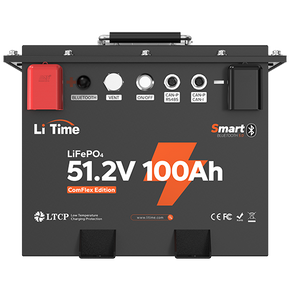
If you’ve decided to build Home Battery Backup, the bigger question isn’t “whether” but “which 48V setup avoids regret.” LiTime’s 48V lineup is organized by real-world needs—Classic, Bluetooth, Low-Temp, Self-Heating, 2C-Rate, ComFlex, and Waterproof—so you can choose based on your environment and goals rather than paying for features you won’t use.

Three questions to pick the right direction:
1) Do you face cold conditions (garage, outdoors, winter climates)? If yes, prioritize Low-Temp or Self-Heating to better match low-temperature performance needs.
2) Are your critical loads power-hungry (fridge plus microwave/coffee maker/small AC)? If yes, focus on discharge capability and inverter headroom—2C-Rate options are positioned for higher discharge demands.
3) Do you value convenience monitoring or long-term expandability? For easier day-to-day visibility, Bluetooth helps make state-of-charge and status more intuitive. For a more scalable system plan, ComFlex aligns with a “build once, expand later” mindset.
Practical rollout tip: Start with essential loads (refrigerator, router, lighting, home-office equipment) to validate runtime and power needs. If you already know you want solar-plus-storage, the 48V ecosystem can support a smoother upgrade path using a 48V Solar inverter charger 3.5kW or 48V Solar inverter charger and off-grid kit options (3.5kW/5kW/10kW).
A side-by-side comparison of LiTime’s 48V lithium battery options is available.
Conclusion: In a More Complex Grid Era, Home Battery Backup Brings Household Certainty
Rising data-center electricity demand is becoming a meaningful new variable in the global energy system. The IEA provides clear scale and growth context, and North American reliability assessments flag new data centers as one factor behind higher peak-demand expectations.
For most households, the productive move isn’t to argue about a single “cause” of outages. It’s to focus on what you can control: build Home Battery Backup capability so your essentials keep running and you have more resilience and peace of mind when the grid gets stressed.

