



A car refrigerator (portable fridge for car) can be great—or frustrating. In many cases, the experience depends less on “which one cools the most” and more on the power system: whether it can handle compressor start-up, whether it shuts down overnight due to low voltage protection, and whether performance drops when the cable run is long. This guide walks you from “how to choose a fridge” to “how to estimate overnight runtime,” then outlines a practical 12V/24V lithium battery recommendation approach that also naturally covers the common term mini fridge for car.
- Are portable fridge for car units really used in RVs or on boats?
- Four things to check before you buy
- How much power does a car fridge use? An official way to estimate runtime
- Why does it shut off overnight? Two main causes
- Three ways to keep it running overnight
- 12V or 24V?
- FAQ
- Safety note
Are portable fridge for car units really used in RVs or on boats?
Yes—very commonly. Many compressor-based car fridges are essentially 12V/24V DC appliances. As long as the platform provides the same DC voltage (common in cars, RV house systems, and marine electrical systems), they can be used there as well.
- ARB’s user manual states the unit can run on 12V DC or 24V DC; the power source can be a vehicle, boat, or caravan, and it can also run on 100–240V AC.
- Dometic’s support content discusses these fridges in DC-use contexts as well (for example, estimating runtime from a 12V battery and addressing low-voltage protection behavior).
Four things to check before you buy
1) Low-voltage protection is a must (otherwise the experience can be terrible)
Low-voltage protection monitors the input voltage and stops the fridge when the voltage drops too low, preventing the power source from being dragged down. For example, Dometic CFX3 clearly describes a 3-stage battery protection system; it shuts down on low voltage primarily to prevent the car’s starter battery from being drained and leaving you stranded.
2) Don’t focus only on “rated input current”—look at “average consumption”
Rated input current is typically a maximum, not your real-world average draw. Dometic emphasizes using average consumption (Ah/h) when estimating runtime and notes that “Rated Input Current” is the maximum rated input.
3) Pay attention to connectors and DC-use details
If you plan to move between the car, campsite, and boat, prioritize models with robust DC plugs and practical power-use features (for example, secure connectors, voltage/charge indicators, or app-based monitoring). These details directly affect how hassle-free the setup feels.
4) For overnight use, don’t expect the starter battery to “power through”
Low-voltage protection reduces risk, but it isn’t a universal guarantee. If you want your fridge to run overnight reliably, a better approach is to take the fridge load off the starter battery and power it from a dedicated deep-cycle system (the next sections give a practical, blog-friendly way to explain this).
How much power does a car fridge use? An official way to estimate runtime
You can directly cite Dometic’s estimation method—simple, authoritative, and practical:
Runtime (hours) ≈ Usable battery capacity (usable Ah) ÷ Refrigerator average consumption (Ah/h).
Dometic also offers a rule-of-thumb for usable capacity by battery chemistry (for estimation):
- Lead-acid: typically assume 50% of rated capacity is usable
- NMC lithium: about 80% usable
- LiFePO4: can be close to nearly 100% usable in their guidance (example references Dometic PLB40) (Dometic Support)
Even if two batteries are both labeled 100Ah, whether the fridge can run through the night depends on usable capacity and average consumption.
What makes “average consumption (Ah/h)” go up?
Dometic’s definition makes the key point clear: average consumption is measured under a given ambient temperature and a chosen set internal temperature.

In real-world use, these factors can significantly increase average consumption:
- Higher ambient temperature (hotter = more energy): More heat enters the cabinet and cooling efficiency worsens, so energy use rises.
- Lower set temperature (colder = more energy): Because the published averages are tied to the set temperature, setting it lower typically makes the compressor run longer, increasing average consumption.
- Frequent or prolonged lid opening: Dometic’s CFX3 documentation warns that keeping the lid open for a long time significantly increases the internal temperature; the greater the rebound, the longer the compressor must run to recover, increasing average consumption. (Source: RV Super Centre)
- Poor insulation or sealing: Heat enters primarily through the cabinet insulation and door seals; weaker insulation or seals increase heat infiltration and energy use. (Source: ScienceDirect)
- Adding lots of warm/room-temperature items (extra thermal load): Experimental research shows extra thermal loads (e.g., adding warmer contents) can significantly affect refrigerator energy consumption. (Source: ScienceDirect)
- Poor ventilation around the unit: Dometic manuals emphasize keeping vents unobstructed; restricted heat dissipation makes the system work harder and run longer. (Source: RV Super Centre)
- Voltage drop / low supply voltage: These fridges monitor DC input voltage and can shut down on low-voltage protection; larger voltage drop makes it more likely the battery still has charge but the fridge-side voltage is insufficient, causing earlier shutdown and worse practical runtime.
Example: average consumption is 1Ah/h and you want 10 hours of runtime
Suppose your car fridge averages 1Ah/h (referenced to a 12V supply) and you want it to run for 10 hours:
- Required usable capacity ≈ 1Ah/h × 10h = 10Ah (adding a buffer is more reliable)
- If you use lead-acid and assume 50% usable, you may need a larger rated capacity to achieve that usable Ah.
- If you use LiFePO4 and estimate with a higher usable fraction, the rated capacity is typically utilized more effectively. (Dometic Support)
The most useful takeaway is the method: estimate your runtime, then account for the factors that increase consumption—hot weather, frequent lid opening, poor insulation/seals, and voltage drop.
Why does it shut off overnight? Two main causes
1) Low-voltage protection triggers (this often means the protection is working)
Dometic clearly explains that when it detects low voltage, it will shut down and display a low-voltage alert—the intent is to prevent the starter battery from being depleted.
If your fridge frequently shuts down due to low voltage, the first thing to recognize is: it may be protecting you, not failing.
2) Voltage drop (thin/long cables or high-resistance connections)
Even if the battery-side voltage looks fine, long cable runs, thin wire, or loose/oxidized connections can make the fridge “see” a lower voltage, triggering low-voltage protection sooner.
In marine/RV DC systems, many installers use Blue Sea’s voltage drop wire sizing guidance:
- Loads that affect safe operation are often sized to 3% voltage drop
- Other loads may be sized to 10% voltage drop (Blue Sea Systems)
Three ways to keep it running overnight
Option A: Run it from the starter battery (not recommended for regular overnight use)
The upside is convenience. The downside is concentrated risk: low-voltage shutdown and the anxiety of not being able to start the vehicle in the morning. Dometic explicitly ties its low-voltage protection to avoiding starter battery depletion.
Option B: Use a portable power station (good for occasional use and convenience)
Pros: plug-and-play, plenty of ports. Cons: cost and size, and usable capacity can fluctuate more in cold conditions.
Option C: Use a dedicated deep-cycle battery system (best for frequent overnight use)
The core idea is to separate the fridge load from the starter battery, power it from a deep-cycle battery, and build the wiring/protection properly to avoid nuisance shutdowns caused by voltage drop.
12V or 24V?
12v lithium battery: the most common, simplest path for car fridges
Best for: sedans/SUVs/pickups, overnight camping, trunk/boot kitchens
Why it makes sense:
- Most car fridges are designed to run on 12V by default, so the setup is straightforward.
- When you estimate runtime using Dometic’s method, “usable capacity” is the key variable; their chemistry guidance makes it easier to explain why LiFePO4 can offer higher usable capacity in practice.
- In engineering design, LiFePO4 is often chosen for reasons such as long cycle life, strong thermal performance, and improved resistance to thermal runaway; Texas Instruments summarizes these considerations in its design guidance.
Recommended LiTime products (two angles):
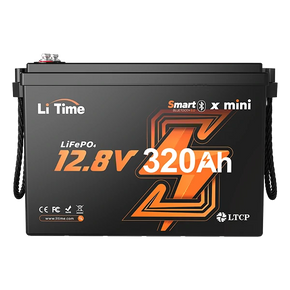
- Compact / flexible installation: LiTime 12V 100Ah XtraMini Bluetooth Small LiFePO4 Battery. It is positioned for compact, flexible installs and emphasizes long-lasting power; a good fit for limited space and readers who want to check battery status on a phone.

- Longer runtime / more loads (fridge + lights + fans, etc.): LiTime 12V 200Ah Plus LiFePO4 Battery. The product description positions it for deep-cycle use across RV/boats/solar and emphasizes stronger performance and safety

24v lithium battery: a “cleaner, more efficient” choice for 24V RV/marine DC systems
Best for: RV house systems, some marine systems, and 24V platform equipment
Why it makes sense:
- At the same power level, a 24V system draws less current, making voltage drop easier to control.
- If your platform is already 24V, using a 24v lithium battery is often simpler and cleaner than “cobbling together” multiple 12V elements.
Recommended LiTime product:
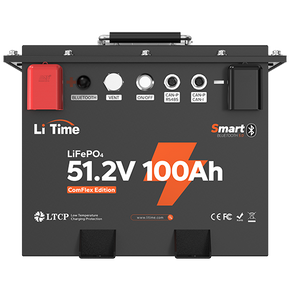
- LiTime 24V 100Ah Lithium Bluetooth Battery for RV & Marine: It highlights Bluetooth monitoring and long-lasting power, making it easier to track battery status and manage your setup.

If you regularly run a portable fridge for car overnight, the power system often matters more than the fridge brand. A practical estimation method is to divide usable battery capacity (usable Ah) by the fridge’s average consumption (Ah/h) to estimate runtime; also remember that rated input current is a maximum, not an average.
On a 12V platform, choosing the right 12v lithium battery is often the most reliable way to achieve “runs all night.” If your platform is 24V (common in some RV/marine systems), choosing a 24v lithium battery and controlling voltage drop with good wiring practices can make the system far more dependable.
FAQ
Why does my fridge show a low-voltage alert and shut down?
In many cases, low-voltage protection is doing its job to prevent the starter battery from being depleted. It can also be caused by voltage drop that makes the fridge-side voltage too low even when the battery still has charge.
Do I need thicker wire? Why do problems show up on long cable runs?
In DC systems, the longer and thinner the cable (and the more connection points), the larger the voltage drop. Blue Sea’s guidance is commonly used: sensitive/safety-relevant loads are often sized to 3% drop, while other loads may be sized to 10%. (Blue Sea Systems)
Is it reasonable to use a car fridge in an RV or on a boat?
Yes. Many models are designed for 12V/24V DC use, and ARB explicitly lists vehicle/boat/caravan as valid DC power sources.
What should I pay attention to when camping in winter?
In cold conditions, pay extra attention to charge protection strategies. A common approach is BMS low-temperature charge protection, which limits or stops charging below a threshold (often around 0°C/32°F) to protect the cells.
Safety note
Vehicle/RV/marine electrical systems involve fusing/breaker protection, wire gauge, and connection reliability. This article provides selection and principles; if you modify wiring, follow the equipment manuals and have a qualified professional inspect the work.

