


Battery capacity is one of the most essential specifications when you pick batteries for RVs, marine vessels, off-grid solar systems, golf carts and portable devices. Many users confuse charge units, energy units, rated values and real-world output, which leads to poor battery selection and unexpected power shortages.
This guide breaks down core definitions, calculation rules, influencing factors, maintenance tips, expansion solutions, scenario-based selection, product recommendations and frequently-asked misconceptions about battery capacity.
- Part1: What Is Battery Capacity?
- Part2: How to Monitor or Measure Your Battery Capacity
- Part3: What Factors Influence Battery Capacity
- Part4: How to Maintain Good Battery-Capacity Health
- Part5: How to Expand Battery Capacity
- Part6: How To Choose Appropriate Battery-Capacity Size
- Part7: LiTime High-Density Large-Capacity Battery
- FAQ on Battery Capacity
What Is Battery Capacity?
Battery capacity describes how much electric charge or energy a battery can store and deliver under defined test circumstances. It directly determines how long your devices can run before recharging. However, nominal figures printed on labels rarely equal real-world usable performance, so multiple concepts need to be clarified.
Battery Capacity and Maximum Battery Capacity
Battery capacity generally refers to rated capacity, the total charge a battery can output following official laboratory testing standards (fixed temperature, standardized discharge current and cutoff voltage).
Battery maximum capacity stands for the total energy the fully-charged rechargeable battery can hold. For lithium batteries, maximum capacity reflects current storage performance compared with factory-original design capacity. As batteries age, maximum capacity gradually declines. A higher maximum capacity means longer runtime per full charge under identical conditions. Note that maximum capacity is not fixed; it will degrade after repeated charge-discharge cycles.
Battery Capacity Units (Ah, mAh, kWh and Wh) and Calculations
Two sets of units are widely used on battery datasheets: charge-based units (Ah, mAh) and energy-based units (Wh, kWh). They serve different analytical purposes and must not be mixed for direct comparison.
- Ah (Ampere-Hour) / mAh (Milli-Ampere-Hour) Ah measures total electric charge output. 1 Ah = 1000 mAh. A 100 Ah battery theoretically supplies 100 A for one hour or 10 A for ten hours under lab conditions. Ah only shows charge quantity; it cannot represent real stored energy without voltage information. Small consumer batteries like power banks and cell phone batteries usually adopt mAh, while large deep-cycle storage batteries use Ah.
- Wh (Watt-Hour) / kWh (Kilowatt-Hour) Wh and kWh measure actual electrical energy. 1 kWh = 1000 Wh. This unit enables fair comparison across batteries of different voltages.
Core conversion formula:
Wh = Ah × Nominal Voltage(V)
kWh = Ah × Nominal Voltage(V) ÷ 1000
Examples:
- 12 V 100 Ah battery: 100 × 12 ÷ 1000 = 1.2 kWh
- 48 V 50 Ah battery: 50 × 48 ÷ 1000 = 2.4 kWh
Runtime estimation formula:
Usable runtime(h) = Battery energy(kWh) ÷ Device power(kW)
A fridge consuming 60 W (0.06 kW) powered by a 1.2 kWh battery delivers theoretical runtime of 20 hours, yet practical runtime is shortened by discharge limits, temperature and equipment cycling behavior.
Rated Capacity vs Actual Usable Capacity
Rated capacity: Test value acquired under standardized laboratory conditions (typically 20-25 °C, low discharge rate). Manufacturers mark this value on product labels.
Actual usable capacity: Real energy you can draw in daily scenarios, always lower than rated capacity. Multiple constraints apply:
- Depth of Discharge (DoD): Lead-acid batteries only allow 50% DoD to extend lifespan, while LiFePO4 lithium batteries safely support deep discharge.
- System losses: Inverter conversion loss, wiring resistance loss, BMS protection cut-offs.
- Environmental conditions: Low temperature reduces deliverable capacity.
When sizing batteries for real projects, always calculate based on usable capacity rather than purely relying on rated-spec figures.
Battery Capacity and Battery Power
Capacity and power are frequently misunderstood.
- Battery capacity (Ah/kWh): Reflects total stored charge or energy; decides how long loads can run.
- Battery power (W/kW): Defines maximum instantaneous output current and wattage, controlled by BMS and cell characteristics. It determines whether your battery can start high-power devices such as air conditioners and stoves.
A battery with large capacity may have low peak power and fail to drive heavy-drain appliances. When selecting batteries, verify both capacity and continuous / peak discharge power specifications.
How to Monitor or Measure Your Battery Capacity
You can monitor and test battery capacity via smart built-in systems or professional testing equipment:
1.Smart BMS & Bluetooth App Monitoring (Lithium batteries) Modern smart lithium batteries integrate Bluetooth‑enabled BMS. Users check real state‑of‑charge(SOC), remaining capacity, voltage, current, temperature and cycle counts through mobile apps. This is the most convenient daily monitoring method, for example the LiTime App supporting the 12V 320Ah Mini battery.
2.Multimeter quick check (for reference only) Measuring open‑circuit voltage roughly judges charge level. Voltage reading cannot calculate accurate capacity, especially for aged lead‑acid batteries with surface‑charge interference.
3.Professional capacity tester / electronic‑load tester (gold‑standard measurement) Operating steps:
- Fully charge battery to manufacturer‑specified cut‑off voltage;
- Discharge with constant‑current load under standard room temperature (25 °C);
- Stop discharging once hitting cutoff voltage;
- Compute capacity = Discharge current(A) × Discharge duration(h).
State-of-Health(SOH) = Measured capacity ÷ Rated capacity × 100%.
State‑of‑Health(SOH) = Measured capacity ÷ Rated capacity × 100%. If SOH drops below 80%, the battery reaches end‑of‑life for heavy‑duty applications.
Note: Always perform capacity testing at ambient temperature near 25 °C; extreme cold or heat will produce distorted results.
What Factors Influence Battery Capacity
Multiple chemical and environmental variables change available capacity throughout battery service life.
1.Battery chemistry and material Different chemistries deliver distinct theoretical capacity, DoD tolerance and anti‑aging performance. LiFePO4 offers stable usable capacity under high discharge rates; lead‑acid suffers heavy capacity loss under large‑current discharge (Peukert’s effect). Electrolyte density also impacts output: excessively‑high density boosts short‑term capacity but accelerates electrode corrosion.
2.Charge‑discharge rate (C‑rate) High‑speed discharge draws large current within short time and reduces actual extractable capacity. Lead‑acid batteries are particularly sensitive. The C‑rate rating of manufacturer test conditions strongly affects the advertised Ah result. Fast‑charging with excessive current will gradually degrade maximum capacity.
3.Ambient temperature Low temperature slows internal chemical reactions, raises internal resistance and cuts deliverable capacity. At −20 °C, many lithium batteries only output 50‑70% of rated capacity. High temperature temporarily lifts short‑term capacity yet speeds permanent aging. Most batteries achieve best performance at 20‑25 °C.
4.Service age and cycle history Every complete charge‑discharge cycle creates minor irreversible chemical degradation. Maximum capacity slowly fades as cycle count accumulates. Battery SOH declines after hundreds or thousands of cycles, varying by battery type. Poor long‑term storage (full‑charge or zero‑charge state for months) also accelerates capacity decay.
5.Depth of Discharge habit Frequently discharging to extremely low voltage accelerates internal aging and speeds capacity loss. Different battery technologies have their safe DoD ranges.
How to Maintain Good Battery-Capacity Health
Comprehensive maintenance slows capacity degradation and extends overall service life:
1.Follow manufacturer‑approved charging parameters. Use matched chargers; avoid over‑charging and over‑discharging. For lithium batteries, respect temperature‑limited charging rules (do not charge LiFePO4 below 0 °C).
2.Operate and store batteries within recommended temperature ranges. Prevent continuous exposure to extreme heat or freezing conditions. Ventilate battery compartments to avoid heat accumulation.
3.Control depth‑of‑discharge: Do not regularly drain batteries to zero. For lead‑acid batteries keep DoD ≤ 50%; for LiFePO4, even though supporting 100% DoD, partial‑discharge cycles still prolong lifespan (keep 20% ≤ DoD≤ 80%).
4.Avoid sustained ultra‑high charge or discharge current. Match load power to battery BMS continuous‑discharge rating.
5.For multi‑battery banks: Use batteries of identical model, age and specifications; execute regular balance management. Prevent cell imbalance which lowers total usable bank capacity.
6.For long‑term storage: Keep partial state‑of‑charge (50‑60% SOC), store in cool dry locations, and perform supplementary charging every few months to avoid deep self‑discharge.
7.Conduct periodic capacity monitoring. For smart batteries, check SOH via App; for traditional batteries, run capacity testing annually to catch capacity fading early.
How to Expand Battery Capacity
When single-battery energy or voltage cannot satisfy your demand, you can connect multiple identical batteries in series, parallel or series-parallel combinations to expand your battery bank.
Parallel Connection
Connect positive terminals together and negative terminals together across batteries with identical nominal voltage.
- Voltage of the whole bank stays unchanged.
- Total capacity(Ah) adds together.
- Purpose: Extend runtime without raising system voltage.
- Restriction: Must use batteries with same model, same age and consistent health status.
Series Connection
Link positive terminal of one battery to negative terminal of next battery.
- Total system voltage sums up.
- Bank capacity(Ah) remains equal to capacity of single battery.
- Purpose: Upgrade system voltage.
- Restriction: Mismatched batteries cause imbalance and safety risks.
Series-Parallel Connection
Combine parallel groups then connect groups in series. This simultaneously raises voltage and total capacity. For instance, sixteen LiTime 12V 320Ah Mini batteries in 4P4S configuration achieve 48 V / 1280 Ah with total energy of 65.5 kWh for large‑scale off‑grid home energy storage.
How To Choose Appropriate Battery-Capacity Size
Selecting battery capacity should be driven by real-world power consumption, runtime requirement, system voltage, installation space, budget and charging source capacity, instead of blindly chasing large-capacity figures.
Practical Selection Tips
Calculate total daily energy consumption: Sum power(W) × daily working hours for every appliance, convert total load into Wh/kWh. Remember to reserve 20‑30% extra capacity as safety margin and account for DoD limits and conversion losses.
Match system voltage: 12 V /24 V for RV and marine; 36 V /48 V for golf carts and high‑voltage off‑grid systems.
Evaluate charging capability: Ensure your solar panel, alternator or generator can fully recharge your battery bank within available time. Oversized batteries paired with insufficient charging equipment stay chronically under‑charged and degrade rapidly.
Check physical constraints: Consider weight, installation dimension and space limits inside vehicles or cabins.
Balance cost‑performance: Larger capacity brings higher price and heavier weight; avoid excessive over‑sizing.
Scenario-Oriented Recommendations
RV / Van‑life camping: Short weekend trips (lights, phone charging, small 12V fridge only): 12 V 100‑165 Ah LiFePO4; Multi‑day off‑grid boondocking (fridge, parking air‑conditioner, coffee maker, kitchen appliances): 12 V 230‑320 Ah; For extra‑large motorhomes, build parallel banks to reach 400‑600Ah total capacity.
Marine / Boat application: Day‑use fishing boats (fish‑finder, lights, small trolling motor): 12V 100‑200Ah; Live‑aboard boats / overnight cruising: 12V 230‑320Ah or 24V 100‑150Ah. Prioritize vibration‑resistant, IP65‑rated compact lithium batteries. Size total bank Ah based on navigation duration and continuous onboard‑electronics load.
Off‑grid cabins & home backup power: Small weekend cabin (basic lighting, fridge, media devices): Build a 48V 100‑200Ah battery bank via series‑parallel combinations; Full‑time off‑grid household: 48V 300‑600Ah total capacity.
Golf carts & light EV: Standard 48‑volt golf cart for short‑range golf‑course use: 48V 50‑100Ah; Extended‑range neighborhood golf cart: 48V 100‑150Ah. Always follow the factory‑recommended system voltage; select Ah rating matching your expected driving mileage.
Car‑camping & portable outdoor power: Overnight car‑camping (LED lights, portable fridge, phone/laptop charging): 12V 50‑100Ah; Multi‑night vehicle camping with high‑power small appliances: 12V 165‑200Ah. Compact‑size high‑energy‑density lithium batteries are strongly preferred over bulky low‑DoD lead‑acid groups.
LiTime High-Density Large-Capacity Battery
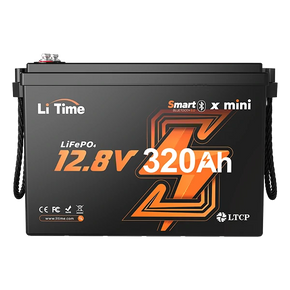
The LiTime 12V 320Ah Mini Bluetooth LiFePO4 battery delivers 4096Wh within a compact footprint, 35% smaller than standard 12V 300Ah lithium models and 70% lighter than equivalent lead-acid banks.
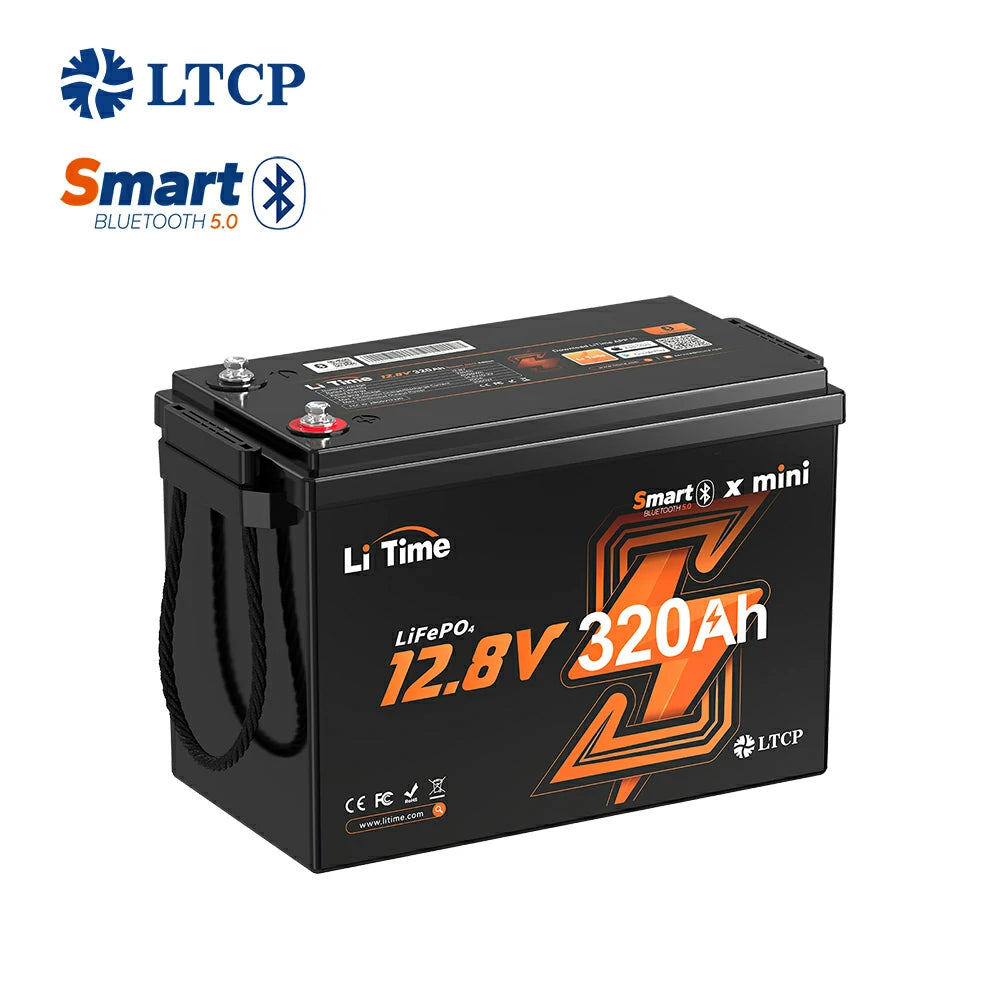
Equipped with an in-house 200A EV-grade BMS, it supports 2560W continuous power and 1000A peak surge for high-draw loads such as parking air-conditioners and kitchen appliances. Built-in Bluetooth 5.0 enables real-time monitoring of SOC, voltage, temperature and cycle data via the LiTime App.
It features low-temperature protection, over 4000 cycles at 100% DoD, and flexible 4P4S expandability. Suited for RV, marine, truck and off-grid installations, it saves precious onboard space while offering higher usable capacity compared with bulky lead-acid alternatives.
FAQ on Battery Capacity
Is Higher Battery Capacity Always Better?
No. Larger capacity provides longer runtime under matching voltage and chemistry, yet it also means higher cost, heavier weight, bigger physical dimension and longer recharging time.
If your charging source cannot fully replenish big‑capacity batteries, chronic under‑charge will accelerate degradation. For equipment with short‑time intermittent usage, over‑sized capacity brings unnecessary cost and weight waste. The optimal capacity balances runtime requirement, available installation space, charging ability and budget, not simply maximum possible Ah.
Does Larger Ah Rating Guarantee a Stronger Battery?
No. Ah only measures stored electric charge, not voltage, power output, chemistry quality or BMS performance.
Battery overall performance depends on voltage, chemistry, BMS power rating, cycle life and temperature adaptability besides Ah value.
Can a 100 Ah Battery Definitely Output 100 A for One Hour?
This is only a theoretical laboratory expectation under standardized low-rate testing conditions. In real-world operation, you cannot guarantee this outcome.
Many factors break this ideal assumption:
1.Discharge rate effect: Drawing high‑current 100 A triggers internal resistance losses; especially for lead‑acid batteries, Peukert’s effect significantly cuts deliverable Ah under heavy load.
2.BMS current limit: Even if cells theoretically support 100 A, the built‑in BMS may set lower maximum continuous‑discharge current and cut output for safety protection.
3.Temperature impact: Cold environments reduce available capacity. 4.Battery aging: A used aged 100 Ah battery with degraded maximum capacity cannot deliver full‑rated charge.

