




What is the difference between rectifier vs inverter? Did you know that the electricity from a household wall outlet and the electricity stored in a smartphone battery are actually completely different in the way they flow?
This difference in the way electricity flows is exactly what direct current (DC) and alternating current (AC) are. And the devices that are indispensable for converting these two types of current into each other are the rectifier and the inverter. In this article, we will clearly explain inverter vs rectifier, DC and AC basics.
Part1: The Basics: Understanding DC and AC

To understand the roles of rectifiers and inverters, it is essential to first grasp the fundamental differences between direct current and alternating current, which are the forms of electricity they convert.
- Direct current (DC) is electric current whose polarity and direction do not change over time. More specifically, it flows steadily in one direction, from the higher-potential positive terminal (+) to the lower-potential negative terminal (-). Because the voltage remains constant, the potential difference between points in the circuit stays stable.
- Alternating current (AC) is electric current whose magnitude and direction reverse periodically over time. The commercial power supplied from household and commercial wall outlets is AC.
The core differences between direct current and alternating current are summarized in the comparison table below.
| Characteristic | Direct Current (DC) | Alternating Current (AC) |
|---|---|---|
| Definition | Current whose direction and magnitude do not change | Current whose direction and magnitude change periodically |
| Voltage waveform | Constant value (flat) | Sine wave (50/60 Hz in Japan) |
| Transmission efficiency | Not suitable for long-distance transmission | Easy to transform voltage and suitable for long-distance transmission |
| Main power sources | Batteries, storage batteries, DC power supplies | Commercial power (wall outlets), generators |
| Electrical polarity | Fixed (+ / -) | Alternating (N / L) |
| Main uses | Electronic circuits, LEDs, energy-saving devices | General home appliances, industrial motors, lighting |
Part2: Inverter vs Rectifier: What Is a Rectifier?

As the name suggests, a rectifier is a power-conversion circuit or device that “rectifies” electrical current by converting alternating current (AC) into direct current (DC).
This conversion process forms the basis for normal operation in electronic devices. As noted above, the electricity delivered to homes and offices is AC, but the precise semiconductor components inside electronic devices require DC with a fixed direction and stable magnitude in order to operate properly.
At the heart of a rectifier is a semiconductor component called a diode, which has the property of allowing current to flow in only one direction.
By arranging and using diodes appropriately, one side of the AC waveform can be removed, producing pulsating current (a pulsed form of DC).
How Does a Rectifier Work?
The core of how a rectifier converts AC to DC lies in the diode’s rectifying action, in other words, its ability to create a one-way flow of electricity.
Using this property, the rectification process can be explained in the following four steps:
1. AC input
First, alternating current from the wall outlet enters the rectifier. This current takes the form of a wave (a sine wave) whose direction and magnitude change over time.
2. Rectification by the diode (core process)
When the incoming AC waveform passes through the diode, the diode’s one-way conduction characteristic allows only one side of the wave (for example, the positive half) to pass through, while blocking the opposite side (the negative half). This is the essence of rectification.
3. Output of pulsating current
After passing through the diode, the current is no longer continuous and smooth. Instead, it becomes a pulsating form of DC. On its own, this pulsating current is still too unstable to power electronic equipment directly.
4. Smoothing (supporting process)
Finally, a smoothing circuit made up of components such as capacitors levels out the peaks and valleys of the pulsating current, converting it into smoother and more stable pure DC.
This overall sequence — “AC input → rectification by the diode → generation of pulsating current → smoothing → output of stable DC” — is the basic operating principle of a rectifier.
What are the Types of Rectifier?
Rectifier circuits are broadly divided into two main types: half-wave rectification and full-wave rectification. These methods differ clearly in conversion efficiency and circuit structure.
| Method | Half-Wave Rectification | Full-Wave Rectification (Bridge Rectification) |
|---|---|---|
| Number of diodes used | 1 | 4 (bridge configuration) |
| Operating principle | Allows only one half-cycle of the AC input to pass through and completely blocks the other half. | Converts both the positive and negative half-cycles of the AC input so that the output is always in the same direction. |
| Output waveform | An intermittent pulse waveform with half of the wave missing. | A more continuous pulsating current with shorter gaps between pulses. |
| Conversion efficiency | Low (theoretical maximum about 40.5%) | High (theoretical maximum about 81%) |
| Features / uses | Simple and inexpensive, but with larger ripple. Used for very simple circuits or very low-power applications. | More efficient and more common. Bridge rectification is the representative circuit type and is used in most AC adapters and power circuits. |
As this comparison shows, full-wave rectification — especially bridge rectifier circuits — is widely used in the power sections of modern electronic devices because of its higher efficiency.
Common Real-Life Applications of Rectifiers
Rectifiers that convert AC to DC play an important role throughout our daily lives. Their applications are wide-ranging.
1. Switching AC adapters / power adapters
These include chargers for smartphones and laptops, as well as external power supplies for home appliances. Their main role is to convert AC from the wall outlet into the DC required by each device. Full-wave rectification (bridge rectification) is commonly used inside them.
2. Internal power circuits in various home appliances
Devices that draw power directly from the wall outlet — such as televisions, audio equipment, and desktop computers — almost always contain an internal power circuit board with a rectifier.
3. Automotive alternators
The electricity generated by an engine is AC, and a high-current rectifier (diode module) is built in to convert it into DC so it can charge the battery and power onboard electronics.
In this way, rectifiers are indispensable devices that quietly support modern electrical civilization behind the scenes.
Part3: Inverter vs Rectifier: What Is an Inverter?

Whereas the rectifier explained in the previous section performs the conversion from AC to DC, an inverter performs the exact opposite conversion: it converts direct current (DC) into alternating current (AC).
It is a key device in modern technologies that rely on DC power sources, such as solar power generation and electric vehicles (EVs).
Why Are Inverters Needed?
The power grid that supports our society is built on AC.
At the same time, many new energy technologies — including solar cells, the high-capacity batteries used in electric vehicles (EVs), and residential energy storage systems — generate and store electricity as DC. The inverter is what bridges the gap between “electricity generated and stored as DC” and “a social infrastructure based on AC.”
A Simple Explanation of How an Inverter Works
At first glance, how an inverter works may seem complicated, but its core is simply “high-speed switching.” To recreate AC from DC, components called power semiconductor switches — such as IGBTs and power MOSFETs — play the crucial role.
This process is easiest to understand when broken down into the following three steps:
1. DC input
DC electricity is supplied from sources such as solar panels or storage batteries.
2. Generation of AC through switching (core process)
Multiple power semiconductor switches are turned on and off at extremely high speed and with great precision. This repeatedly interrupts and reverses the flow of the DC current, generating an alternating pattern of positive and negative current (a square wave), which forms the basis of AC.
3. Waveform shaping (filtering)
The square wave that has just been created has a jagged shape and cannot be used directly by many devices. It is then passed through a filter circuit and shaped into a smooth, continuous sine wave — the same type of waveform used in the power grid — before being output as high-quality AC power.
A simple analogy: imagine sending a stream of water that always flows in one direction (DC) through a device that switches multiple valves at ultra-high speed, turning it into a flow that moves back and forth (AC). An inverter does this with electricity, and it does so with very high precision.
This sequence — “DC input → generation of pseudo-AC through switching → shaping into a sine wave through filtering” — is the basic principle of an inverter.
Modern Technologies Supported by Inverters
With the advanced operating principle described above, inverters have become key devices supporting modern core technologies and are indispensable in the following fields:
- Solar power systems: The electricity generated by solar panels is DC. To use it in the home or to sell it to the utility through grid connection, it must be converted into AC 100 V (or 200 V).
- Electric vehicles (EVs) and hybrid vehicles (HVs): The onboard high-capacity battery is a DC power source, while the drive motor is often an AC motor. The inverter converts DC into AC with the required frequency and voltage in order to control rotation efficiently.
- UPS (uninterruptible power supply): During a power outage, the system switches to battery power (DC), but connected devices such as PCs and servers normally operate on AC. The inverter converts DC back into AC so those devices can continue running.
- Residential energy storage systems: As with EVs, electricity stored in a home battery is DC, and the inverter converts it into the AC 100 V used by household appliances. This role is especially important in areas where reliable backup power is needed to maintain daily life during outages.
For this reason, inverters are a key technology for making efficient use of DC power sources and supporting the operation of today’s energy society.
Comparison Table of Main LiTime Inverter Models
| Feature / Spec | 12V 1000W Model | 12V 2000W Model | 12V 3000W Model |
|---|---|---|---|
| Rated / surge output | 1000W / 2000W | 2000W / 4000W | 3000W / 6000W |
| Output waveform | Pure sine wave | Pure sine wave | Pure sine wave |
| High conversion efficiency | Over 90% | Over 90% | Over 90% |
| Main output ports | AC×3, USB-A×1, USB-C×1 | AC×4, USB-A×1, USB-C×1 | AC×4, USB-A×1, USB-C×1 |
| Display and control | Includes LCD remote controller (approx. 4.5 m) | Includes LCD remote controller (approx. 4.5 m) | Includes LCD remote controller (approx. 4.5 m) |
| Frequency switching | 50Hz / 60Hz | 50Hz / 60Hz | 50Hz / 60Hz |
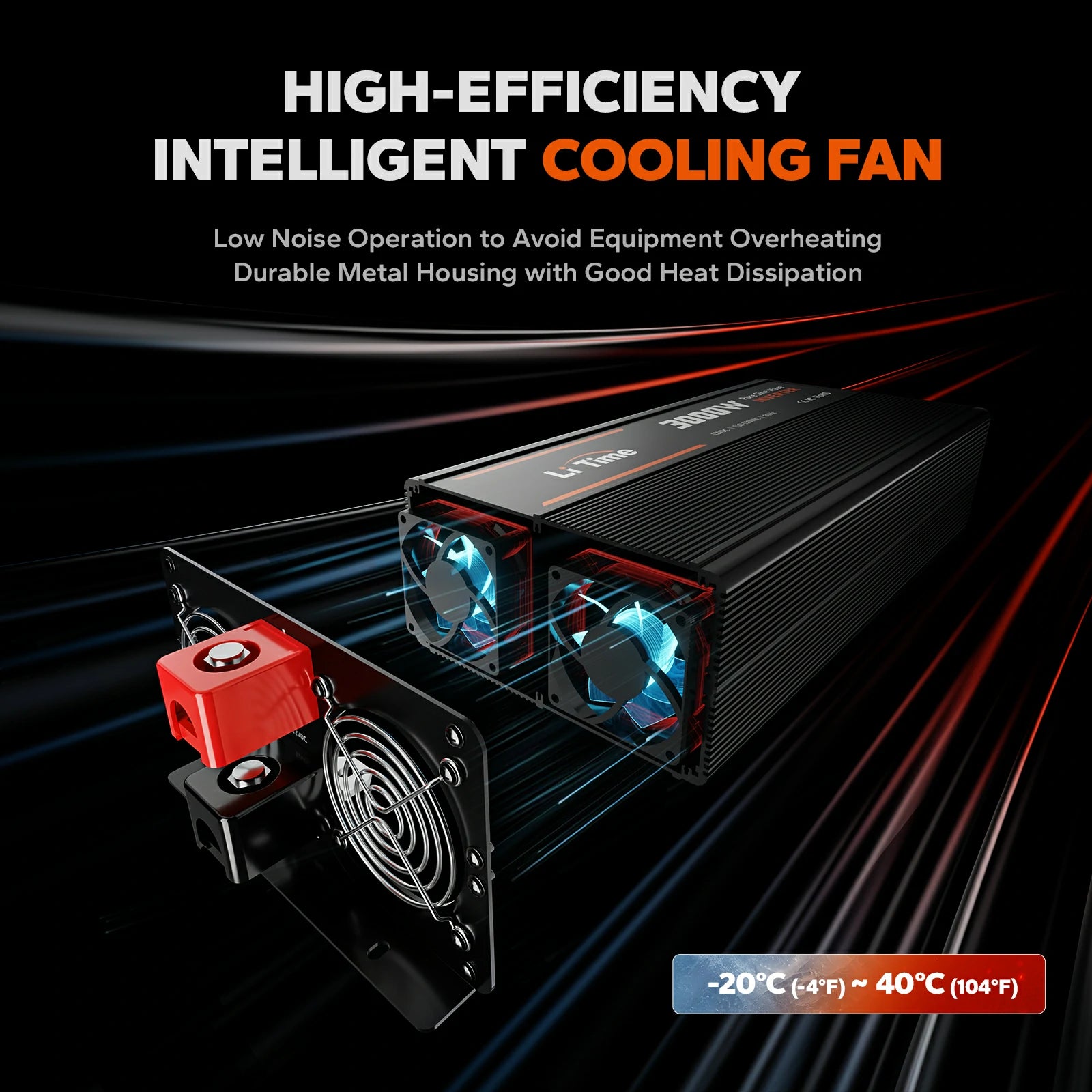
| Cooling system | Dual cooling fans | Dual cooling fans | Dual cooling fans |
| Operating temperature range | -20°C to 40°C | -20°C to 40°C | -20°C to 40°C |
| Recommended uses | Car camping, camping, small appliances | Microwaves, rice cookers, off-grid systems | Refrigerators, large appliances, marine use |
Shared core advantages of LiTime inverters:
- Pure sine wave output: Safe for precision electronics and motor-driven equipment.
- Over 90% high conversion efficiency: Minimizes battery energy loss and converts DC to AC more efficiently.
- LCD remote controller included as standard (approx. 4.5 m): Lets you check input voltage, output power, and battery level and control on/off operation even from a distance.
- Comprehensive protection features: Helps protect equipment and batteries against overload, overheating, short circuits, and other abnormal conditions.
Part4: FAQs about inverter and rectifier
Does a rectifie charge a battery?
A rectifier itself does not charge a battery directly. It converts AC power to DC power, which is one necessary step in battery charging.For a battery to charge safely, you usually need a battery charger, not just a rectifier.
Can a rectifier be used as an inverter?
No, a rectifie cannot be used as an inverter.
That is because a rectifier (AC → DC) and an inverter (DC → AC) are devices with exactly opposite functions.
To use an analogy, it would be like confusing a device that turns a one-way road into a two-way road with a device that does the reverse. Not only would it fail to work, it could even damage the equipment.
It is therefore important to understand the role of each device and choose the one that suits your purpose.
What is the difference between an inverter and a converter?
An inverter is the specific name for a device that converts DC into AC. Its conversion direction is limited to DC → AC.
A converter is a broader term used for any device that changes an electrical form, such as voltage, frequency, or waveform.
In other words, an inverter is one type of converter.
Converters also include DC-DC converters that change DC voltage and frequency converters that change AC frequency. So it is easiest to think of “inverter” as a name for a specific function, while “converter” refers to a broader category.
For a more detailed explanation, please also read the related article: Understanding the Variances: Inverter VS Converter
Conclusion
In this article, we started with the basic concepts of direct current (DC) and alternating current (AC), then explained in detail the working principles, applications, and differences of rectifiers and inverters, which convert between them.
These two devices are exact opposites in terms of conversion direction, and they also differ in the core components they use and their main applications. Even so, each plays a unique and essential role, and if you need reliable DC-to-AC power conversion in real-world scenarios such as camping, RV travel, off-grid living, or backup power, LiTime pure sine wave inverters offer a practical solution with efficient performance, broad appliance compatibility, and dependable protection features.


