


Selecting the right battery can be a challenge, especially with designations like Group 27 and Group 31. Batteries are essential for various aspects of our everyday lives, including vehicles and renewable energy systems. This article will clarify the distinctions between Group 27 and Group 31 batteries.
We will explore their sizes, performance, weight, cost, and applications. By the end, you'll have a solid grasp of which battery type is most suitable for your needs and the reasons behind your choice.
Table of Content
What Does Group Size Mean?
Group size refers to the physical dimensions and terminal configurations of a battery, which are standardized by the Battery Council International (BCI). Each group size number corresponds to a specific set of dimensions, allowing for compatibility with various battery trays and compartments in vehicles and equipment. Understanding group size is crucial when selecting a replacement battery, as it ensures a proper fit and connection.

Differences Between Group 31 VS Group 27 Lead Acid Battery
1. Size and Dimensions
The main difference between Group 31 and Group 27 batteries is size. Group numbers are based on battery dimensions, which affect how well the battery fits in a designated space.
- Group 31 Battery: Typically, these measure 13 x 6.81 x 9.44 inches (L x W x H). Sizes can vary slightly by manufacturer, but this is the standard.
- Group 27 Battery: Slightly smaller at 12.06 x 6.81 x 8.88 inches (L x W x H).
The larger Group 31 batteries offer more power but need more space.
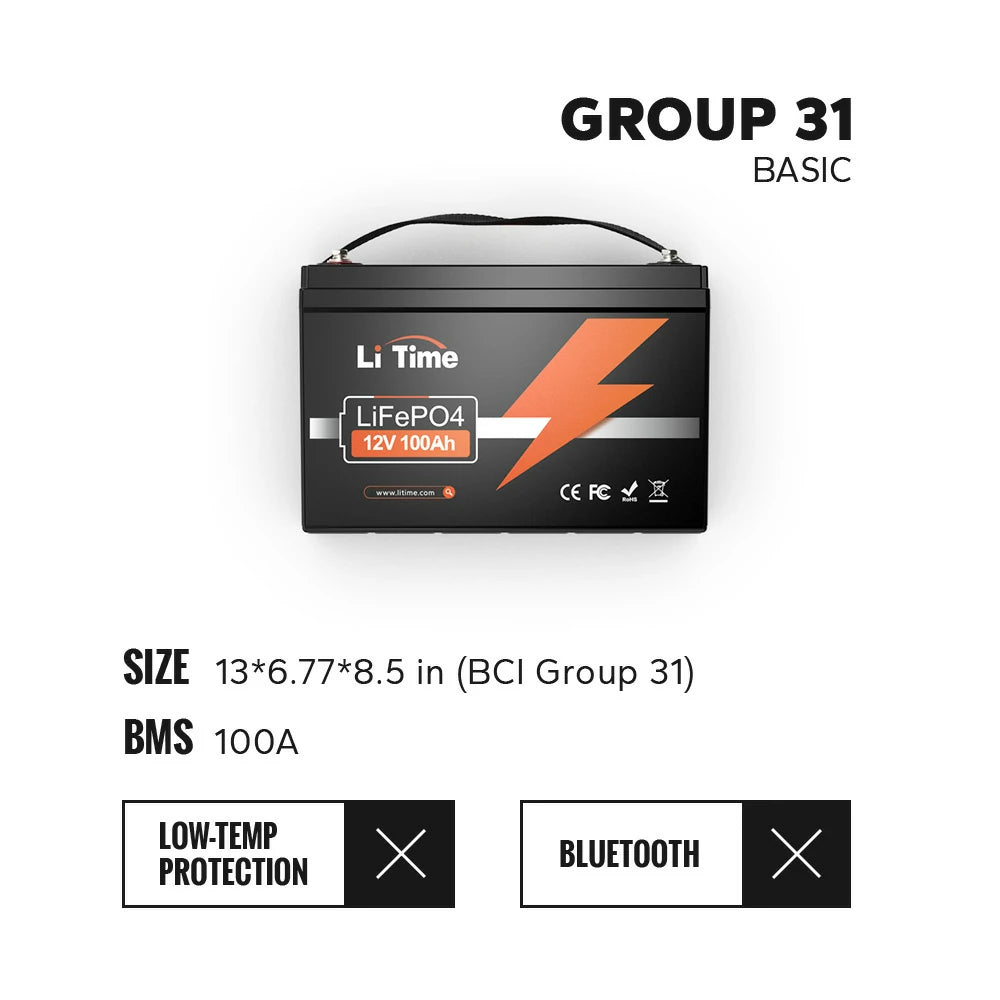
LiTime 12V 100Ah Group 31 Lithium Battery
2. Capacity and Performance
Capacity shows how much power a battery can store and provide. This is measured in ampere-hours (Ah) and reserve capacity (RC).
- Group 31 Battery: Has a capacity ranging from 100 Ah to 125 Ah, with a reserve capacity of 190 to 220 minutes.
- Group 27 Battery: Has a lower capacity, ranging from 80 Ah to 100 Ah, with a reserve capacity of 160 to 200 minutes.
With a higher capacity, Group 31 batteries can run longer and power more demanding devices.
3. Cold Cranking Amps (CCA)
Cold Cranking Amps (CCA) measures a battery’s ability to start an engine in cold weather.
- Group 31 Battery: Offers CCA between 700 and 1,150 amps.
- Group 27 Battery: CCA ranges from 600 to 1,000 amps.
The higher CCA of Group 31 makes it a better choice for cold climates, where reliable engine starts are critical.
4. Weight
Battery weight impacts the overall weight of your vehicle or boat, affecting performance and handling.
- Group 31 Battery: Weighs 50 to 75 pounds.
- Group 27 Battery: Weighs lighter, at 45 to 60 pounds.
5. Applications
The right battery depends on its intended use.
- Group 31 Battery: With more power, it’s ideal for large boats, RVs, commercial trucks, and industrial applications. It’s also a common choice for backup power systems.
- Group 27 Battery: Best for smaller boats, RVs, and light trucks. It works well when space is tight, or weight is a concern.
6. Cost
Group 31 Battery: Costs more because of its size and capacity.
Group 27 Battery: Typically more affordable, perfect for lower-power needs.
Here’s a quick comparison table of typical Group 27 vs Group 31 lead-acid batteries:
| Parameter | Group 27 Lead-Acid Battery | Group 31 Lead-Acid Battery |
|---|---|---|
| Typical Dimensions (L×W×H) | ~12.06 × 6.8 × 8.88 in | ~13 × 6.8 × 9.4 in |
| Capacity Range (Ah) | ~80 – 100 Ah | ~100 – 125 Ah |
| Reserve Capacity (RC) | ~160 – 200 minutes | ~190 – 220 minutes |
| Cold Cranking Amps (CCA) | ~600 – 1,000 A | ~700 – 1,150 A |
| Typical Applications | Smaller boats/RVs, light trucks, moderate backup use | Large boats/RVs, commercial trucks, heavy-duty backup |
| Relative Cost | Lower, more budget-friendly | Higher, reflects larger size & capacity |
How to Choose Between Group 27 and Group 31 Batteries
When deciding between Group 27 and Group 31 batteries, consider these factors:
- Space and Size: If you have limited space, a Group 27 battery is a better fit due to its smaller size.
- Power Needs: For higher power and longer use, go with a Group 31 battery.
- Budget: If you need a cost-effective option, Group 27 batteries are more affordable.
- Application: Match the battery to its use. If space is limited and the load is moderate, choose a Group 27 battery. If you have more room and need higher power output or commercial-grade performance, choose a Group 31 battery.
Choosing a Group 27 Battery
Pick a Group 27 battery if you need:
- An affordable, budget-friendly option.
- A lighter battery that’s easy to install and move.
- Moderate power for RVs, small to medium boats, and backup systems.
- A compact size that fits in tight spaces.
Choosing a Group 31 Battery
Go with a Group 31 battery if you need:
- Higher power and longer backup times.
- A battery for heavy-duty uses like large boats, trucks, and industrial gear.
- A reliable, long-term investment in performance.
- To meet large energy needs in off-grid solar or renewable systems.
Lithium Group 27 VS Group 31 Batteries: Breaking the Limitations
While lead-acid Group 27 and Group 31 batteries have been widely used for decades, lithium iron phosphate (LiFePO4) batteries revolutionize performance, lifespan, and efficiency. Unlike traditional batteries, lithium models offer significant advantages in weight, capacity, and overall reliability.
1. Weight Reduction and Higher Energy Density
One of the biggest advantages of lithium batteries is their lightweight design.
- Group 27 Lithium Battery: Weighs approximately 20–25 lbs, significantly lighter than its lead-acid counterpart.
- Group 31 Lithium Battery: Weighs around 22–26 lbs, still much lighter than lead-acid versions that range from 50–75 lbs.
This weight reduction improves fuel efficiency in vehicles and makes installation easier, especially in marine and RV applications.
2. Superior Capacity and Usable Energy
Lithium batteries provide 100% depth of discharge (DoD) without harming battery health, whereas lead-acid batteries should only be discharged to 50% to maintain longevity.
- Group 27 Lithium Battery: Typically offers 100Ah or more, delivering full capacity for use.
- Group 31 Lithium Battery: Provides 100Ah–200Ah, with a higher capacity option for energy-demanding applications.
Since lithium batteries maintain stable voltage throughout discharge, they provide consistent power output, unlike lead-acid batteries that experience voltage drops as they discharge.
3. Longer Lifespan and Maintenance-Free Operation
Lithium batteries far outlast lead-acid options:
- Lithium cycle life: 4,000–15,000+ cycles, 10+ years lifespan.
- Lead-Acid cycle life: 200–500 cycles, Replace every 2–3 years.
Additionally, lithium batteries require no maintenance, eliminating the need for checking water levels, cleaning terminals, or dealing with acid spills.
4. Faster Charging and Efficiency
- Lithium batteries charge 4–5 times faster than lead-acid due to higher charge acceptance.
- They also have a 100% efficiency rate, meaning more energy is available for use rather than lost as heat.
- Many lithium models, such as LiTime Group 27 and Group 31 batteries, support high-speed charging with a BMS (Battery Management System) that prevents overcharging and overheating.
| Specification | LiTime Group 27 Lithium Battery | LiTime Group 31 Lithium Battery |
|---|---|---|
| Capacity | 12V 100Ah | 12V 165Ah |
| Weight | 22.85 lbs | 32.15 lbs |
| Size | 12.13 × 6.69 × 8.31 in (Group 27 size) | 13 × 6.77 × 8.5 in (Group 31 size) |
| Energy | 1280Wh | 2112Wh |
| Bluetooth Function | ✔ | ✔ |
| Low Temp Protection | ✔ | ✔ |
| Max Charging Current | 100A (1C) | 165A (1C) |
| Cycle Life | 4000 cycles at 100% DOD, 6000 cycles at 80% DOD, 15,000 cycles at 60% DOD | 4000 cycles at 100% DOD, 6000 cycles at 80% DOD, 15,000 cycles at 60% DOD |
Why Choose LiTime 12V Group 27 & Group 31 Lithium Battery?
Choosing LiTime’s 12V Group 27 or Group 31 lithium battery means choosing more than superior power and performance — it means choosing a brand that puts customers first at every stage of their energy journey. LiTime combines advanced LiFePO₄ technology with a complete support ecosystem designed to make upgrading effortless, reliable, and worry-free.
✔ Exceptional Customer Support
LiTime is known for its responsive and knowledgeable customer service team. Whether you need help selecting the right battery, understanding your setup, or troubleshooting, LiTime provides fast assistance through dedicated channels such as Contact Us and Sale Support.
✔ Clear and Transparent Warranty Protection
Every LiTime battery is backed by a straightforward and trustworthy warranty. You can easily check coverage details in the Warranty Policy and review the Return & Refund Policy, so you know exactly what kind of protection you have over the long term.
✔ Helpful Resources for Easy Installation & Use
LiTime offers detailed User Manuals, step-by-step How-to Videos, and a comprehensive FAQs section to guide you through installation, wiring, charging, and everyday use. Even beginners can set up their lithium system correctly and safely.
✔ Real User Reviews & Community Stories
To help new users make informed decisions, LiTime showcases real-world feedback on the All Reviews page and encourages customers to Share Your Story or browse the User Story Collection. These experiences highlight how LiTime Group 27 and Group 31 batteries perform in RVs, boats, and off-grid systems.
✔ Exclusive Deals & Extra Value
LiTime regularly provides attractive promotions, such as seasonal Black Friday Deals, and special offers for new customers through New User Benefits. Ongoing perks like the LiTime Membership and Referral Program add extra value for loyal users and those who recommend LiTime to friends and family.
In short, choosing a LiTime Group 27 or Group 31 lithium battery gives you reliable power backed by exceptional service — a combination that ensures safer use, easier installation, and a more satisfying ownership experience.
FAQs about Group 31 VS Group 27
1. What is the main difference between Group 27 and Group 31 batteries?
Group 27 batteries are smaller and typically offer less power capacity compared to Group 31 batteries. Group 31 batteries are larger, provide more power, and are often used in heavy-duty applications like commercial trucks and large boats.
2. Which battery is better for a boat?
If you have a smaller boat or need moderate power, a Group 27 battery is a good choice. For larger boats or those requiring more power for longer periods, a Group 31 battery is better suited.
For better protection, it's recommended to use a battery box. LiTime marine battery box is suitable for group 24/27/31 battery.

3. Can I replace a Group 31 battery with a Group 27 battery?
It depends on your power needs and available space. If your application requires higher power and longer runtime, a Group 31 battery is the better option. A Group 27 battery may not provide enough power for such demands, but it could fit in smaller spaces.
4. Do Group 27 and Group 31 batteries fit the same space?
No, Group 27 batteries are smaller and more compact, while Group 31 batteries are larger and require more space. Be sure to check the available space before selecting a battery.
5. Can Group 27 and Group 31 batteries be used interchangeably?
Not always. While they may work in some cases, they are designed for different applications. Group 31 batteries provide more power and are used for larger, more demanding systems. Always consider your power needs before replacing one with the other.
Conclusion
Choosing between a Group 31 and Group 27 battery depends on your needs. Group 31 offers more power, better cold performance, and longer running times. However, it’s larger, heavier, and more expensive. Group 27 is smaller, lighter, and cheaper, making it a great choice for smaller, less demanding applications.
Understanding these differences helps you pick the right battery for your situation, balancing power, space, weight, and cost.


