


When it comes to choosing the right inverter for your power needs, understanding the difference between 12V and 24V systems is crucial. Both options have their advantages and disadvantages, and the choice can significantly impact the performance of your devices and systems.
In this article, we'll explore the key differences between 12V and 24V inverters, helping you make an informed decision for your specific application.
Table of Content
- Part 1: What is an Inverter?
- Part 2: Key Differences Between 12V and 24V Inverters
- Part 3: How to Choose the Right Inverter for Your Solar System
- Part 4: Best 3 Inverter Recommended
- 1.LiTime 2000 Watt 12V Pure Sine Wave Inverter
- 2. LiTime 24V 3000W Pure Sine Wave Solar Inverter Charger
- 3. LiTime 48V 3500W Pure Sine Wave Solar Inverter Charger
- Part 5: Frequently Asked Questions
Part 1: What is an Inverter?
An inverter is an electrical device that converts direct current (DC) into alternating current (AC). This conversion allows you to power standard household appliances and electronics from battery systems, which is essential for RVs, boats, solar power systems, and off-grid setups.
The operation of an inverter is both intriguing and intricate. At its essence, an inverter employs electronic circuitry to rapidly alternate the direction of the DC input, generating an AC output. This process involves several key steps:
- Input Stage: The inverter starts by receiving DC power from sources such as batteries or solar panels.
- Switching: High-speed electronic switches, like transistors or MOSFETs, turn the DC current on and off at a rapid pace.
- Waveform Generation: This switching action produces a square wave alternating current.
- Filtering: The square wave is then filtered to smooth it into a sine wave, the standard form of AC power used in residential and commercial applications.
- Transformation: A transformer may step up the voltage to the desired level, typically 120V or 240V for household use.
- Output Stage: Finally, the converted AC power is delivered, ready to power standard electrical devices.
Modern inverters often utilize advanced methods like MPPT to create a more efficient and cleaner sine wave output. They are also equipped with safety features such as overload protection, short circuit prevention, and temperature regulation to ensure reliable performance.
Understanding the mechanics of inverters is essential for appreciating their vital role in renewable energy systems, off-grid installations, and backup power solutions.
As technology evolves, inverters are becoming increasingly efficient, compact, and capable of meeting diverse power requirements, making them essential components in the shift toward cleaner, more adaptable energy systems.
Part 2: Key Differences Between 12V and 24V Inverters
When navigating off-grid power systems, RV setups, or backup power solutions, choosing between a 12V and a 24V inverter is crucial. This decision can greatly influence the efficiency, performance, and overall functionality of your power system. Understanding the key differences between these two options is essential for tailoring your setup to meet your specific needs.
|
Feature |
12V Inverter |
24V Inverter |
|
Power Capacity |
Best for small to medium loads |
More efficient for handling larger loads |
|
Efficiency |
Lower, with higher current draw |
Higher, with lower current draw |
|
Battery Life |
Shorter due to higher current demand |
Longer due to reduced current demand |
|
Installation Cost |
Lower initial costs |
Higher initial costs but requires fewer batteries and wiring |
|
System Size |
Ideal for small systems |
Better suited for larger systems |
|
Maintenance |
Requires more frequent maintenance |
Requires less frequent maintenance |
1. Inverter Efficiency
Inverter efficiency is a vital consideration when deciding between 12V and 24V systems. Efficiency refers to how effectively DC power is converted to AC, impacting system performance and operating costs.
- 12V Inverters: Common in smaller setups, 12V inverters often face efficiency challenges due to higher current requirements, leading to energy loss through heat and voltage drop. This makes them suitable for low-power applications but less efficient for larger systems.
- 24V Inverters: These systems generally offer higher efficiency, particularly in larger installations, thanks to lower current demands and reduced wire losses. This improved efficiency translates into energy savings, longer battery life, and potentially smaller system components. For instance, a 2400W inverter would require 200A at 12V but only 100A at 24V, significantly reducing wire size and cost.
2. Battery Bank Comparison
The choice between 12V and 24V also impacts your battery bank design:
- 12V Systems: These systems are simpler and compatible with a wide range of off-the-shelf components, making them ideal for smaller setups like RVs or basic off-grid cabins. They generally have lower initial costs but may struggle with efficiency in larger installations.
- 24V Systems: In contrast, 24V battery banks excel in efficiency and scalability, particularly for high-power demands. They require less current, resulting in reduced heat generation and energy loss through wiring. Although 24V batteries may have a higher individual price, the overall system cost can be lower due to decreased wiring needs and fewer components. 24V systems also typically perform better under high-drain conditions and charge more efficiently with renewable sources.
3. Cost Considerations
When comparing 12V and 24V inverters, cost extends beyond the initial purchase price:
- 12V Inverters: These often come with lower upfront costs, making them appealing for smaller applications. However, they may incur higher operational costs due to inefficiencies.
- 24V Inverters: While they may have a higher initial investment, particularly for batteries and some components, 24V systems can be more cost-effective in the long run, especially for larger installations. Their higher efficiency results in lower energy losses and reduced operating costs. Additionally, the requirement for thinner, less expensive wiring can offset some of the initial costs.
Conclusion
Ultimately, the choice between a 12V and a 24V inverter depends on your specific power needs, budget, and long-term plans for your energy system.
For smaller applications, a 12V system might save you money upfront. However, for larger or expanding power requirements, a 24V system often offers better value due to its improved efficiency and scalability.
Part 3: How to Choose the Right Inverter for Your Solar System
Selecting the right inverter is a crucial step in designing an effective solar power system. The inverter is responsible for converting the DC electricity generated by your solar panels into usable AC electricity for your home. To make an informed choice, consider the following factors:
1. System Size and Energy Needs
Assessing Your Energy Consumption: Before choosing an inverter, it’s essential to evaluate your household's energy needs. Start by examining your monthly electricity bills to determine your average energy consumption in kilowatt-hours (kWh). This will help you understand how much power your solar system needs to generate.
Sizing the Inverter: The inverter's capacity should be matched to your energy needs. It’s recommended to size the inverter to handle your peak load, which is the maximum amount of power your household uses at any one time. For example, if your peak load is 3,000 watts, you’ll want an inverter that can handle at least that much power. However, consider the possibility of future expansions, such as adding more solar panels or electrical devices, and choose an inverter that can accommodate that growth.
System Design: Also, think about the configuration of your solar system. For instance, a grid-tied system may allow you to take advantage of net metering, while an off-grid system requires careful calculation of energy storage needs.
2. Cost and Installation
Initial Investment: Inverters come in various price ranges, and while the upfront cost is a significant factor, it’s important to consider the long-term value. While lower-cost inverters may be attractive, they could compromise efficiency and durability. Look for a balance between cost and quality to ensure reliable performance over the life of the system.
Installation Costs: Installation costs can vary based on the complexity of your solar setup. Consider whether you plan to install the inverter yourself or hire a professional. Professional installation may add to the initial costs, but it can ensure that the system is installed correctly and operates efficiently.
Warranty and Support: Check the warranty offered by the inverter manufacturer. A longer warranty period often indicates confidence in the product's reliability. Additionally, consider the level of customer support available, as this can be helpful if you encounter any issues during installation or operation.
3. System Efficiency
Understanding Efficiency Ratings: Inverter efficiency refers to how effectively the inverter converts DC power from solar panels into AC power. Higher efficiency ratings mean less energy is wasted during the conversion process. Look for inverters with efficiency ratings of 95% or higher for optimal performance.
Maximum Power Point Tracking (MPPT): Choose inverters with advanced features like Maximum Power Point Tracking (MPPT). This technology optimizes the power output from solar panels by adjusting the electrical operating point, ensuring that you extract the maximum amount of energy available, especially under varying sunlight conditions.
LiTime 24V 3000W Pure Sine Wave Solar Inverter Charger
Performance in Real-World Conditions: Consider how the inverter performs under different environmental conditions. Some inverters are better equipped to handle extreme temperatures or partial shading, which can affect energy output. Research user reviews and performance reports to understand how different models perform in real-world scenarios.
4. 48 Volt Option
In addition to the more common 12V and 24V inverters, a 48V option is also available. Operating at a higher input voltage, 48V inverters offer even greater efficiency than their 24V counterparts.
However, it’s essential to understand that utilizing a 48V inverter necessitates setting up a corresponding 48V battery bank, which can introduce added complexity and higher costs compared to a 24V system. As a result, 48V inverters are generally best suited for larger, high-demand applications where their enhanced efficiency and performance can be fully realized.
Part 4: Best 3 Inverter Recommended
Choosing the right inverter for your solar system can significantly boost performance and reliability. LiTime stands out in the solar industry, recognized for delivering highly efficient and dependable products.
1.LiTime 2000 Watt 12V Pure Sine Wave Inverter
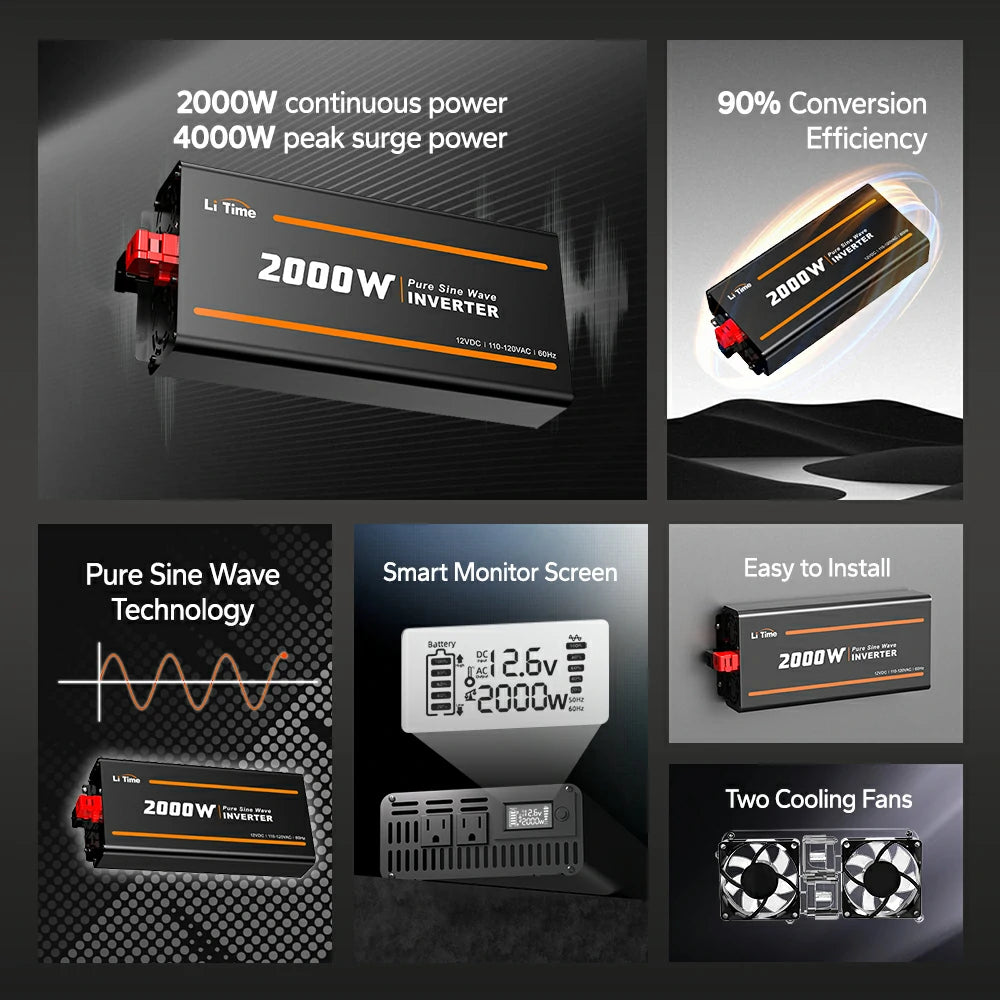
LiTime 2000W Pure Sine Wave Inverter—a powerful and efficient solution for converting 12V DC power into 110-120V AC power. With a peak surge capacity of 4000W, this inverter delivers clean, stable, and interference-free power, ensuring the reliable operation of all your appliances over time.
- Powerful 2000W Output: The LiTime inverter efficiently powers a wide range of devices, making it ideal for camping, off-grid solar systems, RV trips, and more.
- Reliable Performance in Extreme Conditions: Equipped with dual cooling fans, it operates smoothly in temperatures ranging from -20°C to 40°C, ensuring consistent performance in both hot and cold environments.
- Comprehensive Safety Protections: The inverter includes full safety features such as low and over-voltage protection, overheating prevention, overload protection, and short circuit protection, ensuring safe and worry-free operation.
- Easy Installation and Monitoring: With two AC outlets, battery-to-inverter cables, mounting screws, and an easy-to-read monitoring screen, you can quickly set up and keep track of the inverter’s real-time status for your battery and load conditions.
Whether you need a reliable power solution for your off-grid setup or RV adventures, the LiTime 2000W Pure Sine Wave Inverter is designed to deliver efficiency, durability, and safety.
2. LiTime 24V 3000W Pure Sine Wave Solar Inverter Charger
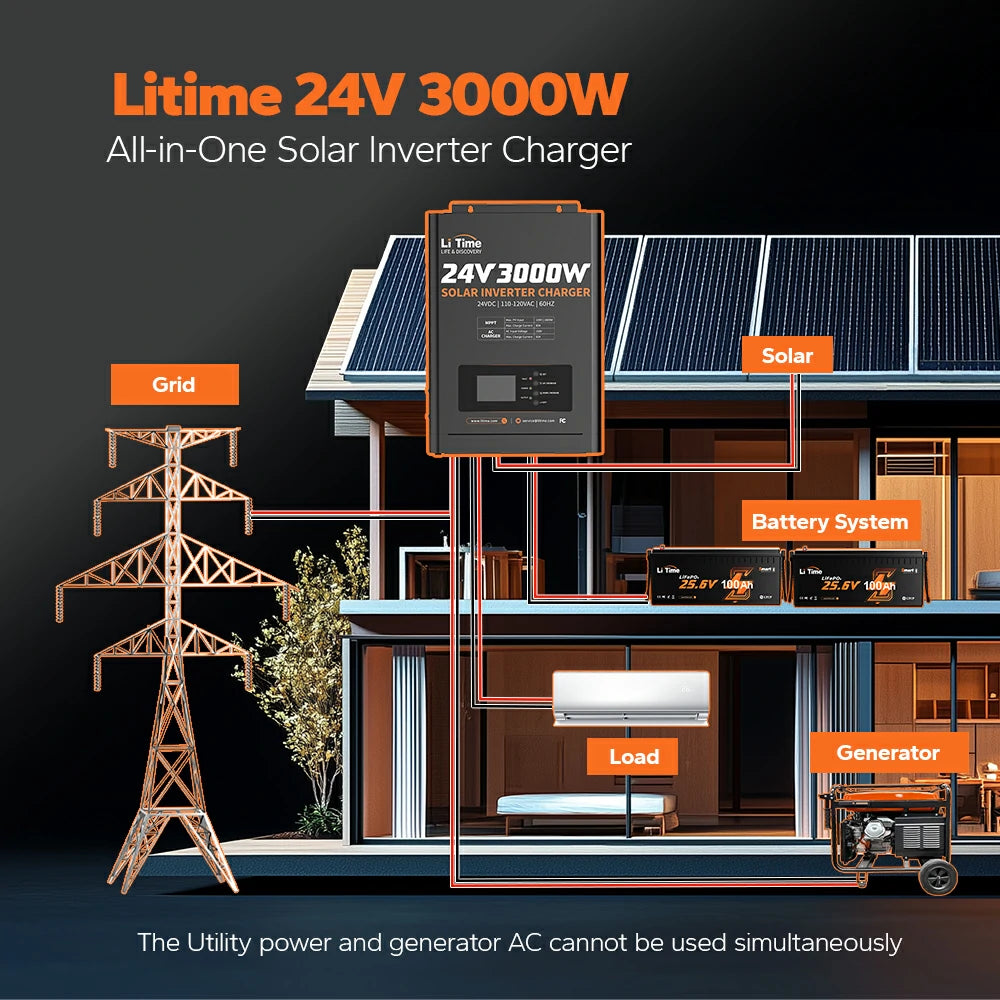
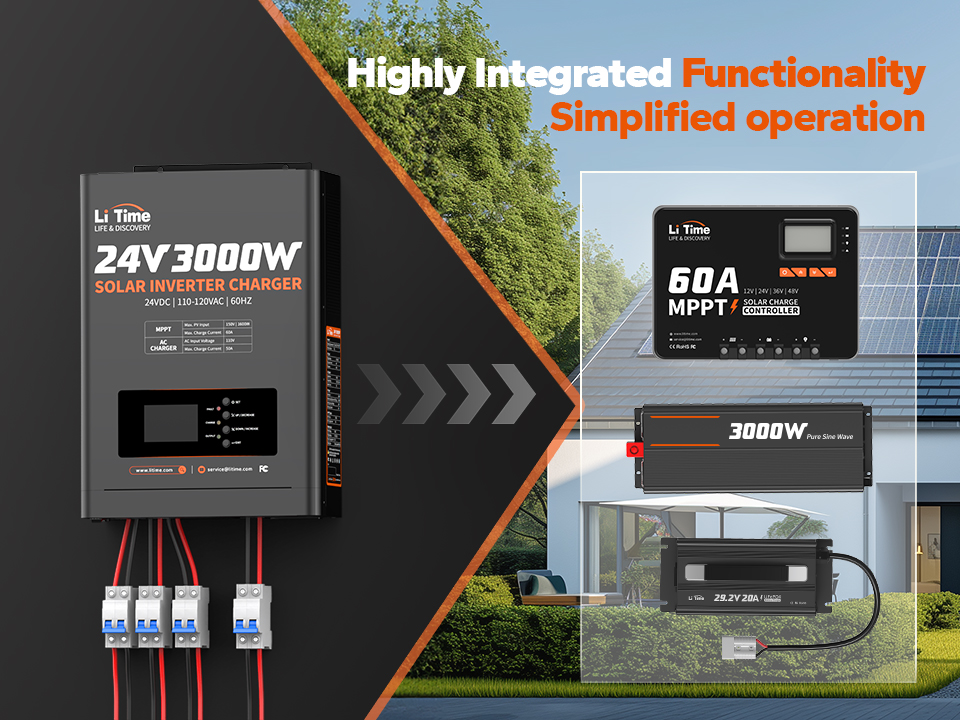
The LiTime 24V 3000W All-in-One Solar Inverter Charger, the perfect solution for Home Energy Storage and Off-Grid Solar Systems. This high-performance inverter combines an MPPT solar controller, inverter, and charger into a single unit, delivering a powerful 3000W output with a 9000W surge capacity. With its pure sine wave output and automatic photovoltaic tracking, it ensures stable, efficient energy conversion for all your power needs.
- High-Performance Solar Inverter Charger: Integrated MPPT controller, inverter, and charger in one, making it ideal for both home energy storage and off-grid applications.
- Enhanced Energy Stability and Cost Savings: Multiple output modes (MPPT First, Grid First, Inverter First) provide uninterrupted power supply (UPS), significantly reducing reliance on traditional energy sources and lowering energy costs.
- Smart Charging & Flexible Output: Featuring 3 charge modes and 3 output modes, this inverter offers versatile energy management for various scenarios. The integrated LCD screen and LED indicators provide real-time system monitoring for easy management.
- Advanced Communication & System Protection: Equipped with RS485 communication protocol, the system reports vital battery data, ensuring enhanced energy management and protection. Comprehensive protection features include short circuit, over-temperature, overload, and PV reverse polarity safeguards.
- Reliable Design with Intelligent Features: Adjustable-speed fans and a lithium battery activation function ensure longevity and optimal performance. Compatible with various 24V battery configurations, including LiTime 24V100Ah, 24V 200Ah, and more.
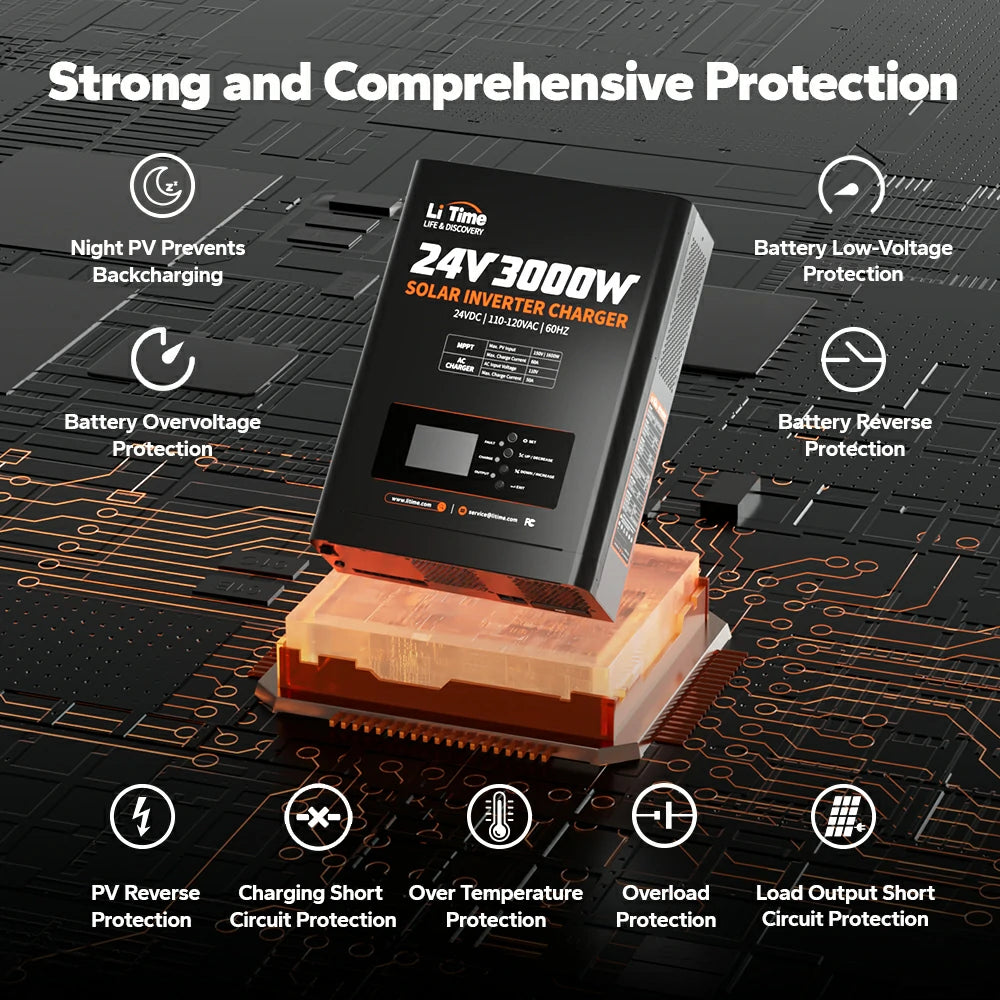
The LiTime 24V 3000W Solar Inverter Charger delivers superior energy efficiency, making it the ideal choice for anyone looking to optimize their home energy storage or off-grid solar system.
3. LiTime 48V 3500 Watt Pure Sine Wave All in One Solar Inverter Charger
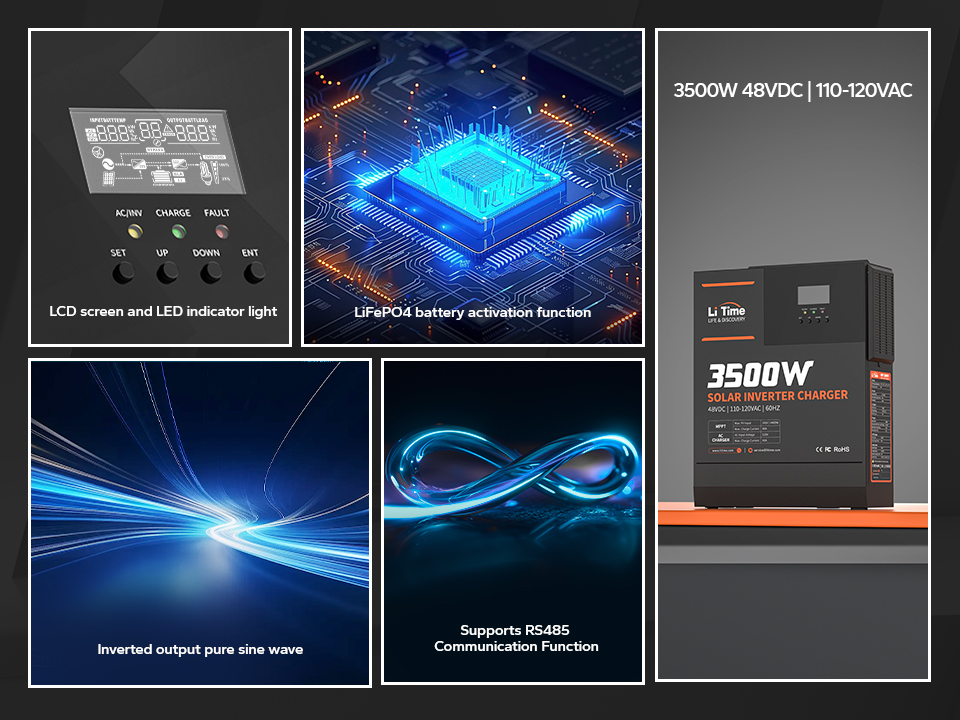
The LiTime 48V 3500W All-in-One Solar Inverter Charger, a high-performance solution for Off-Grid Solar Systems, Home Energy Storage, and Cabin Power Solutions. This versatile inverter integrates an MPPT Solar Controller, inverter, and charger into a single unit, delivering pure sine wave output for stable and efficient energy conversion. Ideal for off-grid setups, it supports seamless operation and optimized energy usage.
- High-Performance Solar Inverter Charger: Combines MPPT solar controller, inverter, and charger in one unit, making it perfect for off-grid solar systems and home energy storage solutions.
- Enhanced Energy Stability & Savings: Features uninterrupted power supply (UPS) and multiple output modes like Inverter Priority, PV Priority, and Utility Priority, significantly reducing dependence on traditional energy sources and lowering energy costs.
- Smart Charging & Flexible Output: Equipped with four charge modes—Solar Only, Utility Priority, Solar Priority, and Hybrid Charging—this inverter offers flexible energy management. The integrated LCD screen and LED indicators allow for real-time monitoring of the system, including battery status, MPPT function, AC output, and input parameters.
- Advanced Communication & Integration: Supports RS485 communication protocol for detailed battery monitoring, including undervoltage, overvoltage, overcurrent, and more. This feature ensures superior energy management, making it ideal for homes with advanced energy storage needs.
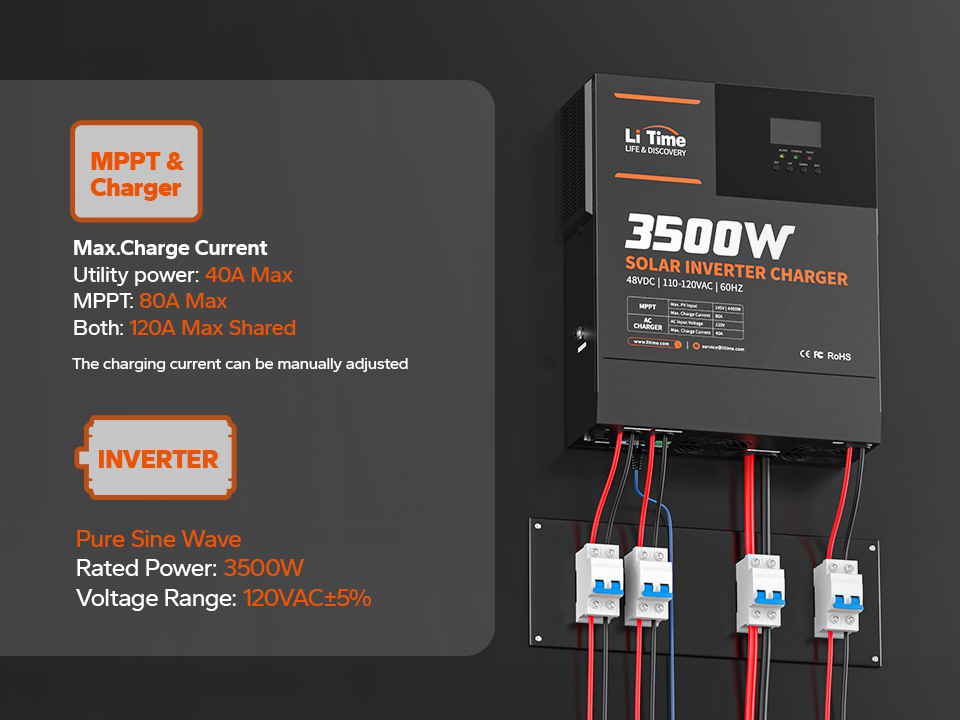
The LiTime 48V 3500W Solar Inverter Charger is engineered to deliver reliable and efficient power for your off-grid and home energy storage systems, offering unmatched flexibility and safety in managing your energy needs.
Part 5: Frequently Asked Questions
1. Can I use a 12V inverter with a 24V battery?
No, you cannot directly use a 12V inverter with a 24V battery. Inverters are specifically designed to match the voltage of the battery they are connected to. Using mismatched voltages can damage both the inverter and the battery, leading to equipment failure and safety hazards. Always ensure that the inverter voltage aligns with the battery voltage.
2. Is 12V to 24V more efficient than 120V to 24V?
Yes, converting from 12V to 24V is generally more efficient than converting from 120V to 24V. This is because lower voltage conversions result in less energy loss due to reduced current flow. This higher efficiency makes 12V to 24V conversions preferable for specific applications like solar power systems and mobile setups where minimizing energy waste is crucial.
3. How many batteries can be connected to a 24V inverter?
The number of batteries you can connect to a 24V inverter depends on the amp-hour (Ah) capacity of the batteries and the inverter's power rating. For a 24V system, batteries are typically connected in series to reach the required voltage. The total battery capacity should match or exceed the inverter’s power requirements. Refer to the manufacturer's guidelines for the maximum battery bank size and ensure correct wiring for optimal performance and safety.
Conclusion
Choosing the right inverter for your solar system involves careful consideration of system size and energy needs, cost and installation, and overall system efficiency. By evaluating these factors, you can select an inverter that meets your requirements and contributes to the long-term success of your solar energy investment. Take the time to research and compare options, ensuring you make an informed decision that enhances the efficiency and reliability of your solar power system.


