


If you often run out of power while boondocking, camp off-grid without shore power, or struggle to keep your RV fridge, lights, fans and electronics running overnight, installing a dual battery setup is the most reliable upgrade for your rig. Adding an RV second battery or RV auxiliary battery doubles your energy storage, avoids dead starter batteries, and delivers stable off-grid power for all daily appliances.
This ultimate guide covers everything you need to know about upgrading your RV power system with dual batteries, including working principles, required components, wiring diagrams, series vs parallel connection comparisons, charging methods, pros and cons, and a full step-by-step installation process.
- Part1: What Is a Dual Battery Setup?
- Part2: What Do I Need for a Dual Battery Setup?
- Part3: Is a Dual Battery Setup Worth It?
- Part4: How to Wire a Dual Battery Setup
- Part5: Series or Parallel: Which Is Better for a Dual Battery Setup?
- Part6: What Are the Disadvantages of a Dual Battery Setup?
- Part7: How Do You Charge Dual Batteries?
- Part8: What Is the Best Battery for a Dual Battery Setup?
- Part9:How to Set Up a Dual Battery System Step by Step
- Part10:FAQs about Dual Battery Setup
Part1: What Is a Dual Battery Setup?
A dual battery setup refers to an onboard power system fitted with two independent batteries for RVs, motorhomes, travel trailers and trucks.
1.1 How a Dual Battery Setup Works
A standard dual battery system runs on a simple but effective separated power logic. Your first battery acts as the dedicated starter battery, only used to ignite the vehicle engine. The second deep-cycle battery works as your RV auxiliary battery, supplying power to all 12V onboard appliances including refrigerators, water pumps, Starlink, lights and inverters.
When driving, the vehicle alternator charges both batteries via an isolator or DC-DC charger, while preventing cross-discharge to safeguard the starter battery. When parked with the engine off, rooftop solar panels convert sunlight into electricity.
1.2 Dual Battery Setup vs Single Battery Setup
| Item | Single Battery Setup | Dual Battery Setup |
|---|---|---|
| Power Storage Capacity | Limited capacity, easy to run out overnight | Double energy storage, supports long-time off-grid use |
| Engine Start Safety | High risk of dead battery failing to start engine | Starter battery is fully protected, zero start failure risk |
| Battery Lifespan | Frequent deep discharge shortens battery life greatly | Separate discharge loop reduces battery wear |
| Best Application Scenario | Occasional camping with shore power access | Boondocking, full-time RV living, long-distance travel |
Part2: What Do I Need for a Dual Battery Setup?
Building a safe and functional dual battery system is more than just adding a second battery. You need matched electronic components to manage charging, isolate circuits and avoid electrical faults on the road.
2.1 Essential Components for a Dual Battery Setup
- Second Battery: Stores extra power for RV appliances, lights, fans, refrigerator, inverter, and backup use.
- Battery isolator or DC-DC charger: Allows the second battery to charge while preventing it from draining the starting battery when the engine is off.
- Heavy-gauge battery cables: Avoid voltage drop and overheating
- Fuses and circuit breakers: Overcurrent protection for overall safety
- Battery Tray or Battery Box: Secures the second battery in place and protects it from movement, vibration, and external damage.
- Battery Monitor: Tracks battery voltage, state of charge, current, and power usage for easier system management.
- Solar Charge Controller: Needed if solar panels are used to charge the second battery or battery bank
- Inverter: Converts DC battery power into AC power for household appliances such as laptops, microwaves, or small kitchen devices.
- Bus bars and wiring terminals: Neat wiring for stable power transmission
2.2 Battery Isolator vs DC-DC Charger
Most RV owners feel confused when choosing between a battery isolator and a DC-DC charger for their dual battery system. Here is a clear comparison for your selection:
| Comparison Item | Battery Isolator | DC-DC Charger |
|---|---|---|
| Cost & Installation | Low cost, easy mechanical installation | Higher cost, needs professional wiring |
| Charging Control | Fixed circuit split, no smart voltage adjustment | Smart adaptive charging with adjustable voltage & current |
| Battery Compatibility | Fits lead-acid & AGM only; not for lithium batteries | Compatible with all battery types, ideal for LiFePO4 |
| Solar Panel Adaptation | Poor solar matching, low charging efficiency | Perfect match with solar controllers for efficient automatic charging |
| Recommended Scenario | Budget RV builds without solar power | Lithium battery systems, solar-equipped RVs and long boondocking |
Part3: Is a Dual Battery Setup Worth It?
3.1 When a Dual Battery Setup Is Worth It
This power upgrade brings clear benefits if you meet any of the following situations:
- You frequently go boondocking with no shore power access for 2+ days
- You run high-power appliances including RV fridges, air conditioners and coffee makers overnight
- You own a large motorhome or heavy-duty truck with heavy daily power loads
- You want 100% protection for your starter battery to avoid engine start failure
3.2 When a Dual Battery Setup May Not Be Necessary
You can skip adding an extra RV second battery under these conditions: You always camp at full-hookup campsites with stable shore power; you only use basic low-power devices like lights and phone chargers; you rarely stay off-grid for more than one night.
3.3 Are Dual Batteries Worth It?
Overall, dual batteries are worth the cost and installation effort for 80% of RV enthusiasts. Compared with upgrading one single oversized expensive battery, this dual-battery solution offers better flexibility, stronger safety performance and easier later maintenance. For long-term RV travel and outdoor off-grid life, this upgrade brings far more benefits than extra costs.
Part4: How to Wire a Dual Battery Setup
Below are clear, step-by-step wiring instructions for installing a second auxiliary battery on standard 12V RVs, travel trailers and motorhomes, covering both alternator driving charging and solar automatic charging circuits:
Wire the alternator charging circuit (for driving charging)
Starting Battery Positive → Fuse / Circuit Breaker → DC-DC Charger Input → DC-DC Charger Output → Fuse / Circuit Breaker → Second Battery Positive
Wire the solar charging circuit (for parked automatic charging)
Solar Panel → Solar Charge Controller → Fuse / Circuit Breaker → Second Battery
Read More: How to Charge Marine Battery With Solar Panel?
TIPS:
Install a fuse or circuit breaker within 30cm of each battery positive terminal to avoid short circuits and electrical fire risks.
Keep positive cables for two batteries the same length to balance charging current, avoiding uneven power distribution between the starter battery and backup battery.
Reconnect battery power, start the RV engine to verify synchronous dual-battery charging, then check solar charging performance under sunlight to confirm normal circuit isolation.
Part5: Series or Parallel: Which Is Better for a Dual Battery Setup?
When wiring your dual battery system, you need to confirm connection modes: parallel or series. These two modes bring totally different voltage and capacity changes to your RV power system.

5.1 Parallel Dual Battery Setup
Parallel wiring keeps the original 12V RV system voltage consistent, while doubling total battery capacity. It extends off-grid power runtime without modifying the RV’s original electrical circuit, making it the universal choice for travel trailers, Class B and Class C motorhomes.
- Battery 1 positive connects to Battery 2 positive
- Battery 1 negative connects to Battery 2 negative
Two 12V 100Ah batteries connected in parallel produce a 12V 200Ah battery bank for longer backup power.
5.2 Series Dual Battery Setup
Series wiring lifts the overall system voltage while maintaining the same battery capacity. Higher voltage reduces current loss during long-distance power transmission inside large motorhomes.
- Battery 1 positive connects to Battery 2 negative
- The remaining Battery 1 negative and Battery 2 positive become the system output
Two 12V 100Ah batteries connected in series form a 24V 100Ah battery bank. This mode is only suitable for customized 24V RV power systems, not standard 12V travel trailers.
5.3 Parallel & Series Dual Battery Setup
Parallel & series dual battery setup combines both wiring methods to increase system voltage and total battery capacity at the same time. This configuration is usually used in larger RV power systems, off-grid setups, high-power inverter systems, and customized 24V battery banks that need both longer runtime and higher operating voltage.
- Battery 1 positive connects to Battery 2 negative
- Battery 3 positive connects to Battery 4 negative
- Then the two 24V battery groups are connected in parallel
Four 12V 100Ah batteries connected in a 2S2P series-parallel setup produce a 24V 200Ah battery bank.
Can You Run Batteries in Parallel and Series at the Same Time?
Yes, series-parallel mixed connection is available for large battery banks with four or more batteries. It can boost voltage and capacity simultaneously. However, this complex wiring is unnecessary for standard two-battery systems, and it will increase wiring difficulty and failure risks.
Can I Connect a 100Ah and 200Ah Battery in Series or Parallel?
Never connect batteries with different capacities together. Mixing 100Ah and 200Ah batteries will cause severe current imbalance during charging and discharging. The smaller battery will be overcharged and damaged easily, while the larger battery cannot be fully used. Always match batteries with identical voltage, capacity, brand and age for any dual battery installation.
Part6: What Are the Disadvantages of a Dual Battery Setup?
Although dual battery systems greatly improve off-grid power performance, they still have unavoidable drawbacks for you to consider before installation:
- Extra cost: You need to purchase a second battery, isolator, cables and other matching accessories
- Extra installation space: The second RV backup battery takes up extra compartment space inside your RV
- Increased overall weight: Extra battery weight reduces vehicle fuel economy slightly
- More complex battery maintenance: You need to inspect two batteries and related circuits regularly
Even with these minor downsides, the performance improvement of dual batteries still outweighs the disadvantages for most off-grid RV users.
Part7: How Do You Charge Dual Batteries?

There are three mainstream charging methods for dual battery banks: alternator charging while driving, solar panel charging when parked, and shore power charging at campsites.
7.1 Charging from Alternator
Alternator charging is the most convenient free charging method during your RV driving. The alternator generates electricity and charges both starter battery and auxiliary battery automatically through the isolator or DC-DC charger.
Can a Stock Alternator Run Two Batteries?
Most factory stock alternators can support standard dual battery banks for daily low-power use. But if you adopt large-capacity lithium batteries or run heavy loads simultaneously, the original alternator may not provide enough charging current, leading to slow charging speed.
7.2 Charging from Solar Panels
Solar charging is the best solution for long-time boondocking. Solar panels absorb sunlight and replenish your dual battery bank all day long, realizing fully self-sufficient off-grid power supply.
How Long Will a Solar Panel Take to Charge a Battery?
Taking two parallel 12V 100Ah lithium batteries as an example: A 400W solar panel needs around 6-7 hours of full sunlight to fully charge the dual battery bank. Bad cloudy weather will prolong the charging time obviously.
Read More: [Full Guide] How Many Solar Panels Do I Need for My RV
7.3 Charging from Shore Power
When you park at standard campsites with shore power, your onboard converter will charge both batteries steadily. This charging method features stable voltage and full charging efficiency, suitable for supplementing battery power during long-time camping stops.
7.4 Charging Lithium Dual Batteries
LiFePO4 lithium batteries require constant and stable charging voltage. For lithium dual battery systems, a DC-DC charger is highly recommended instead of a regular isolator. It matches lithium battery charging curves perfectly, shortens charging time and prolongs overall battery cycle life up to 4000+ times.
Read More:
[Full Guide] How To Charge RV Batteries Safely
5 Ways about Charging a Camper Battery
Part8: What Is the Best Battery for a Dual Battery Setup?
Your choice of battery type plays a vital role in overall system efficiency, available power capacity and long-term durability of your RV dual battery system. To help you select the optimal battery for your auxiliary power bank, we have compared three common RV battery types across key metrics including usable depth of discharge, cycle lifespan, overall cost and real-world camping performance.
| Battery Type | Usable DOD | Cycle Life | Overall Cost | Best For Dual Battery Setup |
|---|---|---|---|---|
| Flooded Lead-Acid | 40%-50% | 500 cycles | Lowest | Budget temporary dual battery system |
| AGM Battery | 50%-60% | 1200 cycles | Medium | Standard daily RV dual battery use |
| LiFePO4 Lithium | 100% | 4000+ cycles | Higher upfront cost | Best overall, perfect for long-term boondocking and full-time RV dual battery builds |
Read More: AGM vs. Lithium Batteries: Which is Better for RV and Marine
If you plan to upgrade your RV auxiliary battery with reliable LiFePO4 options, LiTime offers perfectly RV batteries for dual battery setups, covering different power demands for daily camping and long-term boondocking:
| LiTime Battery | Energy | Size | BMS | Bluetooth | Waterproof Performance | Best RV Application Scenarios |
|---|---|---|---|---|---|---|
| 12V 100Ah Bluetooth LiFePO4 Battery | 1280Wh | Group 24(10.24 × 6.61 × 8.30 in) | 100A BMS, full protection against overcharge, over-discharge, short circuit and overcurrent | √ | IP65 | Entry-level dual battery setups, small travel trailers, occasional weekend camping with basic appliances |
| 12V 165Ah Bluetooth LiFePO4 Battery | 2112Wh | Group 31(13 × 6.77 × 8.5 in) | 165A BMS, upgraded smart BMS with multi-layer safety protection, compatible with DC-DC chargers and solar charge controllers | √ | IP65 | Most mainstream RV dual battery systems, multi-day boondocking, motorhomes running fridges, lights and medium-load electronics |
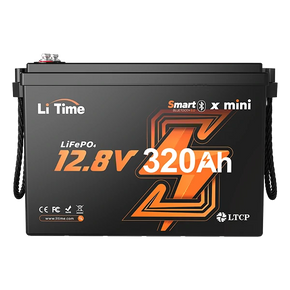
| 12V 320Ah Mini Bluetooth LiFePO4 Battery | 4096Wh | Class Mini Size(14.49 × 7.44 × 10.04 in) | 200A high-current smart BMS, excellent overload resistance for high-power inverters | √ | IP65 | Full-time RV living, long-term off-grid boondocking, large motorhomes with air conditioners and other high-power appliances |
Part9:Conclusion: How to Set Up a Dual Battery System Step by Step
Finally, you can follow this step-by-step guide to finish your own dual battery installation.
Step 1: Calculate Your Power Needs
Count total daily wattage of all your RV appliances, confirm your average off-grid days, and confirm required total battery capacity before adding an extra auxiliary battery.
Step 2: Choose the Right Second Battery
Match the second battery with your original starter battery in voltage, capacity and chemistry. Do not mix different battery models to avoid current imbalance.
Step 3: Choose Parallel, Series, or Isolated Setup
Choose parallel connection for ordinary 12V RV systems; choose series connection only for customized 24V high-voltage systems. Most regular users pick isolated parallel wiring for universal compatibility.
Step 4: Choose a Battery Isolator or DC-DC Charger
Pick an isolator for lead-acid/AGM batteries; upgrade to a DC-DC charger if you use lithium batteries for better charging performance.
Step 5: Select Proper Cable Size, Fuse, and Breaker
Use thick enough gauge cables to prevent voltage drop. Install matched fuse and circuit breaker near battery terminals for full electrical safety protection.
Step 6: Mount and Secure the Second Battery
Fix your new auxiliary battery tightly with professional brackets. Leave reserved gaps for heat dissipation and avoid shaking during driving.
Step 7: Connect and Test the System
Finish complete wiring following standard dual battery wiring diagrams. After installation, test charging function, discharging output and circuit isolation to make sure the whole system works normally.
Part10:FAQs about Dual Battery Setup
Can a stock alternator handle a 2000 watt amp?
A standard factory stock alternator cannot support a 2000W amplifier steadily under dual battery loads. High-power inverters and amplifiers bring huge instantaneous current draw. You need to upgrade to a high-output alternator to match this heavy electrical load.
Is LiFePO4 Good for a Dual Battery Setup?
LiFePO4 works extremely well for RV dual battery systems. It supports full depth of discharge, has longer service life, lighter weight and more stable charging performance than AGM and lead-acid batteries. Pairing lithium batteries with a DC-DC charger creates the most worry-free dual battery power system.
Do you need a bigger alternator for dual batteries?
For standard dual battery banks with daily medium loads, a stock alternator works fine. If you use large-capacity lithium batteries, high-power inverters or run multiple appliances at the same time, upgrading to a bigger high-output alternator is necessary to speed up charging and avoid alternator overload.
Do I Need a Battery Isolator for a Dual Battery Setup?
Yes, you absolutely need one. Without a battery isolator, two batteries will connect directly and discharge each other automatically. When one battery drains faster, it will pull power from the other healthy battery, causing both batteries to lose power quickly. An isolator ensures unidirectional charging and separated discharging, which is the core guarantee for a reliable dual battery system for RVs.

