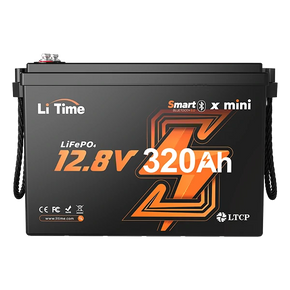


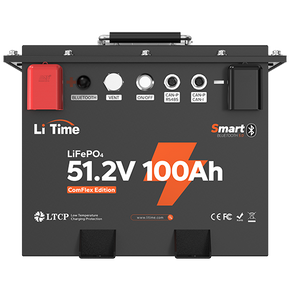

Setting off on an off-grid journey with your RV can create lasting memories. It allows you to break away from your everyday routines and fully embrace the natural surroundings.
Yet, to ensure an optimal experience, choosing the best lithium rv battery to support your appliances during periods when your solar system isn't actively generating power, like during the night, is crucial. However, the real challenge lies in selecting the most suitable battery for your off-grid setup.
This article delves into the different kinds of RV batteries that are worth considering for your off-grid solar system. Additionally, it sheds light on why LiTime RV batteries stand out as the ideal choice for dry camping.
- Part 1: The 10 Best Lithium Batteries for RV
- Part 2: The Purposes of RV Lithium Battery
- Part 3: Types of RV Deep Cycle Batteries & Why Lithium The Best
- Part 4: How to Choose the Best RV Lithium Battery?
- Part 5: Best Lithium Battery Size for RV Types
- Part 6: Lithium Batteries in Parallel VS A Large Capacity Battery: Which is Best?
- Part 7: Why Choose LiTime - Best Lithium RV Battery Brand?
- Frequntly Asked Questions (FAQs)
Part1: The 10 Best Lithium Batteries for RV
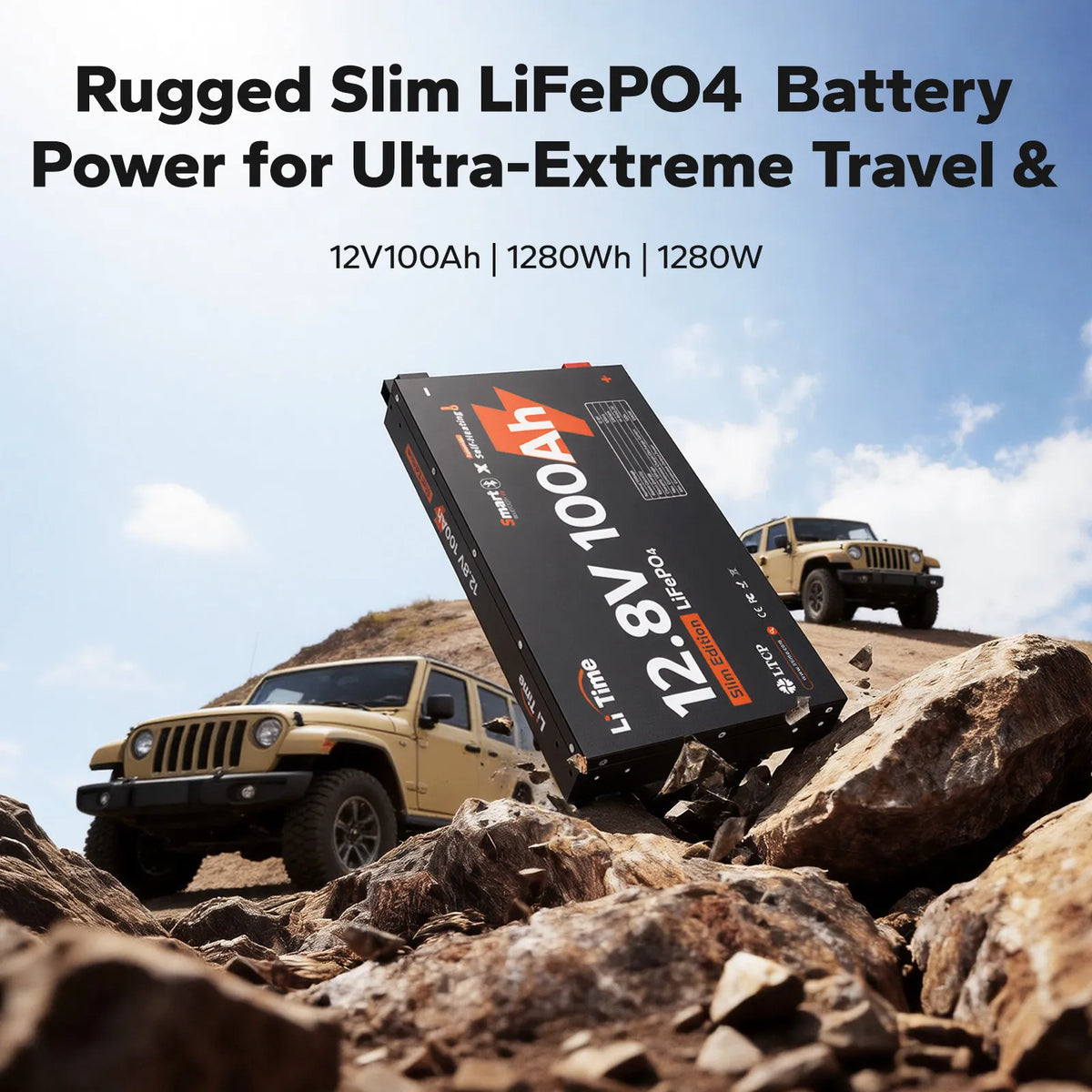
1.LiTime 12V 100Ah Ultra Slim Self Heating Smart Battery
Weight: 33.51 lbs
The 12V 100Ah Ultra Slim self heating battery is a deep‑cycle auxiliary power unit built for space‑constrained mobile scenarios. It works for RVs, pickup trucks, SUVs, camper vans, overlanding adventures and off‑grid camping setups, fitting narrow compartments, under‑seat cavities and wall‑mount positions in vehicles.
Pros:
- Ultra‑slim 2.44‑inch thickness; much thinner and lighter than Group 31 lead‑acid batteries for tight vehicle mounting spots
- Dual‑mode self‑heating enables safe cold‑weather charging for winter camping and frigid‑climate road trips
- IP65 dust‑water resistance, rugged metal housing for bumpy off‑road and wet outdoor conditions
- Bluetooth 5.0 mobile App for real‑time battery status checking, remote diagnostics and heating control
- Built‑in 100A BMS offers multi‑layer safety protection; long service life with 4000 cycles@100% DOD
Cons:
- Higher upfront purchase cost versus traditional lead‑acid batteries
- Not designed for engine cranking; only serves as house/auxiliary load power source
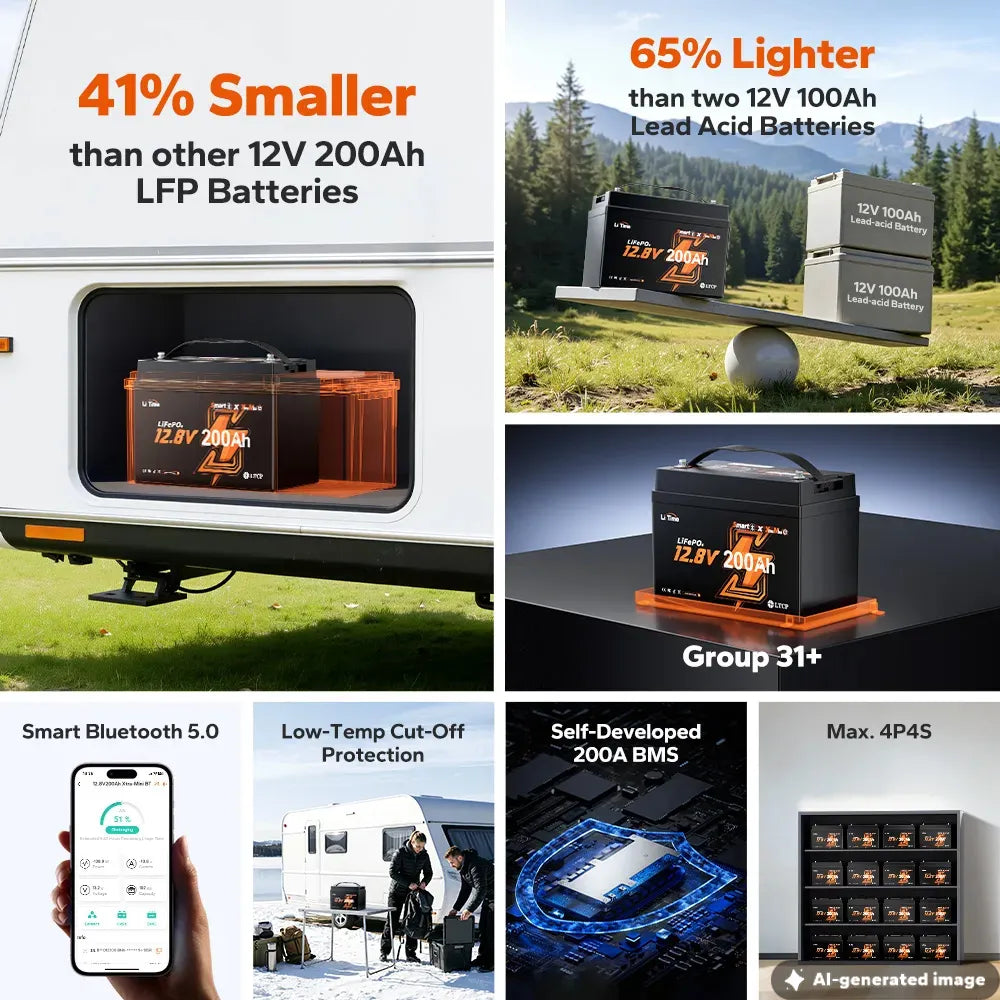
2.LiTime 12V 200Ah Xtra‑Mini LiFePO4 battery
Weight: 44.5 lbs
The 12V 100Ah Xtra-Mini battery is built for space‑limited auxiliary power scenarios. It applies to RVs, camper vans, travel trailers, marine applications, off‑grid cabins and camping setups, designed to fit compact Group 31‑style battery bays for heavy‑load mobile energy storage.
Pros:
- Extremely compact footprint; 41% smaller than conventional 12V 200Ah lithium batteries
- Lightweight at 44.5 lbs, 65% lighter than dual 12V 100Ah lead‑acid batteries for easy one‑person installation
- High cycle performance: 6000+ cycles@100% DOD for long‑term heavy deep‑cycle usage
- Bluetooth 5.0 enables real‑time phone App monitoring of SOC, voltage, temperature and battery diagnostics
- IP65 dust‑water resistance adapts to outdoor, marine and wet travel environments
- Intelligent low‑temperature cut‑off protection safeguards battery in cold climate conditions
Cons:
- No built‑in self‑heating function; charging will be automatically disabled below 0°C, limiting winter charging capability
- Not fully compatible with standard Group 31 battery boxes
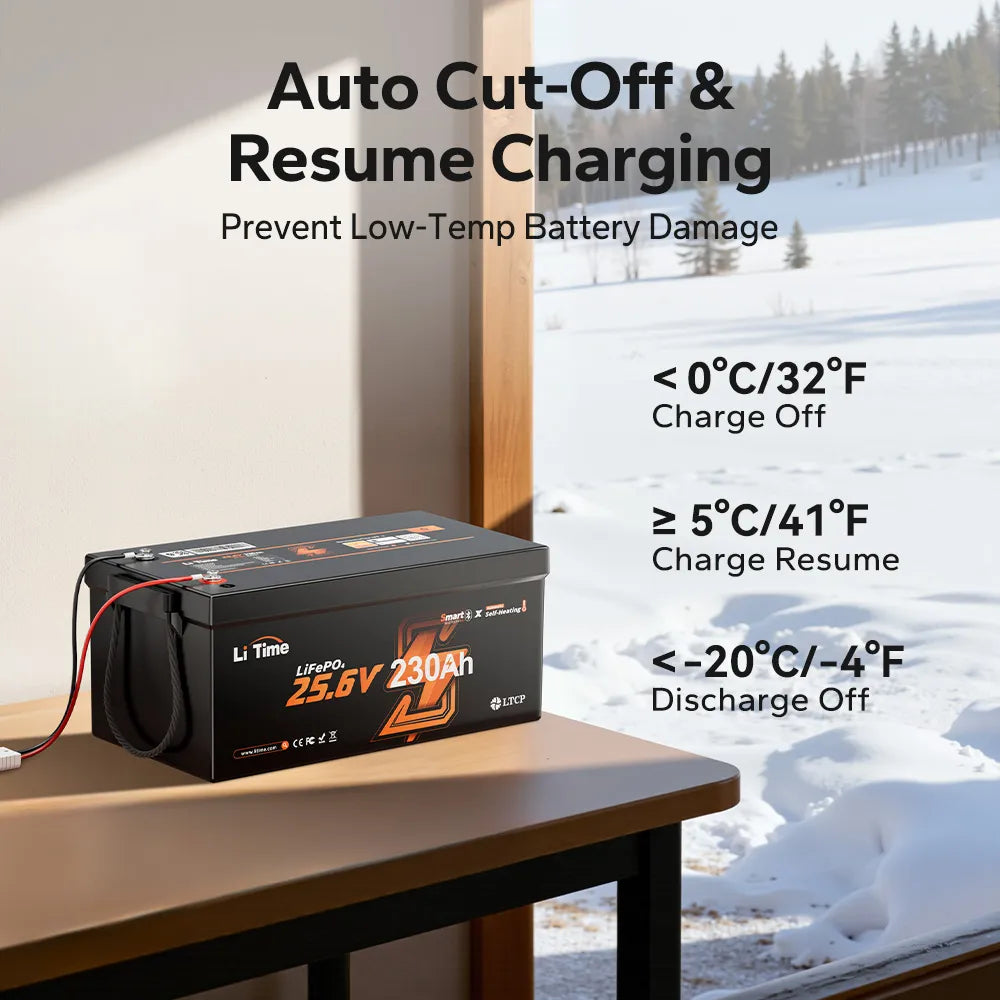
3.LiTime 24V 230Ah dual‑mode self‑heating LiFePO4 battery
Weight: 84.1 lbs
The 24V 230Ah self heating battery is a heavy‑duty deep‑cycle energy‑storage unit. It is built for cold‑climate RVs, marine vessels, off‑grid solar systems and home backup power applications for all‑season high‑load auxiliary power supply.
Pros:
- Dual‑mode self‑heating system enables safe charging under freezing‑temperature outdoor conditions
- Large 5888Wh capacity with 5120W continuous output, supports multiple high‑power household appliances simultaneously
- Bluetooth 5.0 mobile App for real‑time status tracking, heating‑mode adjustment and remote battery shutdown
- IP65 dust‑and‑water‑resistant housing, suitable for marine, bumpy outdoor and moist working environments
Cons:
- Heavy‑weight unit; needs careful assessment for vehicle‑mount installation load limits
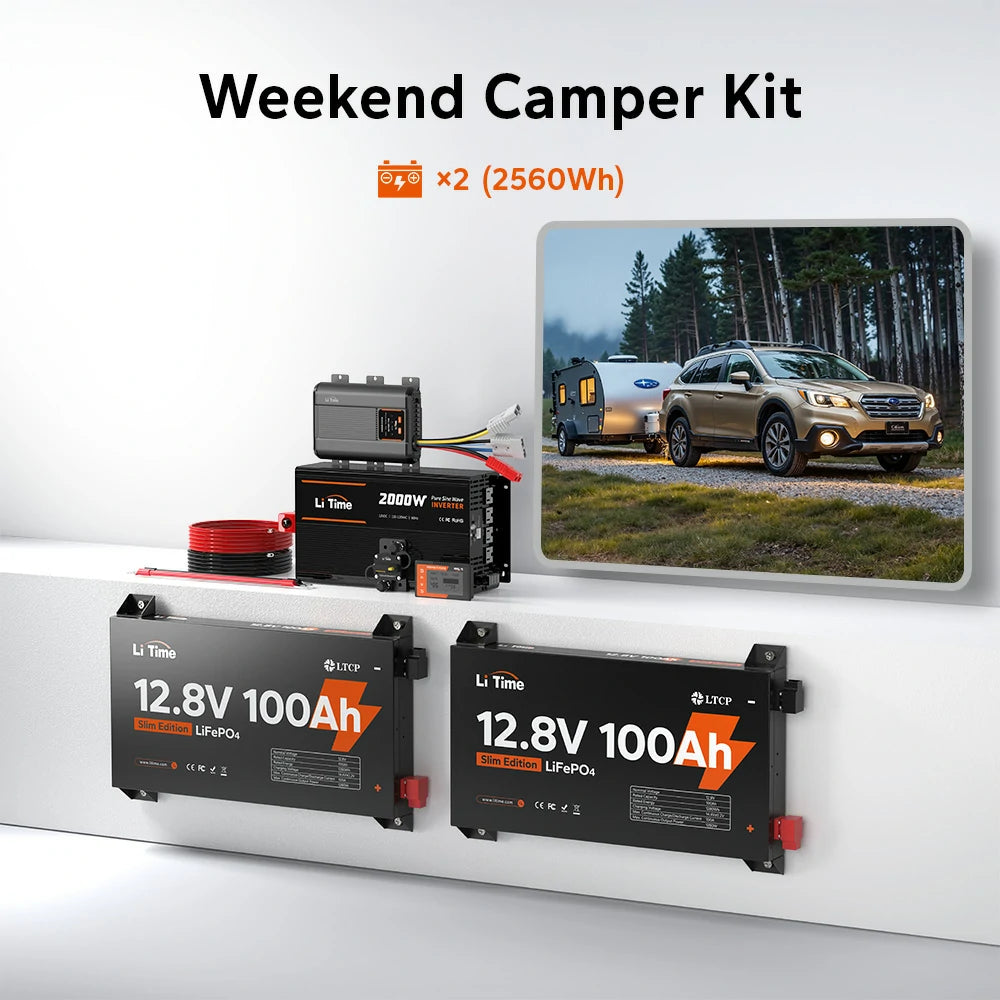
4.LiTime RV Lithium Bttery Conversion Kit
LiTime RV Power Solution is an all‑in‑one pre‑integrated off‑grid power kit. It is designed for weekend boondocking, short‑term RV and camper‑van trips, delivering auxiliary power for basic onboard appliances in recreational vehicles and overland travel scenarios.
Pros:
- Pre‑matched complete package including batteries, inverter, DC‑DC charger, monitor, circuit breaker and battery cables for RV off‑grid use
- Covers daily RV loads such as lights, refrigerators, TVs and small kitchen electronics for weekend camping
- Different tier kit options are available for weekend trips, family journeys, long‑haul travel and heavy‑duty overland expeditions
Cons:
- Base weekend‑camper kit has limited total energy, cannot run high‑draw appliances like RV air‑conditioner for long continuous hours
5.LiTime 12V 100Ah Group 24 Lithium Smart Self-Heating Battery
Weight: 21bs
The LiTime 12V 100Ah Group 24 Lithium Smart Self-Heating Battery is an excellent choice for RV enthusiasts, offering lightweight portability, advanced safety features, and reliable performance in various conditions.
Pros:
- Lightweight: Weighs only 21 lbs, making it easy to install and transport.
- Self-Heating Function: Ensures safe charging in freezing temperatures, ideal for winter camping.
- Bluetooth 5.0: Allows for convenient remote monitoring and control via the LiTime App.
- Advanced BMS: Offers over 20 protections, enhancing safety and reliability.
- High Cycle Life: Provides 4000+ cycles at 100% depth of discharge, ensuring longevity.
- Powerful Energy Storage: Delivers 1280Wh of energy and 1280W of output power, suitable for various applications.
- High Peak Discharge: Supports 500A 1s peak discharge current, accommodating larger surges.
.jpg)
Buy LiTime 12V Smart Self-Heating Battery
Cons:
- Lower Capacity: Compared to larger batteries, it may not meet the energy needs for extended use in larger RVs.
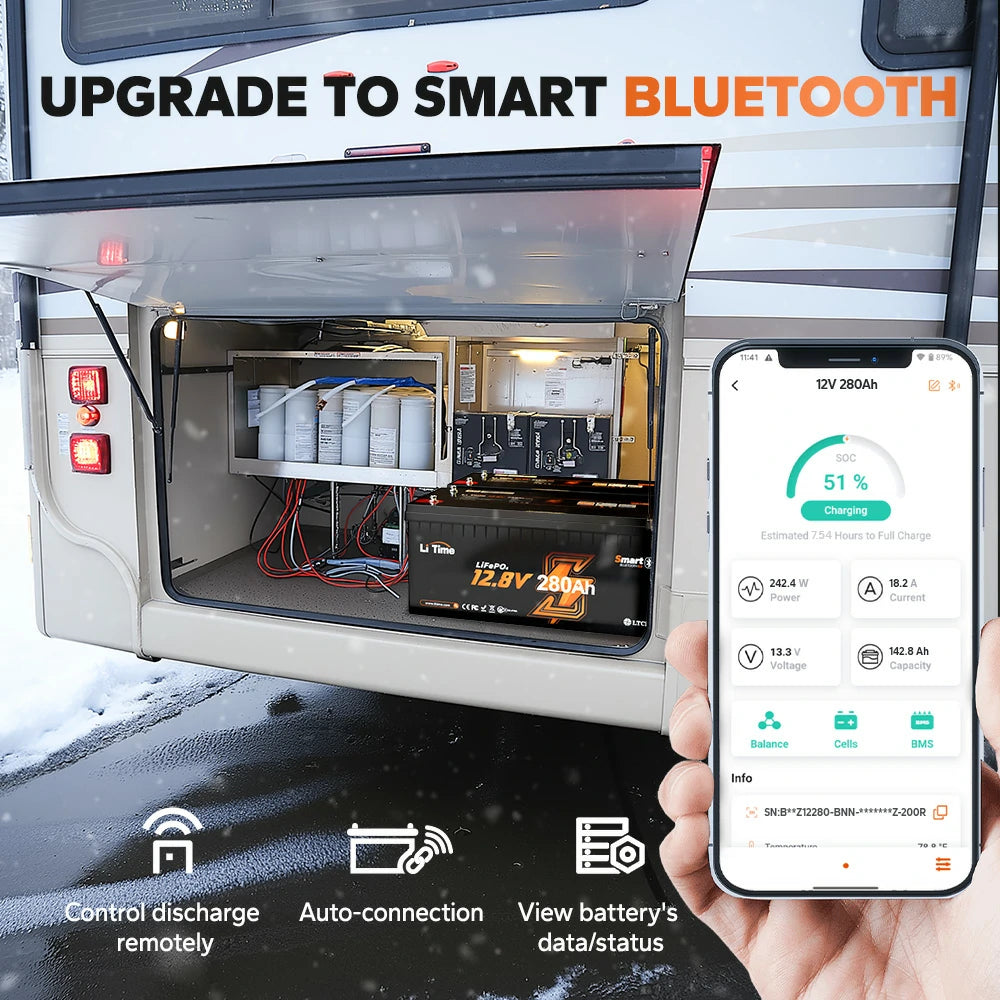
6. LiTime 12V 280Ah Bluetooth Battery
Weight: 57.7lbs
The LiTime 12V 280Ah Bluetooth Battery is a high-capacity power solution perfect for serious RV travelers, off-grid living, and home energy storage, delivering exceptional power and longevity.
Pros:
- High Capacity: Offers a massive 280Ah, providing 3584Wh of energy for extended use.
- Powerful Performance: Delivers 2560W of continuous power with a 200A BMS to run demanding appliances.
- Bluetooth 5.0: Allows for real-time monitoring of battery status and remote control.
- Advanced BMS: Features a 200A BMS with over 20 protections for enhanced safety and battery health.
- Low-Temperature Protection: Automatically cuts off charging below freezing to prevent cell damage.
- Long Lifespan: Built with EV-grade LiFePO4 cells, offering 4000+ cycles at 100% depth of discharge.
- Expandable: Can be connected in up to a 4P4S configuration for a massive 57.344kWh energy system.
Buy 12v 280ah bluetooth battery
Cons:
- Larger size: Their bigger footprint may not fit every battery compartment or space-constrained setup.
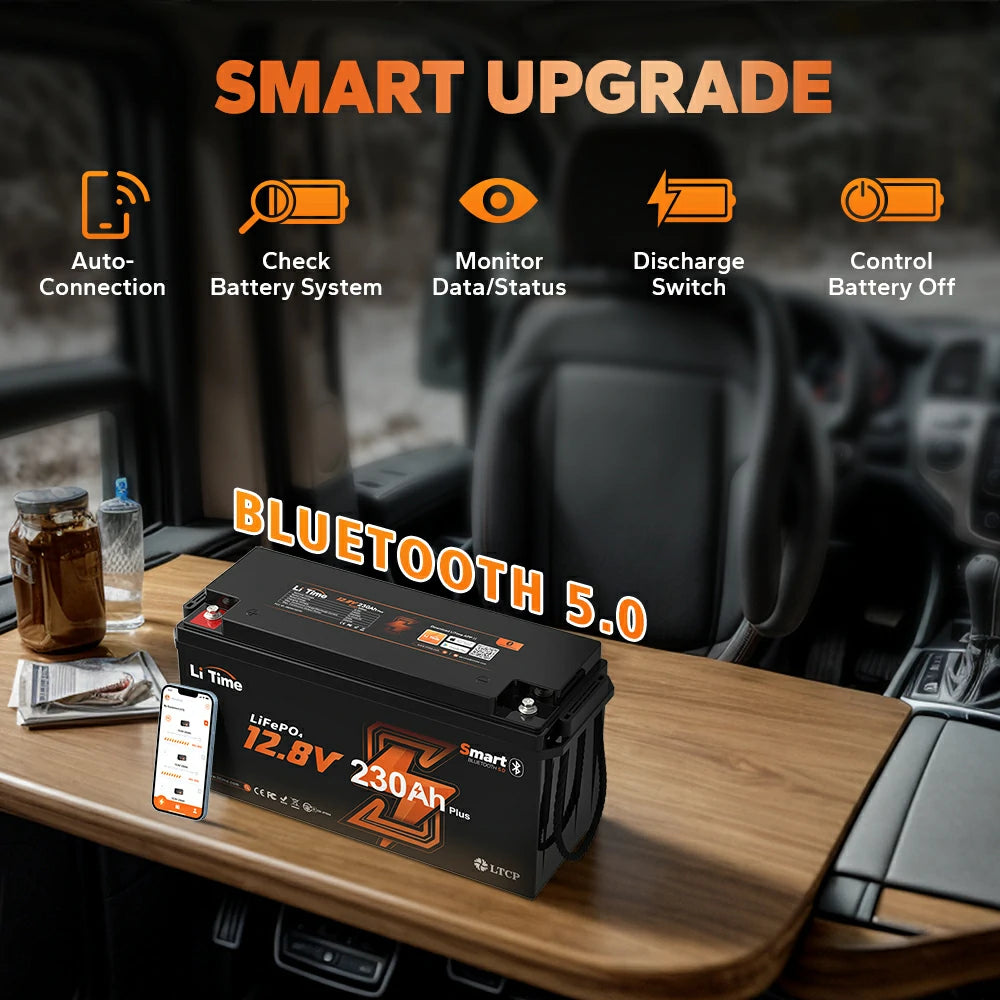
7. LiTime 12V 230Ah Deep Cycle Lithium Battery
Weight: 45.22 lbs
This powerhouse delivers an impressive 2944Wh of energy and a robust 2560W of continuous power, making it the perfect choice for all your RV applications. With its high capacity and reliable performance, the LiTime 230Ah battery ensures you can enjoy your adventures without worrying about power limitations.
Pros:
- High Capacity: Delivers an impressive 2944Wh of energy and robust 2560W of continuous power, perfect for RV applications.
- Bluetooth Connectivity: Features smart Bluetooth 5.0 for easy remote monitoring and control.
- Temperature Protection: Charging and discharging protections at extreme temperatures ensure safe operation.
- Advanced BMS: 200A self-developed battery management system with over 20 protections for enhanced safety.
- IP65 Rating: Waterproof and dustproof, making it durable for outdoor use.
- High Output: Supports 200A max continuous current and 1000A 1s max surge discharge, handling larger power demands.
- Eco-Friendly: Utilizes EV-grade LiFePO4 cells that are non-toxic and reliable.
Cons:
- Higher cost: They’re typically more expensive than smaller batteries, which is an important consideration for budget-conscious buyers.
8. Battle Born Batteries 12V 100Ah Battery
The Battle Born 12V 100Ah LiFePO4 Deep Cycle Battery is a versatile and lightweight lithium battery designed for various applications, providing reliable power with a long lifespan.
Weight: 31 lbs
Pros:
- High Capacity: Offers 100Ah with 100% usable power, ideal for RVs, boats, and off-grid systems.
- Durability: Built for rugged use with a long cycle life of 3,000-5,000 deep discharge cycles.
- Advanced BMS: Features a built-in battery management system for safety and efficiency.
- Versatile Installation: Can be wired in series or parallel and mounted in any orientation.

Cons:
- Expensive: More expensive than other alternatives, which may deter budget-conscious buyers.
- Heavier: Weighing at 31 lbs, heavier than other 12V 100Ah lithium batteries
- No bluetooth: Lacks smart monitoring features like Bluetooth connectivity for remote management.
9. Manly 12V 200Ah LiFePO4 Lithium Battery
The 12V 200Ah LiFePO4 Lithium Deep Cycle Battery from MANLY Battery is a robust and high-capacity solution designed for various applications, including marine, RV, and off-grid systems, offering reliable performance and longevity.
Weight: 49 lbs
Pros:
- High Capacity: Provides 200Ah with over 6,000 cycles, making it ideal for extended use in demanding environments.
- Advanced BMS: Includes a battery management system for protection against overcharge, over-discharge, and overheating, enhancing safety.
- Lightweight: Weighs approximately 22.3 kg (around 49 lbs), which is significantly lighter than traditional lead-acid batteries.
- Eco-Friendly: Made with Grade A+ LiFePO4 cells, free from harmful chemicals, and designed for long-term use with minimal environmental impact.

Cons:
- No Self-heating function: In cold winter day, customers should charge it in warm area.
- No Built-in Bluetooth Functionality: Lacks smart monitoring features like Bluetooth for remote performance tracking, which some users may find inconvenient.
10. Dakota Lithium 12v 100Ah Deep Cycle LiFePO4 Battery
The Dakota Lithium 12V 100Ah Deep Cycle LiFePO4 Battery is designed for high-performance applications such as marine use, RVs, and solar energy systems. This lightweight and robust lithium battery offers exceptional longevity and reliability, making it an ideal choice for powering a variety of devices.
Weight: 23 lbs
Pros:
- High Cycle Life: Provides over 5,000 recharge cycles, significantly longer than traditional lead-acid batteries.
- Lightweight Design: Weighs only 23 lbs, making it easy to transport and install compared to heavier lead-acid options.
- Versatile Applications: Suitable for trolling motors, fish finders, and other marine electronics, as well as RV and solar setups.
- Optimal Performance: Functions well in extreme temperatures, with optimal performance down to -20°F.
- Eco-Friendly: Built with safe lithium iron phosphate (LiFePO4) technology, free from harmful chemicals.

Cons:
- Higher Initial Price: The upfront cost may be higher than that of other competitors, which could be a consideration for budget-conscious buyers.
- No Low-Temperature Charging off Protection: Does not offer low temperature charging cutoff protection, which could lead to potential battery damage in cold environments.
- No Built-in Smart Features: Lacks integrated smart monitoring functions like Bluetooth, which could enhance user experience for real-time monitoring.
Part2: The Purposes of RV Lithium Battery
Leisure batteries, often used in recreational vehicles (RVs), are designed to provide a steady supply of power for appliances and devices when the vehicle is not running. These batteries are different from car batteries, which are primarily designed to provide a burst of energy to start the engine.
RV leisure batteries are deep-cycle batteries, meaning they are built to provide a steady amount of power over an extended period. They are capable of being discharged and recharged multiple times without significantly affecting their lifespan or performance. This makes them ideal for powering appliances such as lights, refrigerators, televisions, and other electronic devices commonly found in RVs.

An RV battery serves multiple purposes, including:
- Powering Appliances: RV batteries are essential for running various appliances such as lights, water pumps, refrigerators, and entertainment systems when you are not connected to shore power.
- Storing Solar Power: In off-grid situations, RV batteries store the energy generated by solar panels for use during periods when sunlight is not available.
- Providing Backup Power: RV batteries can serve as a backup power source in case of emergencies or when shore power is unavailable.
- Operating Slide-Outs and Leveling Systems: Many modern RVs have slide-outs and leveling systems that are powered by the RV battery.
In essence, RV batteries are crucial for providing power to essential systems and appliances, making them indispensable for both off-grid adventures and regular RV use.

LiTime Clearance Sale
Clearance Sale | Featured LiFePO4 Battery DealsExplore featured clearance deals on reliable LiFePO4 batteries and power solutions for RV, marine, and off-grid applications.
Part3: Types of RV Deep Cycle Batteries & Why Lithium The Best
There are several types of deep cycle batteries commonly used in RVs, each with its own advantages and disadvantages. The most common types include:
1. Lead-Acid Batteries:
- Flooded Lead-Acid: These are the traditional, most affordable, and widely used deep cycle batteries. They require regular maintenance and ventilation due to off-gassing of hydrogen during charging.
- AGM (Absorbent Glass Mat) Lead-Acid: These are sealed lead-acid batteries that require less maintenance and are more resistant to vibration and shock.
2. Gel Batteries:
Gel batteries are also sealed lead-acid batteries, but they use a gelified electrolyte. They are maintenance-free and can handle deep discharges well.
3. Lithium-Ion Batteries:
Lithium RV batteries are becoming increasingly popular in RVs due to their high energy density, longer lifespan, lighter weight, and faster charging capabilities. They also have a higher depth of discharge (DoD) compared to lead-acid batteries, meaning you can use more of their capacity without damaging them. Additionally, they require minimal maintenance and have a longer cycle life compared to lead-acid batteries.
AGM VS Lithium RV Batteries: Full Comparison
AGM is the most popular RV battery in the market, what’s the differences between AGM and lithium? Let’s take a full comparison.
| Characteristic | AGM Battery | Lithium Battery |
|---|---|---|
| Depth of Discharge (DoD) | Typically around 50% | Over 80% and even 100% without damage |
| Lifespan | 200-500 life cycles, 2-3 years | 4000-15000 life cycles, up to 10 years |
| Size and Weight | Heavier, e.g., 12V 100Ah: 63-70 lbs | Lighter, e.g., 12V 100Ah: 21 lbs |
| Energy Density | Around 7.23Wh/lbs | 60.95Wh/lbs |
| Charge Time and Efficiency | Longer charge times, lower efficiency | Faster charging, higher efficiency |
| Maintenance | Intensive, occasional equalization charging | Minimal, no regular equalization charging |
| Environmentally Friendly | Recyclable, significantly lower energy density | Recyclable, higher energy density, longer lifespan |
| Safety | Considered safe, may release hydrogen gas | No gas generation, no toxic liquids, with BMS |
| Bluetooth Technology | Typically not included | Included, enables real-time monitoring |
| Initial Cost | Lower initial cost | Higher initial cost, superior lifetime cost |
Subscribe for LiTime Updates & Exclusive Offers
Subscribe to get exclusive LiTime offers, limited-time discounts, new product updates, and practical battery tips delivered to your inbox.
Part4: How to Choose the Best RV Lithium Battery?
When choosing an RV battery, several key factors should be taken into account:
Longevity
The durability of a battery significantly affects its lifespan and performance. For instance, lithium batteries can endure up to 10 years and sustain approximately 4000-15000 cycles of charge and discharge. In contrast, lead acid batteries typically last about 2-3 years and can withstand around 200-500 cycles of charge and discharge.
Power Output
To determine the most suitable battery capacity for your needs, it's essential to calculate your daily energy consumption. This involves listing all power-consuming appliances and their wattage plus usage time.
After multiplying each power capacity by the estimated hours of usage for each appliance and factoring in an additional 10-20% for inefficiencies and losses during discharging cycles, you can divide the total daily energy consumption by the battery's voltage to ascertain the necessary capacity. This step ensures you acquire the appropriate battery capacity for your RV, particularly if you frequently travel to remote areas.
Battery Capacity
Battery capacity, measured in Ah or Wh, defines how much usable energy the battery can store. It directly determines how long you can run RV appliances (air‑conditioners, fridges, lights, kitchen devices) during off‑grid boondocking. Choosing insufficient capacity leads to frequent power depletion; over‑specifying capacity adds unnecessary weight and cost. You need to match capacity to your actual daily power consumption and trip duration (weekend camping vs full‑time RV living).
Battery Size
Physical dimension and weight are critical for RV installation. RV battery compartments, under‑seat cavities or wall‑mount spots have strict space limits. An oversized battery cannot fit the existing bay. Excessive weight will reduce the vehicle’s available payload. Slim or compact‑size models are preferred for vans and small campers with limited mounting room. Check the RV battery size to choose the right one for you.
RV voltage system
Your RV’s existing electrical setup dictates the battery voltage choice. Most standard RVs run on a 12V DC system, while larger heavy‑duty overland rigs may adopt 24V systems. Mismatched voltage will make batteries incompatible with inverters, DC‑DC chargers, solar controllers and onboard wiring.
BMS protection
The Battery Management System (BMS) is the core safety guard for LiFePO4 batteries. A qualified BMS provides protections against over‑charge, over‑discharge, over‑current, short‑circuit and over‑temperature. It prevents permanent cell damage, fire risks and unexpected shutdowns during RV bumpy travel. For RV use, pay extra attention to continuous discharge current and surge‑current capacity of the BMS to support high‑power RV loads.
Certifications
Official certifications (CE, FCC, RoHS, UN38.3 etc.) verify product safety, quality compliance and transport eligibility. UN38.3 certification is especially vital, as it permits safe battery shipping for RV aftermarket replacement. Certified batteries follow standardized manufacturing rules and reduce failure hazards; uncertified no‑name products carry fire risk and may be denied for shipment.
Low‑temp protection
Lithium iron phosphate cells are vulnerable to charging under freezing temperatures. Without low‑temp protection, charging in cold weather will cause irreversible cell degradation. This function automatically cuts off charging below a set temperature threshold and resumes charging once temperature rises.
Self‑heating
Self‑heating works together with low‑temp protection. It actively warms battery cells in freezing conditions so safe charging can proceed, instead of simply blocking charging. Dual‑mode self‑heating (charger‑powered / battery‑self‑powered) is highly valuable for winter RVing and cold‑weather overlanding.
Bluetooth Function
Bluetooth connects the battery to a smartphone App for real‑time monitoring of SOC, voltage, current and cell temperature. For RV owners, it allows remote checking of power status without physical meter reading. Some models support remote heating mode adjustment or remote shutdown. It is a convenient smart feature yet not strictly mandatory.
IP65 / IP68 Rating
IP rating indicates dust‑proof and water‑proof performance. RV batteries face vibration, splashing rain, road dust and high‑humidity cabin conditions.
- IP65: Dust‑tight and resistant against water splashes; fits most general RV and camper‑van installations.
- IP68: Complete dust‑proof and waterproof against temporary submersion; suitable for marine RV or extremely wet, harsh outdoor overland scenarios. Higher IP grades improve durability for mobile outdoor use, though they usually raise product cost.
Rechargeability
Consider how effectively the battery retains a charge and the time it takes to recharge. Typically, lithium batteries maintain a charge for a longer duration than lead-acid batteries and require less time for recharging. These factors directly influence the optimization of the battery's performance.
Cost and Warranty
When shopping for an RV battery, it's important to align the selection with your budget. Lithium-ion batteries tend to be the most expensive, while flooded batteries are generally the most economical. Additionally, it's advisable to review the product warranty, as this reflects the manufacturer's confidence in the battery's durability.
For instance, LiTime Lithium batteries come with a 5-year warranty, indicating a high level of confidence in their longevity and performance.
Part5: Best Lithium Battery Size for RV Types
Choosing the right lithium battery size for an RV depends on the RV type, available installation space, travel style, and daily power requirements. Smaller RVs such as camper vans usually need compact batteries for essential appliances, while larger RVs like Class A motorhomes and fifth wheels require higher-capacity battery banks to support longer off-grid stays and more electrical loads.
| RV Type | Typical Usage & Power Needs | Recommended Battery Size | Suitable Applications |
|---|---|---|---|
| Class A Motorhome | Large luxury motorhomes with high energy consumption. Suitable for full-time RV living and long-distance travel with appliances such as refrigerators, air conditioners, microwaves, and inverters. | 400Ah–1000Ah+ (12V equivalent)or 24V/48V battery systems | Full-time RV living, off-grid camping, extended travel |
| Class B Camper Van | Compact van-based RVs with limited installation space. Usually powers refrigerators, lights, fans, laptops, and small appliances. | 100Ah–300Ah (12V) | Van life, weekend camping, overlanding |
| Class C Motorhome | Mid-sized RVs designed for family trips. Requires more energy than camper vans for refrigerators, entertainment systems, kitchen appliances, and longer stays. | 200Ah–500Ah (12V) | Family travel, road trips, boondocking |
| Travel Trailer | Towable RVs ranging from small campers to larger family trailers. Battery needs vary depending on appliances and camping duration. | 100Ah–400Ah (12V) | Camping trips, solar RV setups, weekend travel |
| 5th Wheel Trailer | Large towable RVs with spacious interiors and higher electrical demands. Often used for extended stays or full-time RV living. | 400Ah–1000Ah+ (12V equivalent) | Full-time RV living, long-term off-grid use |
| Modified Vehicles | Customized vehicles such as adventure vans, expedition vehicles, and specialty builds. Battery size depends on conversion design and equipment. | 100Ah–400Ah (12V) | Overlanding, custom builds, outdoor adventures |
Part6: Batteries in Parallel VS Large Capacity Battery: Which is Best?
Parallel lithium battery banks connect multiple identical batteries to increase capacity while maintaining the same system voltage. They offer modular expansion, flexible configuration, and easier upgrades, but require matched batteries, proper wiring, fusing, and balanced connections to prevent imbalance or uneven current sharing.
A single large-capacity lithium battery integrates more cells and an internal BMS into one unit, providing simpler installation, fewer connections, easier monitoring, and lower maintenance. However, expansion flexibility is more limited, and a battery failure may affect the entire system.
For RV, marine, and off-grid solar systems, parallel batteries are ideal for users needing higher capacity and future expansion, while a single large-capacity battery suits users who prefer a simple, reliable, and low-maintenance solution with fixed power needs.
Part7: Why Choose LiTime - Best Lithium RV Battery Brand?
Selecting LiTime's RV batteries offers a range of compelling advantages:
Best-Value: LiTime stands out as a provider of tech-driven and best Value RV batteries, ensuring high-quality and efficient power solutions at a wallet-friendly price point.
Versatility: LiTime offers RV batteries in a variety of capacities, spanning from 50Ah, 100Ah, 200Ah, to 560Ah, catering to diverse individual requirements. Whether you seek extended boondocking adventures or shorter trips, LiTime has an RV battery with the perfect capacity for your needs.
Durability: The longevity of LiTime's lithium batteries is directly linked to their Depth of Discharge (DOD), ensuring extended operating hours and sustained performance.
Safety: Employing lithium iron phosphate, known for its safety and resilience, LiTime manufactures its lithium batteries using this material, providing enhanced durability and protection during usage.
Innovative Features: LiTime batteries boast an advanced and innovative design, tailored to withstand rugged environments and harsh weather conditions. Additionally, an optional rugged battery box crafted from polypropylene, complete with ventilation holes and a securing strap, ensures easy installation and protection for your RV battery.
"LiTime combines cutting-edge technology with unmatched reliability, powering users' lives worldwide."
— RV LIFE
Advanced Functionality: Featuring cutting-edge attributes such as a battery saving mode and Bluetooth capabilities, LiTime batteries offer the added benefit of accessing daily power reports, enhancing your overall experience.
Warranty and Support: LiTime offers a five-year warranty on lithium batteries, coupled with round-the-clock customer service to address any concerns or inquiries promptly.
Visit LiTime Youtube Reviews for more information about LiTime batteries.
Frequntly Asked Questions (FAQs)
1.How long will a RV battery Last?
Typically, depending on your power usage, boondocking can be sustained for a period ranging from 2 to 4 days.
Normally, if you have a 100ah LiFePO4 lithium battery, it would last 1-3 days
2.How to charge RV batteries?
There are 4 recommended ways to charge lithium RV batteries,
- LiFePO4 battery charger
- Solar Panel
- Generator
- Alternator
Read on The Best Ways to Charge Lithium LiFePO4 Batteries for more details.
3.What’s the difference between a car battery and an RV battery?
Car batteries are designed for starting the engine and providing short bursts of high power. They are usually referred to as "starting batteries" or "cranking batteries." RV batteries, on the other hand, are often deep cycle batteries designed to provide a steady amount of power over a longer period of time. They are built to withstand deep discharges and recharges, making them suitable for powering appliances and electronics in an RV.
4. How big of a lithium battery do I need for RV?
Choosing the right lithium battery for your RV depends entirely on your power consumption. As a general guideline:
- Smaller RVs and Campers: A 100–200Ah 12V battery is a common starting point.
- Larger Motorhomes & Fifth Wheels: These typically require 200–400Ah systems, which may be 12V or 24V.
To determine your specific needs, you'll want to calculate the total daily amp-hours (Ah) consumed by all your appliances and add a safety buffer.
5. Can my RV’s charging system charge a lithium (LiFePO4) battery?
Yes—most RVs can charge a lithium (LiFePO4) battery once the charging equipment is set correctly.
What you need for proper charging/conversion:
-
Converter/shore charger: Use a lithium-compatible unit so the battery can reach ~14.2–14.6V (absorption). Float can be 13.4–13.8V or disabled.
-
Alternator while driving: Add a DC-DC charger (size ≈ 0.2–0.5C of battery Ah; e.g., 20–50A for 100Ah) to regulate voltage/current and protect the alternator.
-
Solar: Pair panels with an MPPT controller set to a lithium profile.
-
Wiring & protection: Match cable gauge and fuse/breaker to current; verify polarity and torque.
-
Commissioning: Fully charge, confirm resting voltage, and test charging from shore, alternator, and solar.
Conclusion
In the pursuit of the best lithium battery for an RV, it's essential to consider factors such as capacity, lifespan, charging capabilities, and overall performance. By choosing high-quality LiTime recreational vehicle batteries that aligns with your specific power requirements and RV setup, you can enhance your travel experiences with reliable and sustainable energy storage. Whether it's for boondocking adventures or extended road trips, the right lithium battery can truly elevate your RV lifestyle.

