


Solar panels for recreational vehicles (RVs) have surged in popularity in recent years, offering RV owners reliable energy, cost savings, and a sustainable way of living on the road. But determining the correct number of solar panels for your RV can be a bit overwhelming.
Typically, a motorhome requires 2 to 4 200-watt monocrystalline solar panels to compensate for its energy usage. The exact number of solar panels needed will vary based on factors such as the motorhome's location and the amount of electricity consumed per day.
In this article, we'll discuss the factors to consider when deciding how many solar panels you need for your RV, helping you make an informed decision and enjoy the benefits of solar power on your journeys.
How Many Solar Panels Do I Need for My RV?
Factors to Consider When Deciding the Counts of Solar Panels
Peak sunshine hours
The Global Solar Atlas is a great resource for solar panels suitable for motorhomes typically capture solar energy ranging from 100 watts to 400 watts during peak sunshine hours.
How Many Power Do You Need for RV?
Calculating the power consumption of an RV solar system is an important step in determining how many solar panels you need. Here's a step-by-step guide on how to calculate the power consumption:
- Identify your power requirements: Start by making a list of all the appliances and devices you intend to power using your solar system. Include items such as lights, refrigerators, air conditioners, televisions, and any other electrical devices you plan to use regularly.
- Determine the power consumption of each device: Consult the user manuals or product specifications for each appliance or device to find their power consumption in watts. Note down the power ratings for each device, and if they are given in amps or other units, convert them to watts using the formula P (watts) = V (volts) x I (amps).
- Calculate daily energy consumption: Multiply the power consumption of each device by the number of hours you typically use them in a day. For example, if your refrigerator draws 150 watts and runs for 8 hours a day, the daily energy consumption of the refrigerator would be 150 watts x 8 hours = 1200 watt-hours (Wh) or 1.2 kilowatt-hours (kWh). Learn Typical Appliances and How Much Current They Draw
- Sum up the total energy consumption: Add up the daily energy consumption for each device to get the total energy consumption in watt-hours or kilowatt-hours per day. This will give you an estimate of the amount of energy your solar system needs to produce.
- Consider efficiency and losses: Account for inefficiencies and losses in the system, such as conversion losses (from DC to AC), transmission losses, and battery inefficiencies. Multiply the total energy consumption by a factor of 1.2 to 1.5 to compensate for these losses.
- Determine system size: Take the total energy consumption with inefficiencies and divide it by the average daily solar energy available in your location. This will give you an estimate of the system size in watts or kilowatts needed to meet your power requirements.
Rated output of solar panels
Due to their mobility, motorhomes require compact, lightweight, and durable solar power systems that can withstand the rigors of travel.
In addition, the limited roof space of motorhomes can also affect the number and size of solar panels that can be installed. This means that as a motorhome owner, you must carefully consider your energy needs and available space when designing and installing a solar power system.
Once you have gathered all the necessary information related to the three points mentioned earlier, you can use our specially designed formula to calculate the number of solar panels required for your RV.
Real Example on How to Count the Number of Solar Panels
Here's a fomular that can help you to calculate how many solar panles you need.
(Monthly electricity consumption ÷ Monthly peak sunshine hours) x 1000 ÷ Solar panel rated power
Let's look at the example:
If you're planning an RV trip across Texas, you'll want to determine the number of solar panels needed for your energy consumption. For example, let's assume your RV consumes around 4.8 kWh of electricity per month. Here's how you can calculate the number of solar panels required:
Convert your electricity consumption from watt-hours (Wh) to kilowatt-hours (kWh). In this case, 3,848 Wh equals 3.8 kWh.
Multiply the daily peak sunshine hours by the number of days in a month. If Texas receives an average of 4.8 peak sun hours per day, (according to https://climatebiz.com/peak-sun-hours-united-states) that translates to 148 kWh of monthly peak sunshine hours.
Divide your monthly electricity consumption by the monthly peak sunshine hours, and multiply the result by 1000 to convert it to watts. So, (3.8 kWh ÷ 148 kWh) x 1000 equals 795.54 watts.
Divide the wattage per solar panel (which is 200 watts in this case) by the result from step 3. Therefore, 795.54 watts ÷ 200 equals 3.98.
Since solar panels cannot be divided into half units, it's recommended to round up the number. In this case, you would round up to 4 solar panels.
In conclusion, it is advisable to have approximately 4 solar panels, each with a power rating of 200 watts, to offset the energy consumption of an RV traveling across Texas.
Other Things to Consider When Going Solar
1.Solar Panel Type
Both monocrystalline and polycrystalline solar panels are effective in collecting solar energy. However, there are some significant differences between these two types.
The first difference lies in their appearance. Monocrystalline silicon panels are typically black, with a more uniform color and appearance. On the other hand, polycrystalline panels are blue and have a speckled appearance.
Another major difference is their efficiency. Monocrystalline panels have higher efficiency compared to polycrystalline panels. This is because monocrystalline cells are made from a single pure silicon crystal, which minimizes energy loss. Polycrystalline cells are made from multiple silicon crystals, which may result in some energy loss during the manufacturing process, leading to lower efficiency.
Lastly, cost is another significant difference. Monocrystalline panels are usually more expensive than polycrystalline panels. However, in terms of long-term performance and efficiency, monocrystalline silicon panels may be a better investment. Learn more about how to install solar panels to RV batteries.
2.Charge Controller
There are two types of charge controllers commonly available in the market: MPPT (Maximum Power Point Tracking) and PWM (Pulse Width Modulation). MPPT is a newer and more sophisticated technology compared to PWM. While PWM controllers are older and less efficient, MPPT controllers offer better energy optimization and conversion.
MPPT controllers have a higher upfront cost but provide significant benefits in terms of processing power and voltage optimization. They maximize the charging efficiency, allowing the batteries to store the maximum amount of energy possible. On the other hand, PWM controllers are less efficient and lack advanced features, similar to traditional gasoline-powered vehicles compared to electric cars.

Considering the long-term benefits, it is recommended to invest in an MPPT controller unless budget constraints are a primary concern. With its advanced technology and optimization capabilities, an MPPT controller offers higher satisfaction and improved energy efficiency. It is like choosing a Tesla over a traditional gasoline-powered car, where the initial investment may be higher, but the long-term benefits outweigh the costs.
3. Batteries
The market offers three primary types of batteries: lead-acid, AGM, and LiFePO4 lithium batteries. However, lead-acid batteries have become less popular due to issues such as corrosive hydrogen gas and maintenance requirements. AGM and LiFePO4 batteries are now the preferred choices for campers.
While lithium batteries require a higher upfront investment, they are more cost-effective and offer higher power output in the long run. They are also lighter and more durable. If lithium batteries are not currently affordable, AGM batteries can be used temporarily. It is recommended to choose a size that can be easily replaced with lithium batteries in the future, in case your preference changes.

If you opt for AGM batteries for now, a suggestion would be to purchase three and store them. When the time comes, replace them with three lithium batteries, fasten them together, adjust parameters on your charge controller, and enjoy the upgraded power capacity. This upgrade plan helps reduce future expenses and makes the transition to lithium batteries more manageable. To learn more about the advantages of upgrading your RV batteries to LiFePO4, further information can be found.
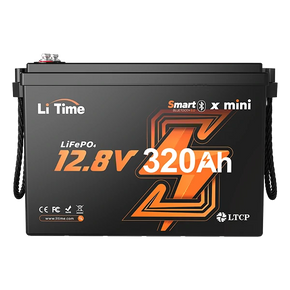
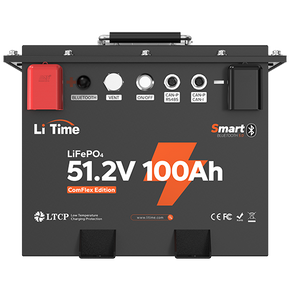
LiTime provides you grade-A cell LiFePO4 batteries, which have the life cycles up to 4000 - 15000 cycles. With 5 year-warranty, you can be confident in the longevity and reliability of your lithium batteries.
FAQs
Can You Run an RV Completely on Solar Power?
Yes, an RV can run completely on solar power if the solar array, battery bank, inverter, and charge controller are properly sized for your daily energy needs.
A solar-powered RV typically uses solar panels to recharge the house battery during the day, while the battery supplies power to 12V DC loads and an inverter converts stored DC energy into AC power for household appliances. Whether solar alone is sufficient depends on daily electricity consumption, available peak sun hours, battery capacity, weather, and the types of appliances you use. High-power loads such as air conditioners, electric heaters, microwaves, and induction cooktops require a much larger solar and battery system. For extended boondocking, it is also practical to keep an alternative charging source available for periods of poor sunlight.
Is 400W Solar Enough for an RV?
A 400W solar system can be enough for an RV with moderate daily power consumption, but it may not be sufficient for regularly running high-power appliances.
Under good conditions, a 400W solar array can generate a useful amount of energy each day for loads such as LED lighting, a 12V refrigerator, water pump, roof fan, phones, laptops, and other small electronics. However, actual solar production depends on peak sun hours, weather, shading, panel orientation, temperature, and system losses. If you frequently use an air conditioner, microwave, electric heater, or other high-wattage appliances, you will likely need a larger solar array and battery bank.
The best way to determine whether 400W is enough is to compare your estimated daily energy consumption in watt-hours with the amount of solar energy your system can realistically produce each day.
Will a 100-Watt Solar Panel Keep My RV Battery Charged?
A 100W solar panel can help maintain or recharge an RV battery with light daily energy use, but it is usually not enough to support a high-consumption RV electrical system by itself.
With several hours of strong sunlight, a 100W panel can provide supplemental energy for basic loads and help replace power used by lights, small electronics, and other low-power devices. However, real-world output is lower than the panel's rated wattage because of weather, temperature, shading, panel angle, controller efficiency, and wiring losses.
If your RV consumes more energy each day than the 100W panel can replace, the battery's state of charge will gradually decrease. Therefore, a 100W panel is better suited for battery maintenance or light camping use, while longer boondocking trips or higher daily energy consumption generally require a larger solar array.
Final Thoughts
In conclusion, determining the number of solar panels needed for your RV depends on factors such as peak sunshine hours, power consumption of your appliances, and the rated output of the solar panels. By following a step-by-step calculation process, you can estimate the number of solar panels required to meet your energy needs.

