


A camper battery powers your essential onboard devices, and choosing the correct charging method directly impacts battery lifespan and camping experience. Below is a simplified overview of the 5 ways about charging a camper battery for quick reference:
| Charging Method | Best Usage Scenario | Difficulty | Charging Speed |
|---|---|---|---|
| Shore Power | Campgrounds with power hookups | Easy | Moderate (Depends on converter amps) |
| Smart Battery Charger | Home storage & battery maintenance | Easy | Adjustable |
| Solar Panels | Off-grid camping & boondocking | Medium | Slow (Weather-dependent) |
| Portable Generator | Bad weather & emergency power | Medium | Moderate |
| Vehicle Alternator / DC-DC Charger | Charging while driving or towing | Medium | Low to Moderate |
- Part 1: Understand Your Camper Battery Type
- Part 2: How to Charge a Camper Battery: 5 Common Methods
- Part 3: Camper Battery Charging Time Chart & Calculation Formula
- Part 4: Best Charging Method by Camping Scenario
- Part 5: Safety Tips Before Charging a Camper Battery
- Part 6: FAQs About Charging Camper Batteries
- Conclusion
Part 1: Understand Your Camper Battery Type
Before learning how to charge a camper battery correctly, it is critical to identify your battery type. Different camper batteries have distinct charging voltage requirements, current limits, maintenance needs, and service lifespans. Using an incompatible charger can cause undercharging, overcharging, overheating, reduced battery lifespan, or safety risks such as excessive gassing in flooded lead-acid batteries.
1.1 Starting Battery vs House (Auxiliary) Battery
Camper electrical systems mainly rely on two core battery categories with completely different functions and charging logic:
Starting Battery (Chassis Battery)
Also known as the cranking battery, its primary purpose is to start the camper’s engine. It delivers a short burst of high current to ignite the engine and is not designed for long-term low-power discharge. This battery features thin internal plates, making it vulnerable to damage from deep discharge. In most stock campers, it is mainly charged by the vehicle alternator during driving.
House (Auxiliary) Battery
Commonly called the deep-cycle battery, it is dedicated to powering daily camping low-voltage electrical appliances, including LED lights, water pumps, fans, control boards, USB ports, and refrigerators. High-draw appliances such as air conditioners usually require shore power, a generator, or a large inverter and battery bank. Built with thick internal plates, it supports repeated discharge cycles. Most daily charging operations target house batteries, which are the focus of this charging guide.
1.2 Four Main Types of Deep-Cycle Camper Batteries
For auxiliary deep-cycle camper batteries, four mainstream chemistries dominate the RV market. Each type has unique charging characteristics and usage limitations:
Battery Type Comprehensive Comparison Table
| Battery Type | Structure & Electrolyte | Service Life | Charging Speed | Maintenance Requirement | Best Application Scenarios |
|---|---|---|---|---|---|
| Flooded Lead-Acid Battery | Liquid sulfuric acid electrolyte, non-sealed structure | 3–5 years | Slow to moderate | High; need regular distilled water topping-up | Budget campers, temporary short-distance camping with good ventilation |
| AGM Battery | Sealed structure, glass fiber mat absorbs electrolyte | 5–7 years | Moderate | Maintenance-free | Most ordinary campers, bumpy mountain or wilderness camping routes |
| Gel Battery | Sealed structure, silica gel solid electrolyte | 6–8 years | Slow | Maintenance-free | Long-term stationary camping, high-temperature or cold extreme environments |
| Lithium Battery (LiFePO4) | Lithium iron phosphate material, built-in BMS protection system | 10–15 years | Fast | Maintenance-free | Frequent outdoor enthusiasts, long-term off-grid sophisticated camping |
Recommended Upgrade: LiFePO4 Battery for Camper Use
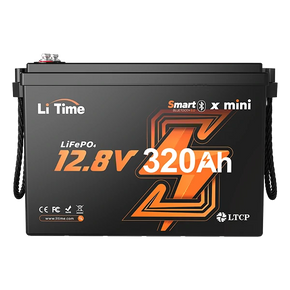
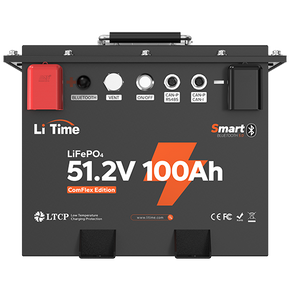
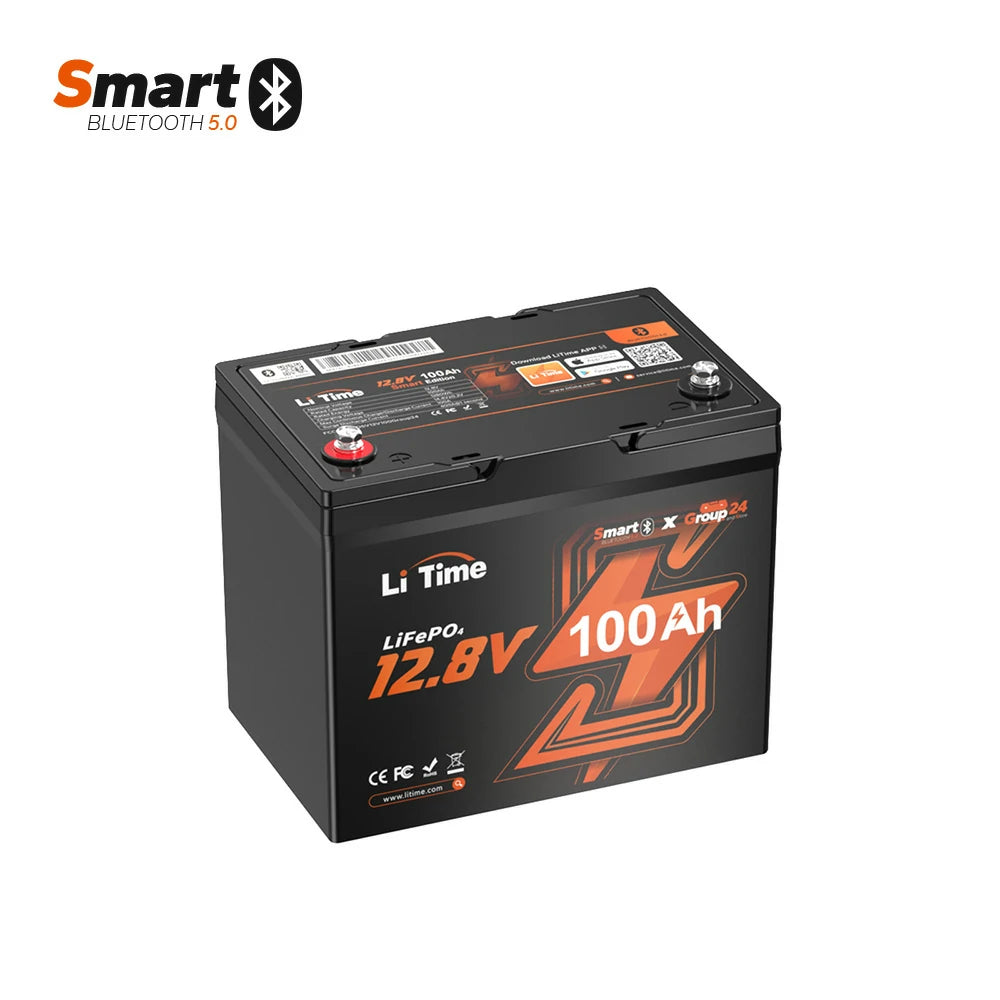
If you want to upgrade from lead-acid to lithium, choose a LiFePO4 battery with a built-in BMS, proper low-temperature charging protection, and stable continuous discharge current for your camper loads. For most small to mid-sized campers, the LiTime 12V 100Ah LiFePO4 Bluetooth Battery is a mature and cost-effective option. It features 4,000+ deep cycles at 100% DOD, a 10-year service life, real-time Bluetooth battery monitoring, and reliable low-temperature cut-off protection, perfectly matching daily RV and off-grid camping power demands.
Part 2: How to Charge a Camper Battery: 5 Common Methods
Based on RV industry usage habits and practicability, we sort out 5 mainstream camper battery charging methods. Each method has unique working logic, advantages, and limitations. No single charging solution fits all camping scenarios.
2.1 Shore Power
Shore power is the most convenient and widely used charging method for stationary camping. When you plug your camper into a campsite power pedestal, the built-in converter converts shore power from 120V AC into the correct DC charging voltage for the camper battery.
Advantages: Stable current, zero noise, no fuel consumption, suitable for long-time static charging; compatible with all battery chemistries.
Disadvantages: Dependent on fixed power sources, completely unavailable for off-grid wild camping. Charging speed is limited by the internal converter output amperage.
2.2 Smart Battery Charger
A dedicated smart battery charger is an independent charging device for camper batteries. You can directly connect the charger to the battery terminals without relying on the camper’s built-in circuit. Modern smart chargers support one-click mode switching for lead-acid, AGM, gel, and lithium batteries, with automatic overcharge protection.
Advantages: High charging precision, adjustable current, suitable for battery maintenance. A maintainer or float mode is useful for many lead-acid and AGM batteries during storage. For LiFePO4 batteries, follow the manufacturer’s storage voltage recommendation and avoid unnecessary long-term trickle charging unless the charger is specifically designed for lithium maintenance.
Disadvantages: Requires manual wiring and carrying additional equipment.
2.3 Solar Panels
Solar charging is the most eco-friendly off-grid charging solution for campers. Fixed rooftop solar panels or portable foldable solar panels capture solar energy, which is converted into stable DC power through a professional solar charge controller to charge the battery. Solar panels cannot charge camper batteries directly without a controller.
Advantages: Renewable energy, zero operating cost, no noise, completely independent of external power sources. Pairing solar setups with reliable lithium batteries like the LiTime 12V 100Ah LiFePO4 battery maximizes solar conversion efficiency, storing surplus power during sunny hours for nighttime use.
Disadvantages: Heavily affected by weather and light intensity; slow charging speed on cloudy days; high initial installation cost.
2.4 Portable Inverter Generator
A portable inverter generator (commonly called a gas generator) is an emergency power generation device powered by gasoline, diesel, or propane. A generator usually does not charge a camper battery directly. Instead, it supplies AC power to the camper’s converter, inverter/charger, or an external smart battery charger, which then converts the power into the correct DC charging voltage for the battery.
Advantages: Strong environmental adaptability, unaffected by weather conditions, stable power output for emergency charging.
Disadvantages: Requires fuel consumption, generates noise and exhaust gas, high long-term usage cost.
2.5 Vehicle Alternator & DC-DC Charger
The vehicle alternator is the built-in power generation device of the camper engine. When you start the engine and drive, the alternator converts mechanical energy into electrical energy. Charging while driving depends on alternator output, wiring size, voltage drop, battery state of charge, and whether a DC-DC charger is installed. For reliable house-battery charging, a properly sized DC-DC charger is usually better than relying on the factory 7-pin connection.
Advantages: Low operating cost if the system is already wired. A DC-DC charger provides stable voltage for lithium batteries.
Disadvantages: Basic alternator charging has slow speed; long-distance driving is required for full charging. A proper DC-DC charger, fuses, and correctly sized wiring may be required for safe and effective charging.
7-Pin Trailer Plug vs DC-DC Charger
Many trailer campers rely on a 7-pin plug for roadside charging, while upgraded RVs use professional DC-DC chargers. The clear comparison below helps you distinguish their differences:
| Item | 7-Pin Trailer Plug | DC-DC Charger |
|---|---|---|
| Charging Speed | Low (5-10A current limit) | Moderate to fast |
| Charging Control | Limited, unstable voltage | Precise voltage and current control |
| Best For | Maintaining charge while towing | Properly charging house batteries while driving |
| Lithium Compatibility | Often poor | Excellent (with lithium charging profile) |
| Main Limitation | Severe voltage drop and low current | Higher one-time installation cost |
Part 3: Camper Battery Charging Time Chart & Calculation Formula
Charging time cannot be judged merely by charging methods. The core influencing factors include battery capacity, charger output current, battery chemistry, depth of discharge, and line loss. We provide a universal charging formula and two scientific tables to replace vague fixed-time data.
Universal Charging Time Calculation Formula
Charging Time ≈ Amp-hours Needed ÷ Charger Amps × 1.1–1.3
The 1.1–1.3 coefficient accounts for natural line loss, temperature interference, and battery absorption-stage energy consumption.
Table 1: Estimated Charging Time for 100Ah Battery (50% to 100% SOC)
| Battery Capacity | Charger Output | Approx. Energy Needed | Estimated Time |
|---|---|---|---|
| 100Ah | 10A | 50Ah + losses | 6–7 hours |
| 100Ah | 20A | 50Ah + losses | 3–4 hours |
| 100Ah | 30A | 50Ah + losses | 2–3 hours |
| 100Ah | 50A | 50Ah + losses | 1.5–2.5 hours |
Table 2: Speed-Determining Factors of Each Charging Method
| Charging Method | What Actually Determines Charging Speed |
|---|---|
| Shore Power | Converter / inverter-charger output current |
| Smart Charger | Charger amperage and battery chemistry |
| Solar Panels | Panel wattage, sunlight hours, controller type, battery SOC |
| Portable Generator | Charger / converter amperage, not generator size alone |
| Vehicle Alternator | Wiring, voltage drop, alternator output, DC-DC charger rating |
Part 4: Best Charging Method by Camping Scenario
There is no universal best charging method for camper batteries. You can select the optimal solution according to your camping environment and travel plans:
4.1 Before Leaving Home
Before every camping trip, prioritize using a smart battery charger for static slow recovery charging. Park the camper in a ventilated garage, disconnect all electrical loads, and fully charge the battery. For long-term stored batteries, maintain low-current maintenance charging to avoid self-discharge failure.
4.2 At a Campground with Power Hookups
When staying in a campsite with complete power pedestals, shore power is undoubtedly the best choice. Plug in the shore power cable equipped with a surge protector to avoid voltage surges damaging the battery. It is recommended to keep the battery power between 80% and 100% without frequent plugging and unplugging.
4.3 Off-Grid Camping
For off-grid camping in wild areas without public power, solar panels are the most cost-effective long-term charging solution. Install fixed rooftop solar panels or place portable foldable panels in unobstructed sunlight areas. Many seasoned off-grid campers choose LiTime RV lithium batteries for their high energy density and compact size, which fit seamlessly into limited camper battery compartments.
4.4 Off-Grid Camping on Cloudy or Rainy Days
On cloudy, rainy, or foggy days with insufficient sunlight, solar charging efficiency drops sharply. At this time, a low-noise portable inverter generator is the reliable backup option. Place the generator in a well-ventilated outdoor area away from the camper to prevent exhaust gas accumulation, and avoid continuous operation for more than 8 hours.
4.5 While Driving
During driving migration, rely on a professional DC-DC charger for passive supplementary charging instead of the original 7-pin plug. Reasonably arrange electrical loads to avoid excessive power consumption causing battery overdischarge.
Part 5: Safety Tips Before Charging a Camper Battery
Improper charging is the leading cause of camper battery damage and safety accidents. Follow these universal RV charging safety rules:
- Always match charger voltage and charging profile with your battery chemistry.
- Use properly sized wires and fuses; install a fuse close to the positive battery terminal.
- Ventilate flooded lead-acid batteries during charging to discharge hydrogen gas.
- Keep sparks and flames away from sealed battery compartments.
- Do not charge LiFePO4 batteries below freezing unless the battery has low-temperature charging protection.
- Check positive and negative polarity before connecting any charging equipment.
- Do not bypass the BMS or original safety protection devices of lithium batteries.
Part 6: FAQs About Charging Camper Batteries
Q1: Why Is My Camper Battery Not Charging?
Follow this standardized troubleshooting sequence to locate faults quickly:
- Confirm stable shore power or generator power input.
- Check the converter or charger real-time output data.
- Inspect fuses and circuit breakers for tripping.
- Ensure the battery disconnect switch is turned on.
- Clean corroded and loose battery terminals.
- Confirm the charger profile matches the battery type.
- Test battery static voltage to judge battery health.
Q2: How Do I Know If My Camper Battery Is Fully Charged?
Voltage judgment is the most convenient method for lead-acid batteries. Measure static voltage after the battery rests for more than 2 hours without load:
| Resting Voltage | Approx. State of Charge |
|---|---|
| 12.7V–12.8V | 100% |
| 12.5V–12.6V | 80–90% |
| 12.4V | 70–75% |
| 12.2V | About 50% |
| 12.0V | About 25% |
| 11.8V or lower | Very low / deeply discharged |
Note: Lithium battery voltage curve is flat; a professional battery monitor is more accurate than simple voltage detection.
Q3: Do camper batteries charge when the camper is plugged in?
Yes. When your camper is plugged into shore power, the built-in converter automatically converts AC power into low-voltage DC power to charge the house battery. In many campers, shore power primarily charges the house battery, not the starting battery. However, some RVs include a battery combiner, isolator, or chassis battery maintainer that can also charge or maintain the starting battery when plugged in.
Q4: Can a completely dead camper battery be recharged?
It depends on battery condition and chemistry. A battery that has remained deeply discharged for weeks or months may suffer permanent capacity loss, especially lead-acid batteries due to sulfation. However, whether it can be recovered depends on voltage, battery chemistry, temperature, and physical condition. Premium lithium batteries such as LiTime LiFePO4 batteries feature intelligent auto-recovery BMS protection, improving the success rate of dead battery wake-up. If a battery cannot hold a charge after professional recovery charging, it should be replaced.
Q5: Can I charge a camper battery with a regular car battery charger?
Yes, but you must select the correct charging profile matched to your battery chemistry. Lead-acid and AGM batteries are compatible with most universal chargers, while LiFePO4 batteries require a dedicated lithium charging mode to avoid BMS protection failure.
Q6: Does a 7-pin trailer plug charge a camper battery?
It can supply weak charging current (5-10A) to maintain battery voltage during towing, but it cannot provide fast and stable charging, especially for lithium batteries. It is not recommended as the main daily charging method.
Q7: What is the best way to charge a camper battery while driving?
Install a professional DC-DC charger. It can stabilize charging voltage, compensate for line voltage drop, and provide an exclusive lithium charging profile, which is far safer and more efficient than the original alternator circuit or 7-pin plug.
Q8: Should I leave my camper plugged in all the time?
For modern smart converters, you can keep lead-acid and AGM batteries plugged in for long-term maintenance. For LiFePO4 batteries, avoid continuous full-state floating charging; unplug the power supply appropriately to extend cycle life.
Q9: Can solar panels charge a camper battery directly?
No. Solar panels output unstable variable voltage. A solar charge controller is mandatory to regulate current and voltage, preventing battery overcharging and burnout.
Q10: How long does it take to charge a 100Ah camper battery?
Refer to the charging formula and current table above. Under normal conditions, a 100Ah lead-acid battery takes 6–14 hours, while a LiFePO4 battery only takes 1.5–8 hours, depending on charger current and sunlight conditions.
Conclusion
Mastering how to charge a camper battery correctly is an essential skill for every camping enthusiast. You need to distinguish between starting batteries and house batteries, understand the characteristics of four common battery chemistries, and select a reasonable charging solution from five mainstream methods according to actual scenarios: shore power for fixed campsites, smart chargers for home maintenance, solar panels for off-grid travel, generators for bad weather, and DC-DC chargers for driving charging.
Use the universal charging formula and scientific time charts to arrange your charging plan reasonably, strictly follow RV charging safety specifications, and regularly troubleshoot common faults. If you plan to upgrade your camper battery for long-term outdoor adventures, LiTime, a professional lithium battery brand with 16 years of manufacturing experience, provides cost-effective, safe, and durable RV battery solutions to power every one of your camping trips reliably.
Read More:
Can I Charge A LiFePO4 Battery with a Normal Charger

