


Is a dual purpose marine battery worth it for your boat? Yes if you run light electronics, have limited space, or want a clean single-battery setup. No if you run heavy sonar systems, dedicated trolling motors, or make frequent short trips where the battery never fully recharges.
In this guide, we'll break down exactly when a marine dual-purpose battery works, when it doesn't, and how to pick the right one.
- 1. What Is a Dual Purpose Marine Battery?
- 2. When a Marine Dual Purpose Battery Makes Sense?
- 3. When a Dual-Purpose Marine Battery Is Not the Right Choice?
- 4. AGM vs. Lithium Dual Purpose Battery --- Which is Better?
- 5. How to Choose the Right Dual Purpose Battery for Your Boat?
- 6. Best Dual Purpose Lithium Marine Batteries by Use Case
- 7. FAQs
What Is a Dual Purpose Marine Battery?
A dual-purpose marine battery is a hybrid designed to do two jobs at once: deliver a high burst of current to crank your engine, and provide steady, low-amp power to run your electronics for hours.

Starting vs Deep Cycle vs Dual Purpose Battery
Traditional starting batteries use thin plates for quick power bursts, while deep-cycle batteries use thick plates for long-lasting energy. A dual-purpose battery balances both with medium-thickness plates. For most boaters running a single-battery setup, that tradeoff is completely acceptable. → Full Guide to Starting Battery vs. Deep-Cycle & Dual-Purpose Battery.
| Starting | Deep Cycle | Dual Purpose | |
|---|---|---|---|
| Primary job | Crank the engine | Run electronics for hours | Both |
| Plate design | Many thin plates | Few thick plates | Medium — balanced |
| Key rating | CCA | Ah | CCA + Ah |
| Deep discharge tolerance | Poor | Excellent | Moderate |
| Best for | Cars, trucks | Trolling motors, solar | Boats, RVs |
Traditional AGM/lead-acid dual-purpose batteries are a compromise. However, modern LiFePO4 versions strong cranking output, higher usable capacity, and longer cycle life when they are specifically rated for marine starting, reducing many of the traditional AGM trade-offs.
When a Marine Dual Purpose Battery Makes Sense?
A dual purpose marine battery isn't the right answer for every setup — but it's the perfect answer for many. Here's how to know which category you fall into.
You Have a One-Battery System
A dual purpose marine battery can be a balanced and convenient solution to provide both cranking power and reserve capacity in one package. It avoids the need to manage multiple batteries, making installation and maintenance easier.
→ Best for weekend boaters, casual anglers, and light recreational users who use simple one-battery system.

Your boat is Space & Weight Limited
A dual-purpose marine battery is useful when your boat has limited battery room. Some small boats cannot easily fit separate starting and deep cycle batteries. It reduces wiring complexity, saves space, and also lowers total system weight.
→ Practical for small fishing boats and compact marine applications.
Your Boat Has Enough Charging Time During Transit
If your boat involves long, continuous runs where the engine has ample time to replenish the charge, this battery is highly effective. This allows the alternator to replace used power and keeps the battery ready for the next engine start, so you never have to worry about not being able to return.
→ Ideal for longer cruising, offshore fishing, or long return trips.
Your Boat Has Light-to-Moderate Electronics with Low Load
If your setups run only essential electronics that do not usually require very high power for short periods, the battery can support these loads while still providing engine cranking power.
→ Effective for boat setups running only with basic navigation lights, standard stereos, live wells, small pumps, or a single fishfinder.
When a Dual-Purpose Marine Battery Is Not the Right Choice?
Compared to a dedicated starting battery of the same size, the battery dual purpose delivers lower peak CCA. Compared to a true deep cycle battery, it handles fewer discharge cycles at the same depth. For the setups below, those limitations matter.
You Run Heavy Electronics
A marine dual purpose battery is not ideal for heavy electronics. Multiple large fish finders, sonar systems, stereos, and live imaging units can drain it quickly. This can reduce the reserve needed for engine starting.
→ A lithium or deep cycle battery supports electronics efficiently, and a starting battery for engine use.
You are on Short Trips with Frequent Stops
Short trips can be hard on a battery dual purpose. The engine may not run long enough to fully recharge it, and the battery may discharge for accessories run at anchor or while fishing. Then, a dual purpose unit will gradually drain down over a long day.
→ Consider a dedicated marine starting battery for the engine, and use a separate lithium battery for fish finders, lights, pumps, and other accessories.
Your Boat Uses a Trolling Motor System
Even if a high-capacity Group lithium dual purpose battery can handle more load, you'd better not utilize a dual-purpose battery marine to power a dedicated trolling motor. This is because trolling motor systems requires continuous, deep discharges over several hours.

Besides, running fish finders on the trolling motor battery can cause electrical interference. For better performance, keep trolling motors and electronics on separate circuits. This also protects engine starting power.
→ Specialized Lithium trolling motor batteries to avoid premature failure.
This limitation is largely a lead-acid and AGM problem. Those chemistries physically can't close the performance gap --- plate design forces the compromise. LiFePO4 works differently. Its low internal resistance allows it to deliver high CCA and genuine deep cycle capacity in the same unit.
AGM vs. Lithium Dual Purpose Battery --- Which is Better?
Both AGM and lithium dual purpose batteries can start engines and power accessories. However, they perform very differently in weight, lifespan, charging speed, and system compatibility. Choosing between them depends on your budget, power demand, and charging setup.

AGM Dual Purpose Battery
An AGM dual purpose batteries are affordable and easy to replace. They work well with most existing marine charging systems without modification and are reasonable starting points for light, occasional use.
Strengths:
- Lower upfront cost: $100–$200 for a Group 24 unit, initially cheaper than lithium options
- High compatibility: Compatible with standard lead-acid chargers and most boat charging systems
- High cranking Amps: Provides strong cranking amps when fully charged.
- Easy to find: Widely available at marine retailers and big-box stores
Limitations:
- Heavier: A Group 24 AGM usually weighs 50–55 lbs, about twice as heavy as lithium.
- Shorter lifespan: 300–500 charge cycles under regular deep discharge use
- Temperature Sensitivity: Discharges well but may lose 30–40% CCA capacity at 0°F
- Less usable capacity: Lose capacity faster under frequent discharge cycles. Regular discharge beyond 50% DoD can shorten battery life.
- Voltage Sag: Voltage steadily drops as the battery drains, which may dim electronics or reduce trolling motor thrust.
Best for: Budget-conscious boaters, seasonal use, light electronics, and boats already set up for lead-acid batteries.
Lithium (LiFePO4) Dual Purpose Battery
LiFePO4 chemistry changes the dual purpose equation fundamentally. Its low internal resistance allows it to deliver high burst current and sustain deep discharge cycles — without the plate design tradeoff that limits AGM.
Strengths:
- Featherlight Weight: 50%~70% lighter than an AGM battery. Litime newtest 12v dual purpose marine battery only weights 22.71lbs.
- Longer service life: 4,000+ charge cycles under single deep-cycle use.
- More usable capacity: Supports 80–100% depth of discharge for longer runtime.
- Consistent voltage: no performance drop as the battery depletes
- Cold-weather option: Self-heating models can charge safely down to -4°F.
- Built-in BMS protection: Against overcharge, over-discharge, and short circuit
Limitations:
- Higher upfront cost: Be 2 to 4 times higher than an AGM.
- Charging limitation: Lithium-compatible charger is a must; standard lead-acid chargers may undercharge or cause issues.
- Cold charging risk: Standard lithium batteries should not be charged below 32°F without low-temperature protection or heating.
Best for: Frequent boaters, anglers, RV owners, long-day use, weight-sensitive setups, and users who want lower long-term replacement cost.
A Quick Comparison between AGM and Lithium Battery Dual Purpose
| AGM | LiFePO4 | |
|---|---|---|
| Usable capacity | ~50Ah (100Ah unit) | ~100Ah (100Ah unit) |
| Voltage under load | Drops steadily | Holds flat |
| Weight (Group 24) | 50–55 lbs | 22.71–26 lbs |
| Cold weather CCA | ~30–40% at 0°F | Stable; heats to ~4°F |
| Cycle life | 300–500 cycles | 4,000+ cycles |
| Charger compatibility | Standard lead-acid | Lithium-compatible required |
| Upfront cost | Lower | Higher |
| Best for | Occasional use, budget | Regular use, long-term value |
Choose AGM if you want a simple, low-cost, plug-and-play solution. It is ideal for small boats, weekend use, and minimal electronics.
Choose lithium if you need maximum efficiency, longer runtime, and frequent cycling. It is best for modern boats with high electronic loads and upgraded charging systems.
How to Choose the Right Dual Purpose Battery for Your Boat?
Choose CCA Based on Engine Starting Needs
Start with CCA if you need reliable cold starts. For small outboards, 500--700 CCA may be enough; for larger outboards, choose 800--1,000+ CCA or follow your engine manual.
Do not choose a dual purpose marine battery by Ah alone. If the CCA is too low, the battery may run electronics but fail to crank the engine. For a deeper breakdown of cranking ratings, read our guide on CCA vs. MCA marine starting battery performance.
Compare MCA for Marine Starting Power
Use MCA to judge real marine cranking performance. MCA is measured at 32°F, while CCA is measured at 0°F, so MCA ratings are usually higher.
As a rough guide, 650--800 MCA fits many small-to-mid boats, while 1,000+ MCA is better for larger engines or heavier marine use. Always match or exceed the engine manufacturer's minimum MCA requirement.
Match Ah to Electronics Runtime
Choose Ah based on how long your electronics need to run. A light setup with one fish finder, navigation lights, and a livewell pump may work with 50--100Ah.
For multiple fish finders, sonar modules, pumps, or longer fishing days, consider 100--165Ah+. A simple formula is: runtime = usable Ah ÷ total amp draw. Not Sure? Read our guide on how long a marine battery last to make a wise decision.
Pick Group Size by Space and Capacity
Choose group size by both battery tray fit and power demand.
Group 24 is compact and usually best for small boats with light electronics. Group 27 gives more reserve capacity for mid-sized boats. Group 31 is better for longer runtime, higher accessory loads, or boaters who want extra starting backup.
Check Charger Compatibility Before Buying
Choose AGM if you want simple compatibility with most standard marine chargers. Choose lithium only if your charger supports a LiFePO4 charging profile.
For lithium dual purpose battery chargers, also check whether the BMS supports engine starting, high discharge current, and marine charging conditions. The wrong charger can cause undercharging, shutdown, or reduced battery life.
Best Dual Purpose Lithium Marine Batteries by Use Case
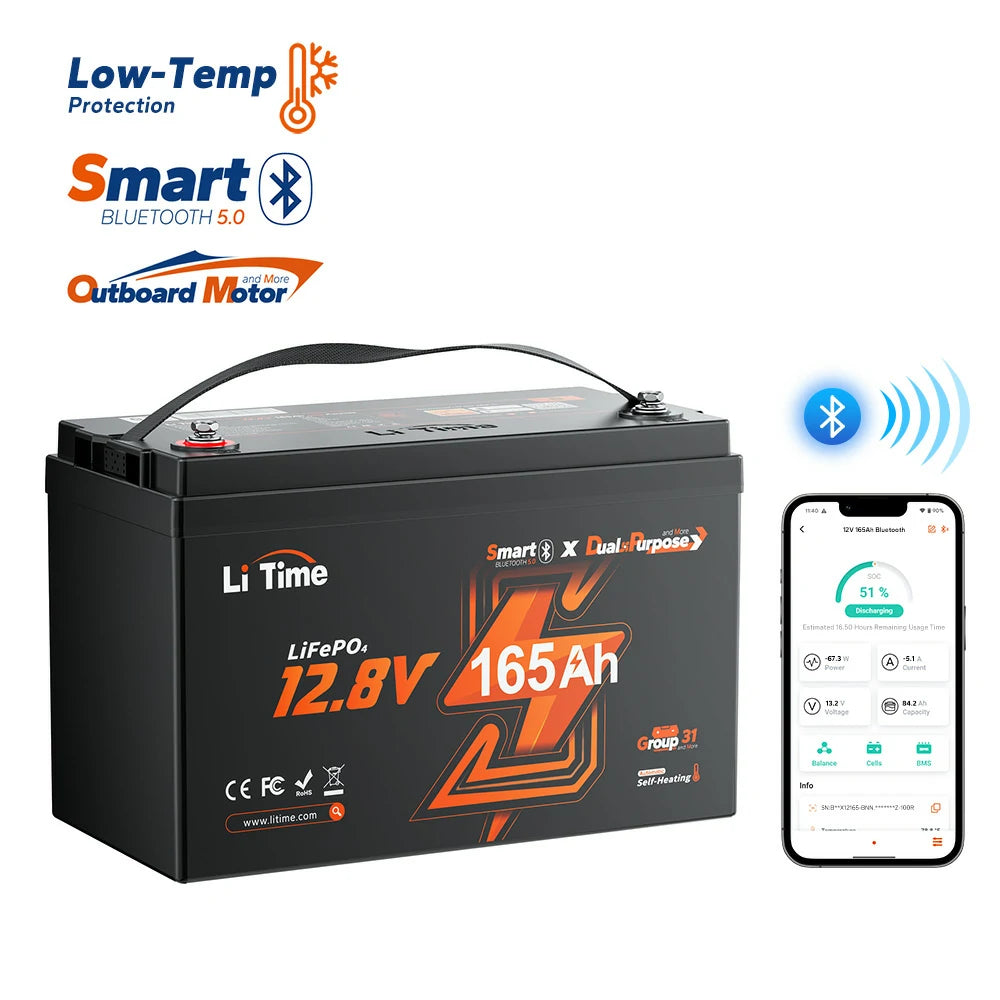
LiTime 12V 165Ah Dual-Purpose Battery--- Best for Max Runtime
Capacity: 165Ah massive energy reserve.
Best For: Offshore fishing boats with heavy electronics.
Key Features:
- Longer runtime for fish finders, pumps, and lights.
- More reserve capacity for single-battery setups.
- Better for long fishing days and offshore trips.
- Best when runtime matters more than compact size.
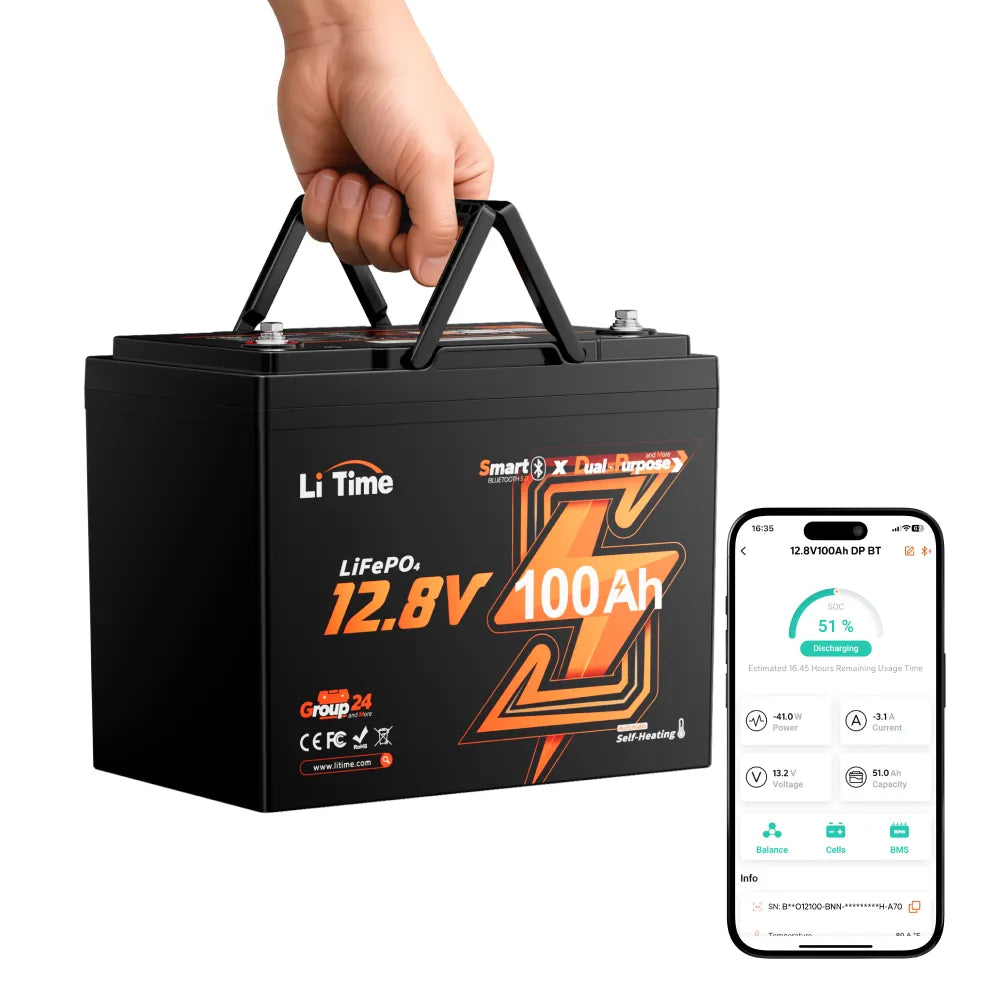
LiTime 12V 100Ah Group 24 Battery --- Best for Compact & Cold Weather
Size & Capacity: Standard Group 24(Only 22.71lbs) / 100Ah.
Power Ratings: 900A CCA / 1000A MCA.
Best For: Bass boats, skiffs, and trailers, especially for freezing early-spring or late-winter trips.
Key Features:
- Compact Group 24 fit.
- Strong 900A CCA / 1000A MCA starting power.
- Built-in self-heating for freezing conditions.
- IP67 waterproof protection for marine use.
FAQs
Is a dual purpose marine battery the same as a deep cycle battery?
No. A deep cycle battery is built for repeated long discharges, while a dual purpose battery balances starting power and accessory runtime.
AGM or lithium: which is better?
AGM is cheaper and easier to replace. Lithium is lighter, lasts longer, offers more usable capacity, and performs better for frequent use.
Does a lithium dual purpose marine battery need a special charger?
Usually yes. Use a lithium-compatible charger or one with a LiFePO4 charging profile.
Can a marine dual purpose battery be used in an RV?
Yes, but it is not always ideal. RVs usually need deep-cycle house power more than engine cranking, so a dedicated LiFePO4 RV battery may be better.
Can one dual purpose marine battery start the engine and run electronics?
Yes, if your electronics load is light to moderate. For heavy sonar, live imaging, or long accessory use, a separate house battery is safer.
What size dual purpose marine battery should I choose?
Choose Group 24 for compact boats, Group 27 for more reserve capacity, and Group 31 for longer trips or heavier electronics.
Can I use a dual purpose marine battery for a trolling motor?
Only for light or occasional trolling motor use. For regular trolling motor use, a dedicated deep cycle or lithium trolling motor battery is a better choice.

