


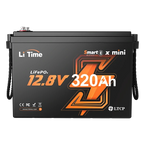


When it comes to powering marines and RVs, finding the right battery is crucial. Two popular types of batteries are starting (cranking or starter) batteries and deep-cycle batteries. But what are the differences between them, and which one is the best for your needs? Let's take a closer look at these two battery types.
Table of Content
Part 1: Understanding Marine Starter Batteries
Marine starter batteries, often referred to as marine cranking batteries or marine engine start batteries, are a specialized type of lead-acid battery engineered specifically to initiate boat engines.
It is primarily designed to deliver high burst current for engine starting. Its starting performance is mainly measured by two ratings: cranking amps (CA) and cold cranking amps (CCA). Among them, CCA specifically evaluates starting capability in extreme cold conditions and is the more critical technical parameter.
In contrast, "cold-cranking amps" (CCA) represent a more demanding assessment of a battery's starting strength. This metric is defined as the maximum current a battery can discharge at a frigid 0°F (-18°C) for 30 seconds while maintaining a voltage of no less than 7.2V (for a 12V battery), again, while maintaining a minimum voltage level. Why is this distinction important? CCA becomes particularly critical when attempting to start an engine in cold weather conditions. Low temperatures cause engine oil to thicken and can significantly reduce a lead-acid battery’s discharge capability, which increases the current required to start the engine. For those interested in a deeper dive into this specific rating, our blog post, "What are CCAs?", offers further information.
Part 2: Exploring Deep-Cycle Marine Batteries
Engineered for endurance, deep-cycle marine batteries are specifically constructed to deliver a consistent and sustained power output over prolonged durations. This characteristic makes them perfectly suited for applications demanding continuous energy.
Unlike starting batteries, which are designed to deliver a short burst of high current, deep-cycle batteries are engineered primarily for cycle life and depth of discharge. Different types of deep-cycle batteries achieve durability in different ways: in traditional lead-acid batteries, this is typically done by using thicker, more corrosion-resistant lead plates or grids to withstand the stress of deep discharges; in lithium-ion batteries, durability relies mainly on more stable electrochemical materials and BMS management.
What kind of onboard equipment relies on such a power source? These batteries are commonly employed to energize a wide array of electrical systems and appliances found on boats. This includes essential items like lighting, as well as equipment such as trolling motors, fish finders, radios, and so on. Consequently, deep-cycle marine batteries play a crucial role in boating activities where a dependable and long-lasting power supply is paramount. Their reliable performance ensures that boaters can fully enjoy their time on the water, free from concerns about unexpected power interruptions.
Part 3: Comparison of Starting Battery Vs. Deep-Cycle Battery
1. Differences in Function:
Starting batteries are designed to provide a burst of high current to start an engine, and then be quickly recharged by the alternator. They are made to supply high electrical current for a short period of time, but not for an extended period of time. They are not designed to be deeply discharged and recharged repeatedly like deep-cycle batteries.
Deep-cycle batteries, on the other hand, are designed to provide a steady, lower current for a longer period of time. They are typically used for applications such as RV house batteries, off grid life, trolling motor batteries, and solar panel batteries. They are designed to provide a sustained flow of electrical power over an extended period of time and to be deeply discharged and recharged repeatedly.
2. Differences in construction:
In terms of construction, lead-acid starting batteries typically use thinner and more numerous lead plates to increase the surface area and provide a high current output. Its plate design allows the battery to remain in an almost “constantly fully charged” state. Any use that drains it below 50% state of charge can cause irreversible damage.
Lead-acid Deep cycle batteries, on the other hand, use thicker and fewer lead plates which can handle deep discharge. Its design allows the battery to achieve a deeper depth of discharge.

Part 4: A Third Option: Dual-Purpose Marine Batteries
Attempting to bridge the gap between starting power and sustained energy, dual-purpose batteries are engineered to offer a compromise between the distinct characteristics of cranking batteries and deep-cycle batteries. Their design allows them to deliver the significant burst of power required to initiate an engine, while also possessing the capability to supply a moderate, continuous flow of electricity for operating onboard electronics and various accessories.
Interestingly, many deep-cycle marine batteries available in today's market are actually designed with this dual-purpose functionality in mind. For individuals with smaller boats that have less demanding engine starting requirements, a high-quality dual-purpose deep-cycle marine battery might indeed provide sufficient power for both starting the engine and running accessories. However, what about situations involving larger vessels or more power-hungry systems? In scenarios with larger boats that have more powerful engines, or if there's a substantial array of onboard electronics and accessories, the generally recommended approach is to utilize a dedicated cranking battery specifically for engine starting. This would then be complemented by a separate deep-cycle battery, or even a bank of batteries, to handle the demands of accessory power.
FAQS about Deep Cycle and Cranking Battery
1. Can You Use A Lead-acid Deep Cycle Battery As A Starting Battery
While a lead-acid deep cycle battery can be used as a starting battery in a pinch, it is not an ideal choice. Lead-acid Deep cycle batteries may struggle to deliver the initial burst of power necessary to start an engine, especially in colder temperatures. Additionally, using a lead-acid deep cycle battery as a starting battery will decrease its lifespan since the repeated high current draws during engine starts can cause internal damage.
2.Can lithium batteries be used for engine starting?
LiTime Lithium dual-purpose batteries give you a high CCA rating(such as 1000A) of engine starting power.
3. Can you run a cranking battery and deep cycle in parallel?
It is strictly prohibited to connect a starting battery and a deep-cycle battery directly in parallel on a permanent basis. Their different chemistries can cause severe internal circulating currents and unbalanced charging/discharging, which can quickly damage the batteries. If you need to use both types together, they must be connected and managed using professional equipment such as a dual-battery isolator or a DC-to-DC charger.
4. Can You Use a Marine Battery in a Car?
Using the wrong type can lead to poor performance, shorter battery life, and potential issues with your car's electrical system. Always best to use a battery specifically designed for automotive use in your car.
Conclusion
Choosing the correct battery is fundamental to ensuring reliable power for your marine vessel or RV, directly impacting your safety and enjoyment.
By carefully considering the unique roles of starting, deep-cycle, and dual-purpose batteries, you can select the right power source—or combination of sources—to keep your adventures running smoothly and without interruption.


