

All-in-one power stations like the EcoFlow DELTA Pro 3 + 400W portable solar panel are very popular for home backup, RV life and off-grid cabins. But they are not cheap. This article shows how to DIY a similar system using LiTime’s standalone components, what you need, how much it costs, and what advantages you gain.
1. Reference Point: What Does EcoFlow DELTA Pro 3 + 400W Solar Deliver?
The EcoFlow DELTA Pro 3 is a high-end portable power station. In the popular bundle with a 400W portable solar panel, it offers:
- Battery capacity: 4,096Wh with LiFePO4 cells (4kWh class)
- Inverter output: 4,000W pure sine wave with 120/240V split-phase output
- Solar input: Up to roughly 2,600W of solar PV input
- Use cases: Home backup, RV/van life, off-grid cabins, outdoor work
During recent Black Friday promotions, the DELTA Pro 3 + 400W portable panel bundle has been seen around $2,549 in the US market (promotional pricing). Even on sale, you are typically looking at a $2,500+ budget for the official EcoFlow solution.
2. Goal: DIY a Similar System with LiTime Components
Our DIY target is to match the core capabilities of the EcoFlow combo using separate components. Concretely:
- Battery capacity: Around 4–5kWh
- Inverter output: Around 4–5kW pure sine wave
- Solar input: At least 400W of PV, with room to expand
With this, you should be able to:
- Keep a fridge, router, lights and a few outlets running during outages
- Power an RV or off-grid tiny home (fridge, small AC, cooktop, laptop)
- Use solar during the day to recharge and extend runtime
3. Component Selection: Building a DIY DELTA Pro 3 with LiTime
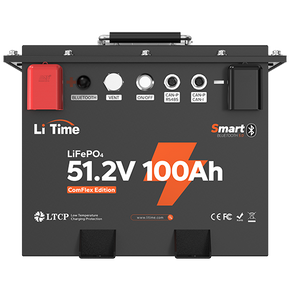
3.1 Battery Core: LiTime 48V 100Ah Server Rack LiFePO4 (≈ 4.8kWh)
The LiTime 48V 100Ah rack-mount LiFePO4 battery is designed for off-grid and home energy storage applications:
- Nominal energy: 48V × 100Ah ≈ 4,800Wh, slightly higher than DELTA Pro 3’s 4,096Wh
- Chemistry: LiFePO4 with long cycle life (typically 4,000+ cycles)
- Form factor: Server-rack style, ideal for cabinets and utility rooms
- Use cases: Off-grid solar, cabins, RVs, home backup systems
At the time of writing, LiTime’s Black Friday price for this model is about $999.99 on LiTime.com (regular price is higher and will vary over time), and it includes a 30-Day Price Guarantee and 30-Day Free Return Policy, so you can lock in a great deal now and still have a full month to make sure it’s the right fit for your setup. Click the image to claim your discount instantly.

Takeaway: This single battery can act as the “energy core” of a DIY system, with slightly more capacity than the EcoFlow DELTA Pro 3.
3.2 System Brain: LiTime 48V 5000W Solar Inverter Charger
EcoFlow integrates inverter, MPPT solar charger and AC charger into one sleek housing. LiTime offers a similar concept with its 48V 5000W pure sine wave solar inverter charger.
Typical capabilities include:
- Continuous power: 5,000W pure sine wave output (with surge capacity)
- Battery input: 48V DC, perfectly matched to the LiTime 48V 100Ah battery
- AC output: 120V AC, with options in many setups to parallel units for 120/240V split-phase
- Integrated MPPT: Built-in solar charge controller for direct PV connection
- Multi-function: Inverter + solar charger + AC charger + UPS-style backup in one unit
In recent promotions, this LiTime 48V 5kW all-in-one unit has been priced around $859.99 on sale (with a higher regular price).

Takeaway: On inverter power alone, the LiTime 5kW unit actually exceeds the EcoFlow’s 4kW rating.
3.3 Solar Input: 400W Monocrystalline Solar Panel
To mirror the EcoFlow DELTA Pro 3 + 400W portable solar bundle, our DIY system needs at least one 400W monocrystalline panel.
On today’s market, a quality 400W panel generally costs:
- Roughly $120–$200 per panel (about $0.30–$0.50 per watt)
You can choose the panel style that fits your use case:
- Fixed rooftop panel for RV roofs, sheds or cabins
- Portable/folding 400W array for more mobile setups (usually higher cost)
Takeaway: With a single 400W panel, the LiTime DIY system offers similar solar input to the EcoFlow combo, and you retain the option to add more panels later.
3.4 Balance-of-System Components
To complete the system, you will also need basic balance-of-system (BOS) hardware such as:
- Battery cables and PV cables (with MC4 connectors)
- DC breakers or fuses for battery and PV lines
- Bus bars, lugs and grounding hardware
- A small AC sub-panel, outlets, or a transfer switch (depending on your integration)
For a small system, a reasonable budget for these parts is about $200, depending on brands and local prices.
4. Build Overview: What You Actually Need to Do
Step 1 – Plan Your Use Case and Location
Start by answering a few key questions:
- Will this system live in an RV / van, or in a home / cabin / garage?
- Where will you place the battery and inverter? (rack, wall, cabinet)
- Where will your solar panels be mounted? (roof, ground-mount, portable frame)
These decisions determine cable lengths, mounting hardware, routing, and ventilation requirements.
Step 2 – Install the LiTime 48V 100Ah Battery
Mount and connect the battery safely:
- Secure the 48V 100Ah LiFePO4 rack battery in a rack, cabinet or bracket.
- Connect the positive and negative terminals using appropriately sized cables.
- Add a properly rated DC breaker or fuse on the positive line.
- Verify torque, polarity and cable gauge according to 48V system requirements.
Step 3 – Install the LiTime 48V 5000W Inverter/Charger
Next, install the all-in-one inverter/charger:
- Mount the unit in a ventilated area, leaving clearance for airflow.
- Use short, thick DC cables to connect the inverter’s DC input to the 48V battery bank.
- Double-check polarity and connection tightness.
- In the settings, choose LiFePO4 as battery type and set bulk, float and cutoff voltages according to LiTime’s recommended values.
Step 4 – Connect the 400W Solar Panel
Hook up the solar side:
- Mount the 400W panel in a sunny location with minimal shading.
- Use MC4 PV cables to connect the panel to the inverter’s MPPT PV input.
- Check that the panel’s voltage and current are within the inverter’s PV input range.
- Optionally add a DC breaker between the array and the inverter for safe isolation.
Later, you can expand by adding more panels in series or parallel to increase total PV power, as long as you respect the inverter’s PV input limits.
Step 5 – Wire the AC Side and Test
Finally, distribute AC power and test the system:
- Connect the inverter’s 120V AC output to a sub-panel, outlet network or transfer switch.
- For home integration (feeding household circuits), it is strongly recommended to work with a qualified electrician and follow local electrical codes.
- Test charging from the grid/shore power to ensure the battery charges correctly.
- Test typical loads (lights, fridge, laptop) on the inverter output.
- On a sunny day, confirm that solar input is charging the battery as expected.
- Simulate a grid outage to verify seamless switchover to battery power.
5. Cost Comparison: LiTime DIY vs EcoFlow Bundle
Let’s compare realistic Black Friday–style pricing. Exact numbers will change over time, but the relative difference is the key insight.
5.1 EcoFlow DELTA Pro 3 + 400W Solar Bundle
Recent Black Friday promos have priced the EcoFlow DELTA Pro 3 + 400W portable panel bundle at about $2,549 in the US.
That’s roughly what you pay for a 4kWh / 4kW + 400W solar all-in-one portable power station from EcoFlow.
5.2 LiTime DIY System
| Component | Description | Approx. Price (USD) |
|---|---|---|
| LiTime 48V 100Ah LiFePO4 Battery | Rack-mount, ~4.8kWh energy storage | $849.99 (Black Friday on LiTime.com) |
| LiTime 48V 5000W Solar Inverter Charger | 5kW pure sine all-in-one unit | ≈$759.99 (discounted promo pricing) |
| 400W Monocrystalline Solar Panel | Third-party fixed or portable panel | ≈$150–$200 |
| Cables, Breakers, BOS Components | Wiring, DC protection, small hardware | ≈$200 (estimated) |
| Estimated Total | ≈$1,960–$2,010 (around $1,990 midpoint) | |
Compared to the EcoFlow bundle at about $2,549, the LiTime DIY system comes in roughly $500–$600 cheaper, or about 20–23% savings, while offering similar or slightly higher capacity and inverter power.
6. Key Advantages of the LiTime DIY System
6.1 More Capacity and Power in the Same Class
- Battery: LiTime 48V 100Ah ≈ 4.8kWh vs EcoFlow at 4,096Wh
- Inverter: LiTime at 5kW vs EcoFlow at 4kW
In other words, you get slightly more usable energy and more inverter headroom for similar or lower cost.
6.2 Much Better Scalability
- Add more batteries: Another 48V 100Ah pack doubles storage to ~9.6kWh.
- Expand solar: Grow from a single 400W panel to 800W, 1200W or more as needs grow.
- Parallel inverters: Many all-in-one units can be paralleled to reach 10kW+ systems.
EcoFlow does offer expansion batteries and smart panels, but all expansions must stay inside their ecosystem, which can become expensive. With LiTime and standard solar components, you have an open, modular platform.

6.3 Open, Modular Architecture
- Components are independent and replaceable: battery, inverter, panels and protection hardware.
- You can upgrade each part over time without throwing away a complete power station.
- Failures are easier to isolate and fix, and long-term maintenance is more transparent.
6.4 Optimized for RVs, Cabins and Fixed Home Installations
EcoFlow excels in true portability – wheels, handles, a single integrated box. LiTime’s DIY system is different:
- Designed to live in an RV, cabin, shed, garage or utility corner.
- Battery and inverter can hide in a cabinet, while AC is distributed to where you actually use it.
- Perfect for semi-permanent or permanent installations where mobility is not the top priority.
7. Trade-Offs and Downsides of DIY
For a fair comparison, here are the main downsides of the LiTime DIY approach.
7.1 Higher Installation Complexity
- You need basic electrical knowledge or a willingness to learn.
- For home integration, you should work with a qualified electrician.
- Planning, wiring and protection take more time than plugging in a portable station.
7.2 Not a Grab-and-Go Portable Power Station
- The LiTime system behaves like a compact off-grid power system, not a suitcase generator.
- It is best suited for RVs, cabins and fixed home setups, not constant relocation.
7.3 Less Polished App and Ecosystem Experience
- EcoFlow offers a highly integrated app and ecosystem across its products.
- LiTime’s inverter/charger is more utilitarian and may rely on onboard displays or third-party tools.
- If you value a single polished app above all, EcoFlow still has an advantage there.
8. Conclusion: The “Open-Source” Version of DELTA Pro 3
The EcoFlow DELTA Pro 3 + 400W portable solar panel bundle is a premium, plug-and-play solution for users who want minimal setup and maximum portability.
A system built from LiTime’s 48V 100Ah LiFePO4 battery plus a 48V 5000W solar inverter charger and a 400W solar panel is different:
- It offers slightly more capacity and inverter power in the same class.
- It can be around 20–25% cheaper at current promotional pricing.
- It scales and upgrades far better over time.
- It’s ideal for RVs, cabins, garages and home backup where a semi-permanent system makes sense.
In that sense, the LiTime-based setup feels like the “open-source DIY edition” of the DELTA Pro 3. If you enjoy building and customizing your own energy system, it can be a smarter and more cost-effective path in the long run.
