


Few things end a boondocking trip faster than a dead house battery — no lights, no fridge, no water pump, and a long drive to the nearest hook-up. So, how long do rv batteries last?
In this guide, we break down real-world lifespan numbers by battery type, show you how to estimate runtime for your own setup, list the warning signs that a battery is about to fail, and share the day-to-day habits that add years to its service life — so you can plan your next replacement and size your system with confidence.
- 1. How Long Do Different Types of RV Batteries Last?
- 2. How Long Does an RV Battery Last on a Single Charge?
- 3. What Affects RV Battery Lifespan?
- 4. How Do You Know When an RV Battery Needs Replacing?
- 5. How to Make an RV Battery Last Longer
- 6. Is Lithium Worth It for Longer RV Battery Life?
- 7. The Best RV LiFePO4 Batteries: LiTime Recommendations
- 8. How to Replace RV Batteries Rightly?
How Long Do Different Types of RV Batteries Last?
RV house batteries come in four mainstream chemistries. Each trades cycle count, depth-of-discharge tolerance, maintenance, and upfront cost in a different way. Below is what you can realistically expect in years on an RV.
Flooded lead-acid (FLA)
Flooded wet-cell batteries are the cheapest option and the original RV workhorse. Under typical use — charging from the alternator, solar, or shore power, discharging to 50% on camping nights — an FLA battery lasts about 3–5 years.
Expect roughly 500–1,000 cycles at 50% depth of discharge (DoD). They require periodic water top-ups with distilled water, venting for hydrogen gas, and equalization charges every few months to prevent sulfation. If you never check the water level, drop below 50% regularly in cold weather, or leave them half-charged all winter, lifespan can collapse to under two years.
AGM (Absorbent Glass Mat)
AGM batteries are sealed, spill-proof, and maintenance-free, and they accept charge faster than FLA. In RV service, a quality AGM typically lasts 4–7 years, with roughly 1,000–2,000 cycles at 50% DoD.
They tolerate deeper discharges better than flooded cells and handle vibration well, which matters on rough roads. The trade-off is higher upfront cost and sensitivity to overcharging — a charger set too high for FLA voltage can boil an AGM internally and shorten its life dramatically.
Gel
Gel batteries use a thickened electrolyte and are very forgiving of deep discharge and vibration, but they demand a lower, precisely regulated charging voltage. In RV use, expect 4–6 years and about 1,000–1,500 cycles.
LiFePO4 (Lithium Iron Phosphate)
LiFePO4 chemistry is the longest-lasting option in the RV market. A well-managed lithium battery delivers 4,000–6,000 cycles at 80–100% DoD, which translates to 10–15 years of real service. You can safely drain it every night without halving its life, it charges 3–5× faster than lead-acid, weighs 50–70% less, and holds a charge for months in storage with negligible self-discharge.
The upfront price is higher, but because you use nearly 100% of its rated capacity (versus 50% for lead-acid), the usable energy per dollar over time is often lower.
Four RV Battery Types at a Glance
| Type | Typical Lifespan | Cycle Count (approx.) | Safe DoD | Maintenance / Notes |
|---|---|---|---|---|
| Flooded (FLA) | 3–5 years | 500–1,000 @ 50% DoD | 50% | Water top-ups, venting, equalization |
| AGM | 4–7 years | 1,000–2,000 @ 50% DoD | 50–80% | Sealed, no watering; charger-sensitive |
| Gel | 4–6 years | 1,000–1,500 @ 50% DoD | 50–80% | Low-voltage charge profile required |
| LiFePO4 | 10–15 years | 4,000–6,000 @ 80–100% DoD | Up to 100% | Sealed, BMS-protected, fast charging |
How Long Does an RV Battery Last on a Single Charge?
Lifespan in years is one question; runtime per charge is the question that decides whether you wake up to a dead fridge. The answer depends on your battery's usable capacity and the continuous power draw of your appliances. Here is how to calculate it yourself.
How to Measure RV Battery Capacity: Ah vs. Wh
Batteries are rated in Amp-hours (Ah) at a nominal voltage (12V, 24V, etc.). To compare across voltages or estimate runtime, convert to Watt-hours (Wh):
Wh = Ah × Battery Voltage
For runtime under a known load, use:
Runtime (hours) = Usable Wh ÷ Load Power (W)
Where Usable Wh = Total Wh × Usable DoD. For lead-acid, usable DoD is 50%; for LiFePO4, it can be 80–100%.
Example: A 12V 100Ah AGM battery holds 1,280 Wh. At 50% safe DoD, usable energy is 640 Wh. Running a 50W load gives 640 ÷ 50 = 12.8 hours. The same 12V 100Ah LiFePO4 battery at 100% DoD gives 1,280 Wh usable — 25.6 hours on the same 50W load.
How Long Does an RV Battery Power Common Appliances?
Two loads dominate overnight RV power use: the refrigerator and the furnace blower. Estimate each with its typical DC draw:
- RV fridge (compressor type): 4–6 Amps DC while running, cycling on/off about 30–50% of the time. A 12V fridge averages roughly 50–80 Ah per day depending on ambient temperature, door openings, and insulation.
- Furnace blower: 8–15 Amps DC depending on furnace size (20,000–40,000 BTU). A cold night with the furnace cycling every few minutes can easily pull 30–60 Ah. The furnace itself burns propane, but the blower motor is 100% electric.
- LED interior lights: 0.5–2 Amps total.
- Water pump: 5–8 Amps, but only runs when a faucet is open — a few Ah per day.
- TV / entertainment: 1–3 Amps.
- Inverter (for AC loads like microwave, coffee maker): The appliance wattage divided by 12V, plus inverter efficiency losses (~10–15%). A 1,000W microwave running for 5 minutes pulls roughly 70–80 Ah in that short burst.
How Long Do RV Batteries Last While Camping?
Using the formulas above, here is a realistic overnight profile for a two-battery 12V setup with moderate use (fridge running, furnace cycling, a few lights, water pump):
| Setup | Usable Energy (50% DoD lead-acid / 100% LiFePO4) | Typical Night Draw | Estimated Night Runtime |
|---|---|---|---|
| 2× 12V 100Ah AGM (200Ah total) | 1,200 Wh usable | ~100–150 Wh/h average | 8–12 hours (one night, then recharge) |
| 1× 12V 320Ah LiFePO4 | 3,840 Wh usable | ~100–150 Wh/h average | 25–38 hours (multi-day boondocking with solar top-up) |
| 1× 12V 100Ah LiFePO4 (Group 24) | 1,200 Wh usable | ~100–150 Wh/h average | 8–12 hours, but can be drained fully without damage |
| 24V 230Ah LiFePO4 | 5,520 Wh usable | ~100–150 Wh/h average | 35–55 hours of off-grid comfort |
The takeaway: lead-acid pairs comfortably support one off-grid night before needing generator, alternator, or shore-power recharge. A single 320Ah lithium battery with modest solar can multi-day boondocking without running the generator at all.
What Affects RV Battery Lifespan?
Even within the same chemistry, two identical batteries can end up with very different lifespans. The factors below explain why.
Battery type
Chemistry is the single biggest predictor. LiFePO4 outlasts lead-acid by a factor of 3–5 regardless of care. Among lead-acid types, AGM generally outlasts flooded cells because sealed construction reduces water loss and contamination.
Depth of discharge (DoD)
Every time you drain a battery to 100% of its capacity, you spend a cycle. Lead-acid batteries are designed for shallow discharges — repeatedly dropping below 50% cuts cycle life by 30–50%. LiFePO4 is the opposite: it is happiest deep, and shallow cycling (top-up after top-up) actually ages it faster than regular full-depth use.
Temperature
Heat is the fastest battery killer. Above 30°C (86°F), lifespan drops sharply; sustained storage above 40°C (104°F) can ruin a lead-acid battery in a single summer. Cold weather slows chemistry and reduces available capacity, but it is far less damaging than heat. LiFePO4 also prefers moderate temperatures, and charging below 0°C (32°F) can cause internal damage — which is why self-heating lithium batteries exist for cold-climate RVers.
Charging method
Undercharging leaves lead-acid sulfated; overcharging boils it dry. The ideal charge profile for each chemistry differs, and using the wrong one is a common cause of early failure. Alternator charging via a simple isolator often leaves batteries at 80–85% SOC for years, which accumulates damage. Smart DC-DC chargers and solar MPPT controllers that run the correct absorption and float stages make a measurable difference.
Storage
A battery left half-charged in storage sulfates (lead-acid) or sits at a degraded voltage (lithium). Lead-acid should be stored at full charge and topped up every 1–3 months; LiFePO4 should be stored around 50–70% SOC in a cool place. Disconnect parasitic loads (propane detectors, CO alarms, stereo memory) or fit a battery disconnect switch.
Electrical load
High continuous draws — running an absorption fridge on 12V all night, an inverter on heavy AC loads, or a furnace blower for hours — push batteries into deep discharge repeatedly. Total cycle count over the year is what matters, not any single night.
Usage frequency
A battery used weekly and properly charged ages more predictably than one parked for months and then dumped on a weekend. Seasonal RVers who disconnect and store correctly often get longer life than full-timers who cycle batteries daily without solar or generator support.
How Do You Know When an RV Battery Needs Replacing?
Batteries rarely die suddenly. They give warnings for weeks or months. Watch for these signs — if two or three appear together, replacement is likely due.
Swelling or bulging case
A visibly bulging or swollen battery case means internal gas buildup from overcharging or heat damage. This is a safety issue. Replace the battery immediately, and find the cause (stuck charger, bad voltage regulator, blocked vent) before installing a new one.
Shorter runtime than before
If the same camp setup that used to last two nights now dies in half a night, the battery has lost usable capacity. This is the most common failure mode: the battery starts and charges, but its internal plates are degraded and it holds less energy.
Difficulty holding a charge
If the battery reads full on the charger in the morning but drops to 12.0V or below within an hour of normal use, it has high internal resistance. Sulfated lead-acid cells and aged lithium both behave this way.
Low or unstable voltage
A healthy 12V lead-acid battery at rest should read 12.6–12.7V when fully charged; LiFePO4 sits at about 13.3–13.4V. If a "charged" battery rests below 12.4V (lead-acid) or 13.0V (LiFePO4), or voltage jumps around under small loads, the cell is failing.
Longer charging time
If your charger used to top up the bank in 4 hours but now takes 10+ hours, or it never reaches the absorption/float stage, the battery's ability to accept charge is reduced.
Physical damage
Cracked case, leaking electrolyte, corroded terminals beyond cleaning, or loose internal plates (audible slosh or rattle) all mean replacement. On flooded batteries, consistently low water level even after weekly top-ups signals internal wear.
Reduced measured capacity
A proper capacity test — fully charging, then discharging at a known rate while measuring Ah delivered — is the definitive check. If the battery delivers less than 80% of its rated Ah, most manufacturers consider it end-of-life.
How to Make an RV Battery Last Longer
Good habits extend every battery type by years. The list below applies across chemistries, with LiFePO4-specific notes where behavior differs.
Keep the battery clean and free from corrosion
Wipe tops with a dry cloth; clean terminal corrosion with a baking-soda paste and wire brush, then rinse and dry. Dirty tops cause parasitic drain and accelerate terminal failure.
Turn off power when not in use
Use the RV's battery disconnect switch or a manual kill switch when parked. Propane detectors, stereo memory, and solar controller standby can pull 0.5–2A continuously — that is 12–48 Ah per week, enough to slowly sulfate a lead-acid bank.
Avoid excessive deep discharges
For lead-acid, stay above 50% DoD whenever possible. For LiFePO4, deep cycling is fine, but avoid leaving it at 100% DoD for days on end. Recharge before the inverter low-voltage alarm triggers.
Use the correct charger
Match the charge profile to the chemistry: FLA, AGM, Gel, or LiFePO4. A smart multi-stage charger (bulk → absorption → float) beats a basic converter. For alternator charging, a DC-DC charger with the correct Li profile is strongly recommended for lithium swaps.
Keep the battery at a suitable temperature
Park in shade on hot days; insulate the battery box in winter. For LiFePO4, never charge below freezing unless the battery has a self-heating function. Cold charging permanently damages lithium cells.
Reduce unnecessary loads
Switch to LED lighting, run the fridge on propane when dry camping, turn off phantom loads, and size your inverter to your actual AC needs. Less depth per cycle means more cycles over the battery's life.
Check connections regularly
Tighten terminal bolts to manufacturer torque, inspect cables for cracking, and clean connections twice a season. Loose connections cause voltage drop, overheating, and false low-battery readings.
Store the battery properly
Before long storage: fully charge lead-acid (or charge LiFePO4 to 50–70%), disconnect parasitic loads, keep it in a cool dry place, and check/recharge every 1–3 months. Never store a lead-acid battery in a discharged state.
Monitor battery status
Install a battery monitor (shunt-based, like a Victron BMV or comparable) so you know state of charge, Ah in/out, and voltage in real time. Guessing SOC from voltage alone is unreliable, especially on lithium.
Follow the manufacturer's operating limits
Respect recommended charge current, max discharge current, temperature range, and equalization guidance. Pushing past specs "just this once" accumulates irreversible damage.
Is Lithium Worth It for Longer RV Battery Life?
Is LiFePO4 worth the upgrade?
Yes for most full-time RVers, frequent boondockers, and anyone frustrated by lead-acid failure cycles. Even though the upfront cost is 2–4× higher, you get:
- 2–4× the usable capacity per Ah (you can actually use what you paid for).
- 3–5× longer service life (10–15 years vs. 3–7).
- 3–5× faster charging, so solar and alternator top-ups are efficient.
- Half the weight, freeing payload.
- No sulfation, no watering, no equalization.
If you camp only a few times a year with shore power most nights, a quality AGM may still make financial sense. If you dry camp, run a fridge and furnace off-grid, or want a "set it and forget it" house battery, lithium pays back within one or two replacement cycles.
The Best RV LiFePO4 Batteries: LiTime Recommendations
LiTime designs self-heating, Bluetooth-monitored LiFePO4 batteries built specifically for RV house banks. Three models cover the most common RV setups:
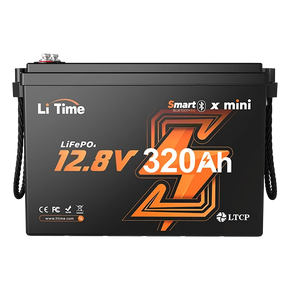
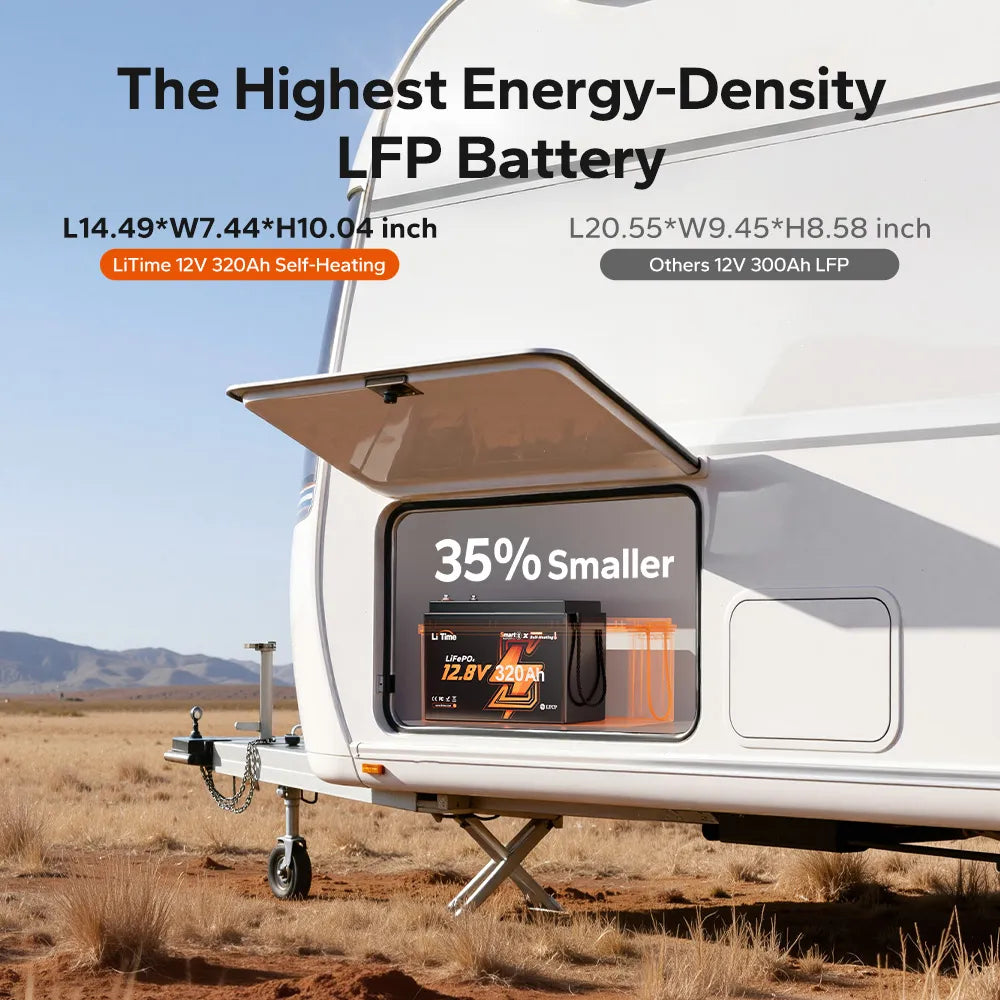
LiTime 12V 320Ah Mini Dual-Mode Self-Heating Lithium Battery
A high-capacity 12V option in a compact footprint. At 3,840 Wh usable, this single battery replaces a pair of 12V lead-acid groups and supports multi-day boondocking. The dual-mode self-heating function lets you charge safely in cold weather, and Bluetooth lets you monitor SOC, voltage, and cell balance from your phone.
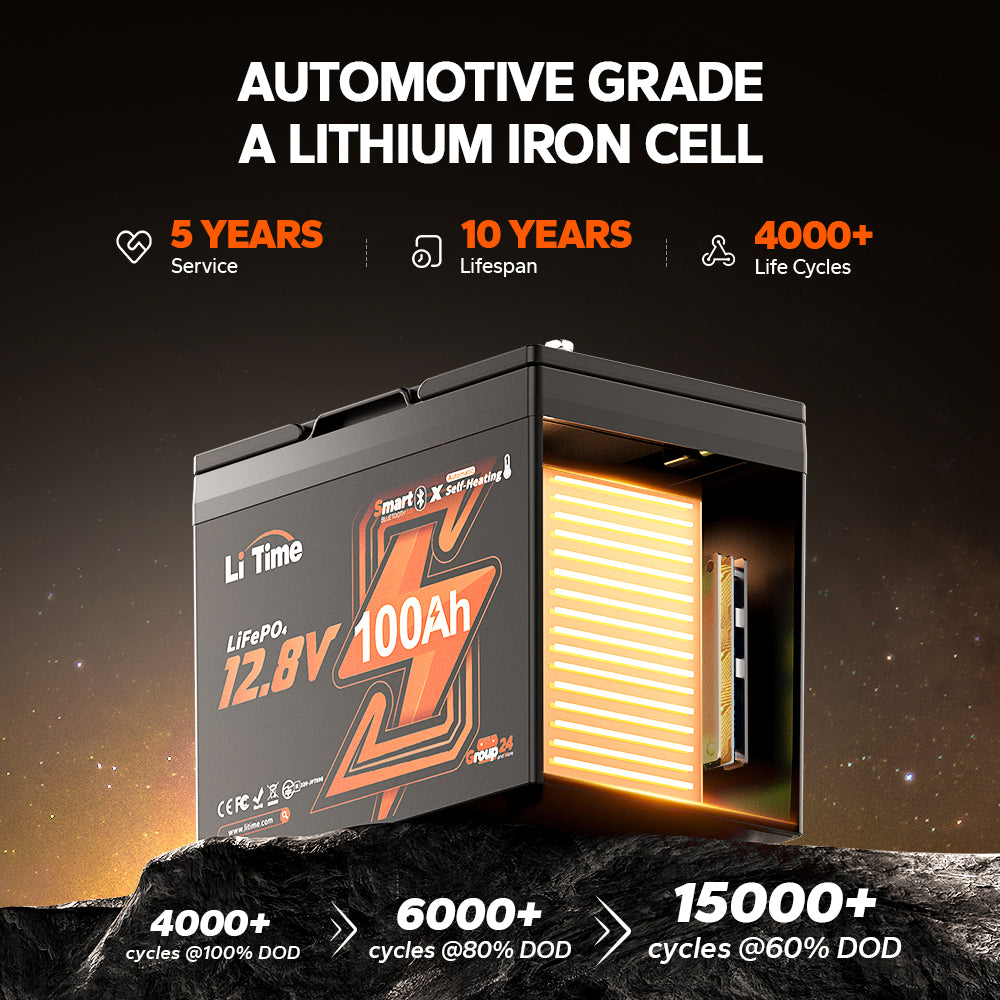
LiTime 12V 100Ah Group 24 Dual-Mode Self-Heating Lithium Battery
A drop-in Group 24 size for smaller RVs, camper vans, or where space is tight. 1,280 Wh usable, with built-in Bluetooth and self-heating. Ideal as a second battery or for Class B/C rigs with limited battery bay room.
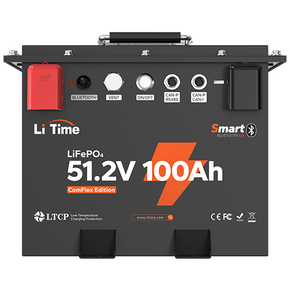
LiTime 24V 230Ah Dual-Mode Self-Heating Lithium Battery
For larger rigs, overlanders, or anyone stepping up to 24V systems. Delivers 5,520 Wh usable with the same BMS, self-heating, and Bluetooth monitoring. Pairs naturally with 24V inverters and high-power solar arrays.

How to Replace RV Batteries Rightly?
Replacement steps and wiring
- Prepare: Turn off shore power, disconnect the inverter/charger, and switch off the battery disconnect. Wear eye protection and gloves.
- Remove old battery: Disconnect the negative cable first, then the positive. Remove hold-down brackets and lift the battery out (lead-acid is heavy — use a battery strap or a helper).
- Clean and inspect: Clean tray and cable ends. Inspect cables for fraying; replace if cracked. Confirm the tray is dry and free of corrosion residue.
- Install new battery: Seat the new battery in the tray and secure hold-downs. Connect positive first, then negative. Tighten to the manufacturer's torque spec (typically 9–12 N·m for 12V terminals).
- Configure charge profile: Set your converter, DC-DC charger, or solar controller to the new chemistry (AGM, Gel, or LiFePO4). This step is often skipped and is a leading cause of early battery failure.
- Test: Turn on the disconnect, start the charger, and verify voltage rises to the correct absorption stage. With a battery monitor, confirm SOC reads correctly.
Precautions during replacement
- Never disconnect the negative while the charger or inverter is powered on — arcing can ignite hydrogen gas from lead-acid batteries.
- Do not mix old and new batteries, or different chemistries, in the same parallel bank.
- When swapping from lead-acid to LiFePO4, verify your charger/inverter supports lithium charging and that your alternator path has a DC-DC charger (a simple isolator does not properly charge lithium).
- Recycle old lead-acid batteries at an auto parts store or battery retailer — they are legally required to take them back in most regions.
FAQs
How often should you replace an RV battery?
Replace flooded lead-acid batteries every 3–5 years, AGM every 4–7 years, and LiFePO4 every 10–15 years as a baseline. In practice, replace when a capacity test shows less than 80% of rated Ah, or when runtime no longer meets your camping needs — whichever comes first.
What drains an RV battery when not in use?
Parasitic loads are the main culprit: propane/LPG detectors, CO detectors, stereo memory, inverter standby, solar controller display, and automatic door locks. Together they can pull 0.5–2 A continuously. A battery disconnect switch, or removing the negative cable during long storage, eliminates this drain.
How often should you charge an RV battery?
After every dry-camping trip, bring lead-acid batteries to 100% SOC using a proper multi-stage charger. During storage, check and recharge lead-acid every 4–6 weeks; LiFePO4 can go 3–6 months between top-ups. Avoid leaving lead-acid below 80% SOC for more than a few days.
Why is my RV battery dying overnight?
The most common causes are: running an absorption fridge on 12V, a furnace blower cycling frequently in cold weather, an inverter left on with AC loads connected, a parasitic draw from a device or light left on, or an old battery that can no longer hold capacity.
Conclusion
RV battery life comes down to four factors: chemistry, depth of discharge, charging, and storage. Flooded lead-acid batteries typically last 3–5 years, AGM 4–7 years, and LiFePO4 10–15 years — which is why most serious RV owners treat lithium as the upgrade that pays for itself.
If you are ready to upgrade, LiTime's RV LiFePO4 lithium batteries delivers 10+ year service life with built-in self-heating and Bluetooth monitoring, so your next battery can be your last for a decade or more.

