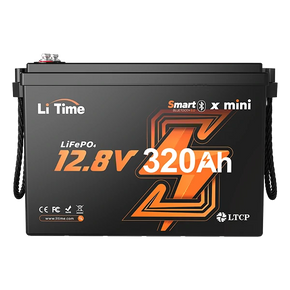


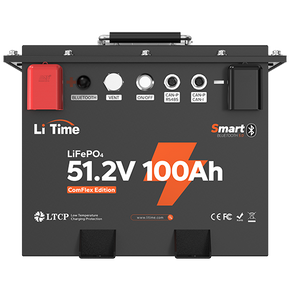

Can a fish finder share a battery with a trolling motor? Yes. Both devices must work with the same battery voltage. The battery and wiring must support their combined load. Each device also needs its own correctly protected branch. This arrangement is most practical on a simple 12V kayak or small boat. A separate electronics battery is usually better for 24V or 36V trolling-motor systems. It is also the safer choice for sensitive sonar or a setup with screen noise, voltage alarms, or unexpected restarts.
The Short Answer: When Can They Share?
Use this decision table before choosing a one-battery setup.
| Situation | Can they share? | Best approach |
|---|---|---|
| 12V motor, fish finder accepts the battery's full operating-voltage range | Usually | Separate fused branches from the same battery; test for interference |
| 12V motor, fish finder resets or shows motor-related noise | Technically possible, but not ideal | Improve wiring first; use a dedicated electronics battery if the problem remains |
| 24V or 36V motor bank, 12V fish finder | Not by direct connection | Dedicated 12V-compatible battery or correctly sized DC-DC converter |
| One 12V battery tapped from a 24V/36V series bank | No | Do not tap the midpoint; it unbalances the bank |
| High-powered or forward-facing sonar | Sometimes, if the manufacturer allows it | Dedicated electronics power is usually the more dependable design |
| Long day where motor range is critical | Possible, but less resilient | Separate batteries prevent electronics from consuming propulsion reserve |
This is not only a question of total amp-hours. Four separate checks determine whether sharing works: voltage compatibility, current capacity, voltage drop, and electromagnetic interference.

Why a Shared Battery Can Work—and Why It Sometimes Does Not
A fish finder is normally a much smaller load than a trolling motor. That makes a shared 12V battery attractive on a kayak or compact boat: it saves weight, cost, wiring space, and charging complexity. LiTime's current 12V 100Ah trolling-motor battery, for example, is specified as a 12.8V, 1,280Wh battery designed to support trolling motors and 12V onboard loads, including fish finders. Compatibility still depends on the exact motor and sonar manuals, not merely the word “12V” on both products.
The challenge is that the two devices behave very differently. A trolling motor is a high-current, rapidly changing load. A fish finder is a sensitive electronic instrument. Putting them on one battery creates four possible problems.
1. The voltages may not actually match
“12V” is a system label, not a promise that voltage remains exactly 12.0V. A charged battery operates across a range, and its voltage can change under load. Compare the battery's full charge/discharge range with the fish finder's published input range. Also confirm polarity and the manufacturer's required fuse.
A dedicated 16V fish-finder battery can be useful only when the connected electronics explicitly support that voltage. Do not assume that a 12V-only device can accept a 16V LiFePO4 battery.
2. Motor demand can cause voltage drop
When the trolling motor draws more current, resistance in undersized cable, long runs, loose terminals, corroded connectors, or a depleted battery can pull the voltage at the fish finder below its acceptable level. Symptoms include dimming, a low-voltage warning, frozen sonar, or a reboot when the propeller starts or speed increases.
Garmin's power troubleshooting guidance identifies voltage drop, inadequate wire size, and poor connections as common causes of marine-device power issues. A larger battery cannot compensate for badly sized or poorly terminated wiring.
3. The motor can introduce sonar interference
Garmin explains that trolling-motor current changes can create an electromagnetic field that distorts sonar information. The symptom may appear as lines, clutter, a changing bottom image, or noise that increases with motor speed. Interference can travel through shared power wiring, or it can be induced when transducer and sonar cables run too close to the motor's high-current cables.
Garmin and Minn Kota both recommend separate batteries as a troubleshooting or prevention measure in relevant installation guidance. That does not mean a shared battery always fails. It means separation is the most direct way to remove a shared power path when sensitive electronics are affected.
4. One battery becomes one point of failure
If a shared battery is depleted, disconnected, or its battery-management system shuts down, both propulsion and navigation electronics can go dark. Separate batteries provide redundancy and keep sonar energy use from reducing the propulsion reserve. Whether that matters depends on the water, weather, distance from shore, and what other navigation or emergency equipment is aboard.
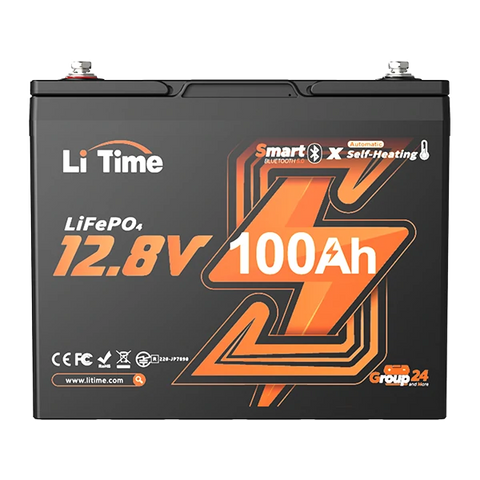
LiTime 12V 100Ah Group 24 Bluetooth Self-Heating LiFePO4 Battery
A compact Group 24 option for compatible 12V marine and onboard-electronics systems, with Bluetooth monitoring and self-heating features. Verify the exact motor, sonar, charging, and current requirements before installation.
The Most Important Rule for 24V and 36V Trolling Motors
Do not connect a 12V fish finder across a complete 24V or 36V trolling-motor bank unless the fish-finder manufacturer explicitly rates the device for that input. Overvoltage can damage the unit.
Also do not connect the fish finder to only one battery in a series-connected bank. This tempting shortcut places an extra load on one battery. Victron's battery-bank wiring guidance warns that taking a lower-voltage load from the midpoint of a series bank creates imbalance and can cause the more heavily used battery to fail prematurely.
For a 24V or 36V motor bank, use one of these designs:
- A dedicated electronics battery whose operating-voltage range matches the fish finder.
- A properly specified marine DC-DC converter connected across the full motor bank, with output voltage, continuous current, transient behavior, grounding, isolation, fusing, and marine suitability verified for the installation.
- A separate house or cranking-battery circuit only when the boat and equipment manufacturers permit it and the circuit is designed for the added electronics load.
A DC-DC converter is not automatically a cure for sonar noise. Its electrical noise performance, cable routing, grounding, and installation still matter. For complex boats, use a qualified marine electrician and follow applicable ABYC standards.
How to Wire a Shared 12V Battery
If the manuals permit a shared 12V source, connect the fish finder and trolling motor as separate loads. Do not daisy-chain the fish finder from the motor plug, motor leads, or the load side of the motor breaker.
                         ┌─ Motor breaker ── Trolling motor
Battery positive (+) ───┤
                         └─ Finder fuse ──── Fish finder

                         ┌────────────────── Trolling motor negative
Battery negative (−) ───┤
                         └────────────────── Fish finder negative
This diagram is conceptual, not a universal installation plan. The correct conductor size, breaker or fuse rating, connector type, disconnect arrangement, and overcurrent-protection location depend on the device manuals, cable length, motor current, and boat standards.

Shared-battery wiring checklist
- Verify the entire voltage range. Check the fish finder, battery, and any accessories—not just their nominal labels.
- Run separate positive and negative conductors. Each device should have its own home run to an appropriate battery connection, bus, or distribution point.
- Protect each branch independently. Use the trolling-motor breaker specified by the motor manufacturer. Use the fish-finder fuse specified by the fish-finder manufacturer. There is no universal fuse size for every sonar unit.
- Size wire for the device and the round-trip cable length. The motor circuit and electronics circuit have very different current and voltage-drop requirements.
- Keep connections tight, dry, and corrosion-resistant. A high-resistance connection may look normal until the motor draws heavily.
- Route sonar and motor wiring apart. Avoid bundling the transducer cable, fish-finder power cable, and motor conductors together.
- Cross at 90 degrees when separation is impossible. Garmin recommends this approach when a transducer or data cable must cross a power cable.
- Test before making the routing permanent. Run the motor through its speeds while watching the sonar image and supply-voltage display.
Minn Kota's current wiring guide emphasizes selecting conductor size and circuit protection from motor draw and wire length, and notes that other devices on a circuit affect the calculation. Follow the exact motor model manual rather than copying a breaker size from another boat.

LiTime 36V 100Ah Electric Outboard Motor Lithium Battery
A 36V 100Ah lithium battery for compatible electric-outboard systems. Keep 12V fish-finder power separate unless the electronics are explicitly rated for the complete 36V operating range.
How Large Should the Shared Battery Be?
Size a shared battery from energy use, not from a generic “hours of runtime” promise. The motor normally dominates consumption, but the fish finder runs continuously and must be included.
For loads on the same 12V-class system:
Estimated daily amp-hours = motor's time-weighted average amps × motor hours + fish finder's average amps × finder hours + other loads
Motor current changes dramatically with speed, wind, current, hull, propeller condition, and boat weight. Do not treat the motor's maximum current as its normal all-day average unless you are deliberately calculating a worst case.
For mixed voltages or a DC-DC converter, watt-hours are clearer:
Battery energy (Wh) = nominal voltage × rated amp-hours
Load energy (Wh) = operating watts × hours
Estimated runtime = chosen usable battery energy ÷ average combined load watts

A practical 12V example
Assume a 12.8V 100Ah LiFePO4 battery, a motor that averages 20A during the trip, and a fish finder that averages 2A.
- Nominal battery energy: 12.8V × 100Ah = 1,280Wh
- Average motor load: 12.8V × 20A = 256W
- Average fish-finder load: 12.8V × 2A = 25.6W
- Combined average load: 281.6W
- Idealized runtime: 1,280Wh ÷ 281.6W = about 4.5 hours
If the owner deliberately reserves 20% of the nominal energy rather than planning to use it all, the planning estimate becomes about 3.6 hours. This is an illustration, not a guarantee. Real runtime changes with battery temperature and condition, motor duty cycle, wiring losses, converter losses, BMS limits, and the reserve needed for a safe return.
How to Stop Trolling-Motor Interference on a Fish Finder
Start with diagnosis rather than immediately replacing the battery.
Step 1: Confirm the pattern
Observe the display with the motor off, then at several motor speeds. If noise or resets track motor operation, record the speed, steering position, and whether the propeller is in the water. A problem that occurs with the motor off may have a different source.
Step 2: Inspect power quality
Fully charge and load-test the battery as appropriate for its chemistry. Check voltage at the fish finder while the motor is operating, not only at the battery with no load. Inspect the fuse holder, terminals, plug, splices, and both positive and negative conductors for heat, looseness, corrosion, or undersized wire.
Step 3: Separate the cable routes
Move the fish-finder power and transducer cables away from motor power wiring, motor controls, chargers, and other noise sources. Garmin notes that about six inches of spacing may be adequate on some small boats, but required distance varies with current and voltage. More separation is preferable when practical. Cross unavoidable power cables at 90 degrees.
Step 4: Check transducer installation
Inspect the transducer cable for damage and verify that excess cable has not been tightly coiled beside motor wiring. Follow the sonar manufacturer's installation instructions for trolling-motor-mounted transducers and grounding or bonding provisions.
Step 5: Try manufacturer-approved suppression
A correctly placed ferrite bead or choke may reduce conducted or radiated noise, but it is not a substitute for proper wiring. Use the device manufacturer's instructions because location and cable choice affect the result.
Step 6: Test with a separate battery
Temporarily power the fish finder from a compatible, fully charged battery. If the issue disappears, the shared power path is implicated. A permanent dedicated electronics battery is often the cleanest solution. If the noise remains, investigate cable routing, transducer placement, motor grounding, or a faulty component.
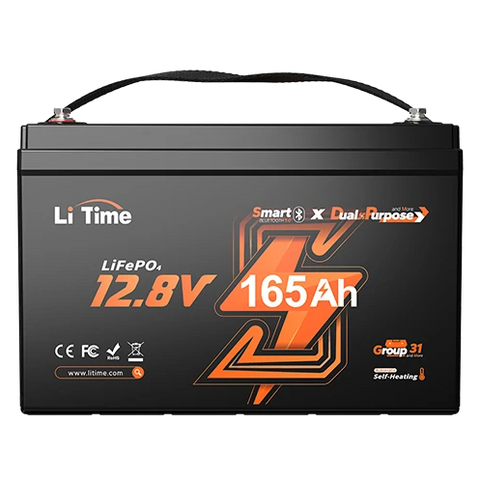
LiTime 12V 165Ah Dual-Purpose Marine Lithium Battery
A higher-capacity dual-purpose marine option for compatible boats that need onboard energy and marine starting support. Confirm the engine, electronics, charging, current, and circuit-protection requirements for the exact installation.
When a Dedicated Fish-Finder Battery Is the Better Choice
Choose separate power when any of these conditions applies:
- the trolling motor uses a 24V or 36V series bank;
- the fish finder or sonar manufacturer recommends separate power;
- forward-facing sonar, multiple displays, radar, networking, or other sensitive electronics are installed;
- the screen reboots, shows low-voltage alerts, or develops noise with the motor running;
- motor range is safety-critical and electronics should not consume its reserve;
- the boat needs redundancy if one battery or circuit fails;
- cable runs are long or the existing distribution system is difficult to correct; or
- the electronics require a voltage that differs from the trolling-motor bank.
LiTime offers dedicated fish-finder batteries and marine battery kits that separate electronics power from trolling-motor power. A 16V model should be selected only after checking every connected device's allowed input-voltage range. Higher voltage is not automatically better, and incompatible voltage can damage equipment.
For a compact 12V shared system, a trolling-motor-rated battery such as the LiTime 12V 100Ah TM Bluetooth battery can support the motor and compatible 12V electronics when the total load, BMS output limit, wiring, protection, and runtime plan all fit. Do not use it for engine starting; the current product page identifies it as a deep-cycle battery, not a starting battery.
Common Mistakes to Avoid
Assuming every “12V” device is compatible
Compare operating ranges, not labels. Charging voltage and battery chemistry affect the actual voltage seen by the fish finder.
Using one fuse for both devices
The motor and fish finder need protection appropriate to their own conductors and manufacturer requirements. One oversized motor breaker does not protect a small electronics cable.
Connecting the finder downstream of the motor circuit
This increases the chance of voltage drop and conducted noise. Give the electronics a separate protected branch.
Tapping one battery in a series bank
This unbalances the bank. Use a dedicated source or a properly engineered converter from the full bank.
Choosing battery capacity by motor thrust alone
Thrust is not electrical current. Use the motor manufacturer's maximum amp draw and realistic duty cycle, then add every other load.
Treating a ferrite choke as the first and only fix
Correct low voltage, loose connections, poor wire sizing, and bad cable routing first. Suppression components work best as part of a sound installation.
Planning to use 100% of the battery
Keep an intentional return reserve. Weather, current, cold, battery aging, and higher-than-expected motor speed can all increase energy use.
Final Verdict
A fish finder and trolling motor can share one properly sized 12V battery, especially on a small, weight-sensitive boat. The installation should use separate fused branches, correctly sized marine wiring, compatible voltage ranges, clean connections, and physical separation between sonar and motor cables.
Sharing is not the best design in every boat. Use a dedicated electronics battery for a 24V or 36V motor bank, recurring interference or reboots, sensitive sonar, or any situation where clean power and redundancy matter more than saving one battery. Never tap one battery from a series bank, and verify all voltage, fuse, and wiring requirements in the exact equipment manuals before installation.
Frequently Asked Questions
Can I run a 12V fish finder from a 12V trolling motor battery?
Usually, yes, if the battery's entire operating-voltage range is within the fish finder's allowed input range. The battery and BMS must support the combined load, and the fish finder should have its own manufacturer-specified fuse and separate wiring branch.
Will a trolling motor interfere with a fish finder?
It can. High and changing motor current can introduce conducted or radiated electromagnetic interference. Symptoms may include screen lines, clutter, distorted sonar, voltage alarms, or reboots that change with motor speed.
Can a 12V fish finder run directly from a 24V trolling motor battery bank?
No, not unless the fish finder's manual explicitly permits the bank's full voltage range. Most 12V-only electronics require a compatible dedicated battery or properly specified DC-DC converter.
Can I connect the fish finder to one battery in a 24V or 36V series bank?
No. Drawing from only one battery creates unequal discharge and bank imbalance, which can shorten battery life. Power the electronics separately or convert power from the entire bank.
Does a fish finder need its own fuse?
Yes. Use the fuse type and rating specified by the fish-finder manufacturer, installed as directed. The trolling motor's breaker is not a substitute for protecting the smaller fish-finder conductors.
Can a lithium trolling motor battery power a fish finder?
Yes, when voltage compatibility, BMS capacity, wiring, and protection are correct. Confirm that the fish finder accepts the lithium battery's actual operating range rather than relying only on the nominal-voltage label.
How much battery does a fish finder use?
Multiply the unit's average current by operating hours to estimate amp-hours on the same-voltage system. Use the actual model specification and include black boxes, live-sonar modules, networking, and other accessories—not only the display.
Why does my fish finder restart when I turn up the trolling motor?
The most likely causes are voltage drop, a weak or depleted battery, undersized or long wiring, a loose or corroded connection, or interference on the shared circuit. Measure voltage at the fish finder under motor load and inspect the complete circuit.
Will a separate battery always eliminate sonar interference?
No. It removes one common conducted-noise path, but interference can still enter through cable routing, transducer mounting, grounding, nearby chargers, or faulty equipment. Test before and after separation to isolate the source.
Should I use a 16V battery for my fish finder?
Only if every connected device is explicitly rated for the battery's full voltage range. Some advanced marine electronics support 16V systems, while others do not. Confirm compatibility in the current manufacturer manual before connection.
Is a DC-DC converter better than a separate battery?
It depends on the boat. A converter can reduce battery count, but it must be correctly rated, protected, wired, and suitable for the marine environment. A separate electronics battery often provides simpler fault isolation and redundancy.
How do I decide between one shared battery and two batteries?
Choose one battery when the system is a simple compatible 12V installation, weight and space matter, and testing shows stable, clean power. Choose two when voltage differs, sonar is sensitive, the motor is 24V/36V, range is critical, or you want redundancy.
Sources
- Garmin: What Causes Sonar Interference and How to Prevent It
- Garmin: Basics of Marine Transducer Installation
- Garmin: Improving LiveScope Image Quality—Power Considerations
- Minn Kota: Trolling Motor Wiring and Battery Guide
- Minn Kota: Trolling Motor Wiring Diagrams
- Victron Energy: Battery Bank Wiring
- U.S. Coast Guard: Recreational Boat Electrical Compliance Guidelines
- eCFR: 33 CFR Part 183 Subpart I—Electrical Systems
- ABYC: Standards List
- LiTime: 12V 100Ah Trolling Motor Battery with Bluetooth
- LiTime: Fish Finder Batteries

