


When your rig runs on sunshine instead of a hookup, the battery bank decides how good the trip feels. Panels are only collectors; the battery is the bank account that keeps your fridge, lights, water pump, and Starlink alive after dark.
Choosing the right RV solar battery is therefore less about shopping and more about designing a power system that behaves well every day of the season. Below is what you need to know before buying batteries for RV solar panels, and which of today's best RV batteries for solar fits your build.
What Is an RV Solar Battery?
An RV solar battery is a deep-cycle energy storage unit wired to your solar array and charge controller. It stores the DC electricity your panels produce during the day and releases it steadily overnight or through cloudy stretches, so your coach keeps running without a generator.

The key distinction is duty. An RV starting battery is built for a burst of current — a few seconds of cranking amps to turn over the engine — and is then immediately recharged by the alternator. It is designed to sit at a high state of charge and delivers a shallow discharge at most. An RV solar battery does the opposite: it is expected to discharge slowly and deeply, then recharge from a variable source that may deliver very little on a gray day. Deep-cycle chemistry, thicker plates or LiFePO4 cells, and a battery management system are what make that repeated cycling survivable.
This is why you should never substitute one for the other. A starting battery used as house storage will sulfate and die early; a deep-cycle solar battery used as a cranking battery can trip its BMS or damage its cells. Keep the two circuits separate.
What Is the Best Type of RV Solar Battery?
Four chemistries dominate the market, and they behave very differently over a decade of travel.
Flooded lead-acid is the cheapest upfront option and tolerates overcharging well, but it needs watering, vents hydrogen, must stay upright, and only gives you about 50% of its rated capacity before sulfation accelerates.
AGM is sealed, maintenance-free, and more vibration-resistant, which suits rough roads. It still only offers roughly 50–60% usable depth of discharge, is heavy for the energy it holds, and gradually loses capacity if it is left partially charged.
Gel batteries resist deep discharge a little better and tolerate heat, but they are charge-rate limited and intolerant of the wrong charging voltage — a poor match for high-output solar arrays.
Lithium (LiFePO4) is the standout choice for solar RV living, and here the case is straightforward rather than promotional. LiFePO4 delivers roughly 90–100% of its rated capacity as usable energy, which means a 100Ah lithium pack does the work of two 100Ah lead-acid batteries at half the weight.
It charges faster, holds efficiency above 90%, self-discharges only 2–3% a month, and lasts thousands of cycles instead of hundreds. A lithium RV solar battery also integrates cleanly with modern electronics — Bluetooth monitoring, low-temperature protection, and CAN or RS485 communication with inverters.
The trade-offs are honest ones: higher purchase price, a BMS that must be respected, and no charging below freezing without heating capability. Over a ten-year horizon, however, the cost per usable kilowatt-hour is lower than lead-acid, and the practical benefits — quieter nights, no generator at 2 a.m., less weight on the axle — are what actually change the experience. For off-grid RV living, RV lithium battery is the best type.
View More: AGM vs. Lithium Batteries: Which is Better for RV?
Is It Worth Adding RV Solar Batteries?
The real question is not "solar or no solar" but "how much of my daily consumption can I shift onto stored sunshine." A working solar-plus-storage system reduces generator hours, cuts fuel and campground fees, keeps the fridge and furnace running through a power outage, and lets you stay in places with no pedestal at all. It also removes the single most annoying RV habit: rationing power after dark because the house battery is at 60%.
For full-time and boondocking life, the payoff is even clearer. Solar plus a properly sized lithium bank supports remote work, medical devices, and extended stays without moving the rig. For weekend campers, the value is mostly comfort and quiet — no generator drone, no idling engine to charge.
View More: Are Lithium Batteries for RV Worth It?
How to Choose the Right RV Solar Battery?
House Voltage and System Architecture
Most travel trailers, camper vans, and Class C motorhomes run a 12V house system, which is where 12.8V nominal lithium batteries drop in most easily. Larger Class A coaches and serious off-grid builds often use 24V to halve current and shrink cable size.
Full-time rigs with big inverters, mini-split air conditioning, or induction cooking increasingly move to 48V, which keeps wire gauges manageable at high power. Buy batteries that match your bus voltage, or ones rated for series expansion if you plan to step up later.
Capacity Sized to Your Off-Grid Reality
Capacity should follow consumption, not the other way around. Estimate daily use in watt-hours — fridge (300–600Wh), lights and fans (100–200Wh), water pump (50Wh), laptop and router (150–300Wh), plus inverter losses of about 10%.
Divide that by 12.8V to get amp-hours, then add one to two days of autonomy for cloudy weather and a 20–30% margin. Because lithium gives you roughly 90% usable capacity, a 200Ah bank realistically supplies about 2.3kWh per day; a lead-acid bank of the same rating supplies half that.
View More: RV Battery Size Chart Guide
Battery Chemistry
Choose lithium. If budget forces lead-acid today, size the bank at double the usable capacity you actually need, and plan the switch.
System Compatibility
Modern coaches increasingly carry Victron, Renogy, Go Power, Xantrex, or AIMS equipment, and smart batteries now speak to those systems over CAN or RS485. If you run a Victron ecosystem, buy a battery with native communication rather than a standalone unit that leaves the inverter blind to state of charge and temperature.
Solar Array Output
Battery capacity should be matched to how much your panels can actually replenish. A 400W array realistically produces 1.2–1.8kWh per sunny day, which supports roughly a 100–200Ah lithium bank; oversized storage on a small array just means chronically full cells and wasted panel output.
Low-Temperature Protection
LiFePO4 batteries generally require temperature-controlled charging. Many models disable charging below 32°F (0°C), while the exact cutoff and recovery temperatures vary by manufacturer and battery model.This is non-negotiable for anyone traveling in shoulder seasons.
Self-Heating
For winter use, a self-heating battery warms its own cells before accepting charge, which removes the need to pull the pack out and bring it indoors.
Series and Parallel Expansion
If you plan to expand your RV battery bank, check the manufacturer's approved series and parallel connection limits. So you can grow from 12V to 24V or 48V and add parallel capacity later without replacing everything.
Weight and Footprint
Lithium already saves weight; compact form factors matter more in vans and truck campers, where the battery bay is a fixed box.
Warranty and Support
Five years and a real service channel is the current baseline for quality lithium. Check certifications — UN38.3, CE, RoHS, FCC — and whether the brand publishes usable technical documentation.
The Best Lithium RV Solar Battery
| Product | Voltage | Energy | Type | Weight | Dimensions (in) | Bluetooth | Low-Temp Protection | Self-Heating | Victron Compatible |
|---|---|---|---|---|---|---|---|---|---|
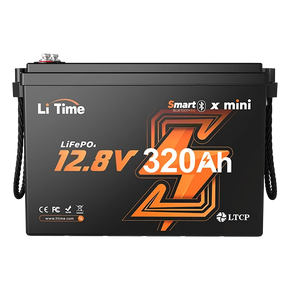
| 12V 320Ah Mini Self-Heating | 12.8V | 4096Wh | LiFePO4 | 57.3 lb | 14.49 × 7.44 × 10.04 | Yes | Yes | Yes | — |
| 12V 100Ah Ultra-Slim | 12.8V | 1280Wh | LiFePO4 | 33.51 lb | 19.69 × 11.02 × 2.44 | Yes | Yes | Yes | — |
| 12V 100Ah Xtra-Mini Smart | 12.8V | 1280Wh | LiFePO4 | 19.13 lb | 9.02 × 5.43 × 8.19 | Yes | Yes | — | — |
| 12V 165Ah Group31 Self-Heating | 12.8V | 2112Wh | LiFePO4 | 33.49 lb | 13 × 6.77 × 8.5 | Yes | Yes | Yes | — |
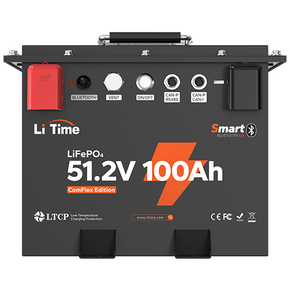
| 12V 100Ah Smart ComFlex | 12.8V | 1280Wh | LiFePO4 | 21.6 lb | 13 × 6.77 × 8.5 | Yes | Yes | — | Yes |
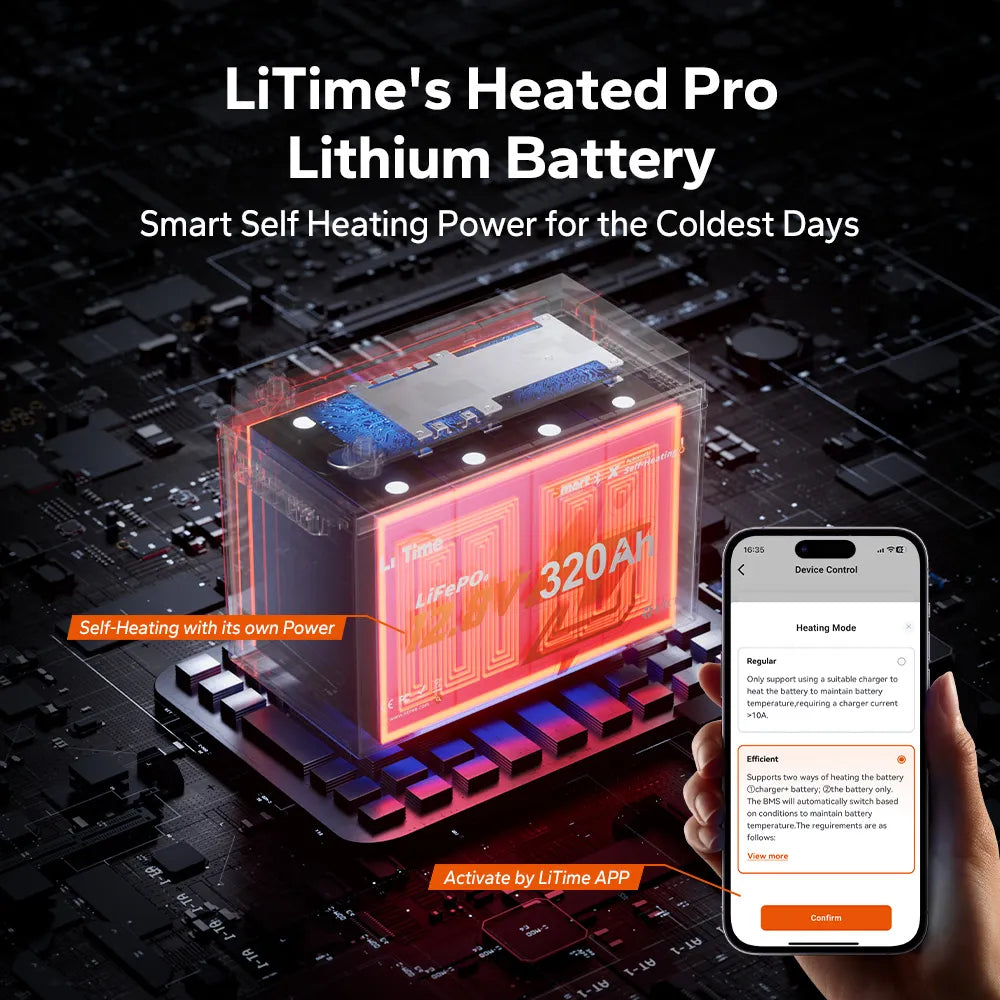
LiTime 12V 320Ah Mini Self-Heating
A 4096Wh pack in a body 35% smaller than a typical 12V 300Ah unit — the anchor battery for a full-time off-grid build.
- 2560W continuous output from a 200A BMS, 1000A peak for one second
- Dual-mode self-heating with charging enabled down to −4°F
- Bluetooth 5.0 monitoring with password-protected control
- 4P4S expansion to 65.5kWh; IP65 housing
- 4,000–15,000 cycles and a 5-year warranty
LiTime 12V 100Ah Ultra-Slim
Only 2.44 inches thick — made for battery bays, under-seat lockers, and van builds where nothing else fits.
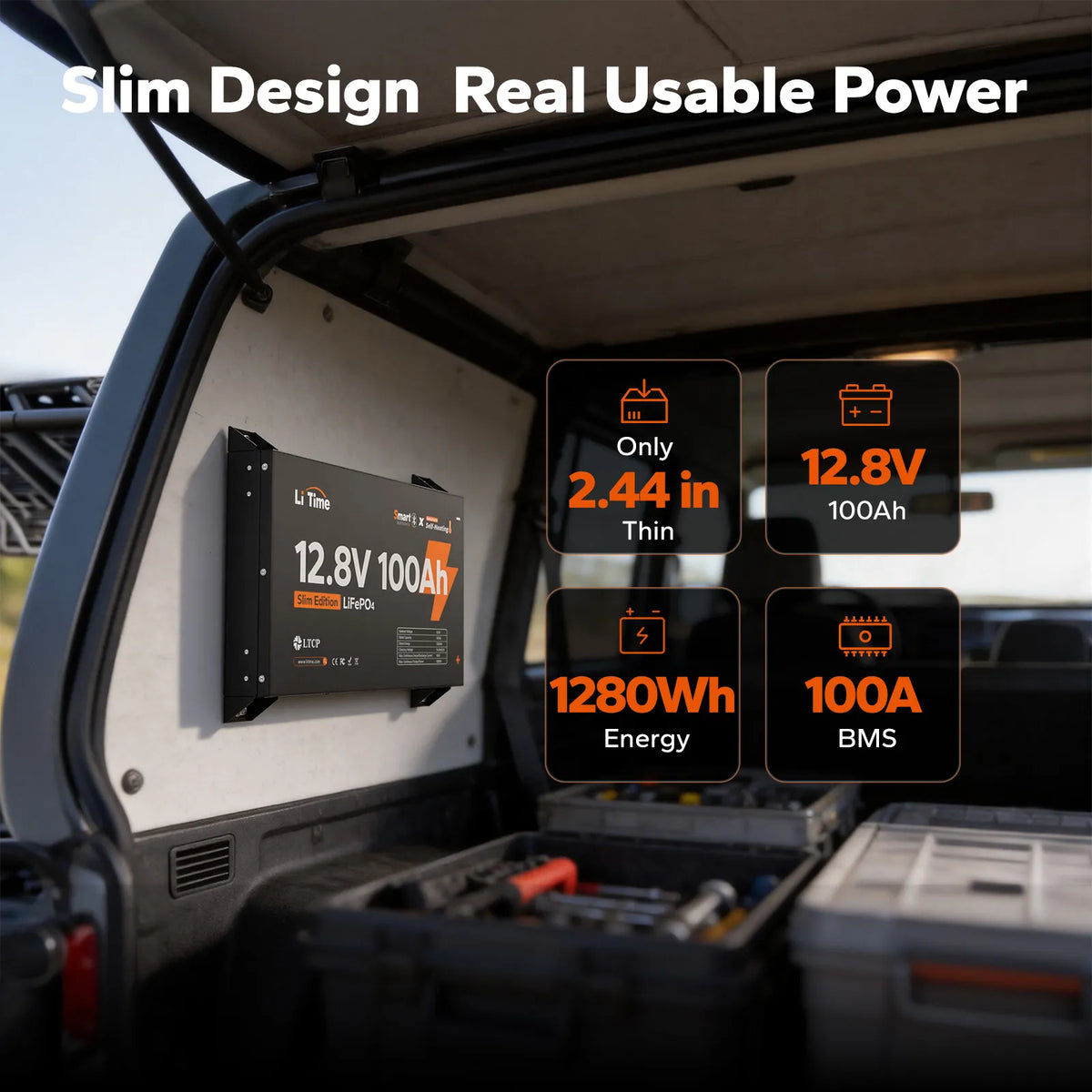
- 1280Wh in a 33.51 lb steel-plate case, 64% thinner than Group 31 lead-acid
- Built-in dual-mode heating plus low-temp charge cut-off
- Bluetooth 5.0 state-of-charge and temperature monitoring
- Charges from solar MPPT, DC-DC alternator, shore charger, or generator
- 4P4S expansion for 12V through 48V systems
LiTime 12V 100Ah Xtra-Mini Smart
The smallest 100Ah option here at 19.13 lb and Group 22NF footprint — ideal for compact campers and truck caps.

- 194.7Wh/L energy density from an in-house smart BMS
- 20+ protections including low-temperature charging cut-off and 30-second overload recovery
- Bluetooth 5.0 real-time SOC, voltage, and current tracking
- 1280W continuous output, 500A one-second peak
- 4P4S expandable, IP65 rated
LiTime 12V 165Ah Group31 Self-Heating
A drop-in Group 31 footprint carrying 1.65× the energy of a standard 100Ah battery — the practical middle ground.
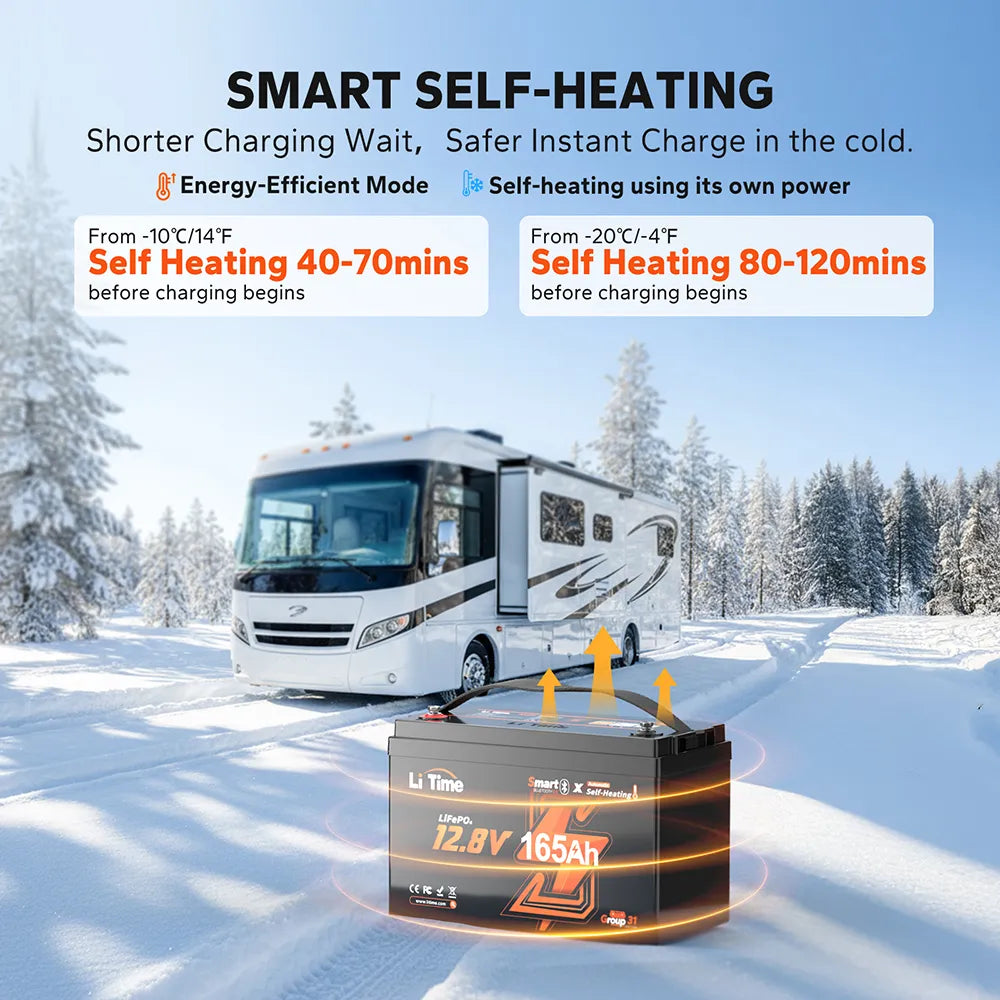
- 2112Wh and 2112W continuous output from a 165A BMS
- LiHeat dual-mode heating: external-charger mode or self-powered preheat
- Bluetooth with password control; low-temp cut-off and salt-spray resistance
- 4P4S expansion to 33.79kWh; IP65 housing
- 4,000+ cycles, 5-year warranty, UN38.3 certified
LiTime 12V 100Ah Smart ComFlex
Built for integrated systems: native Victron compatibility via RS485/CAN, with OTA protocol updates for Xantrex, AIMS, and Go Power.
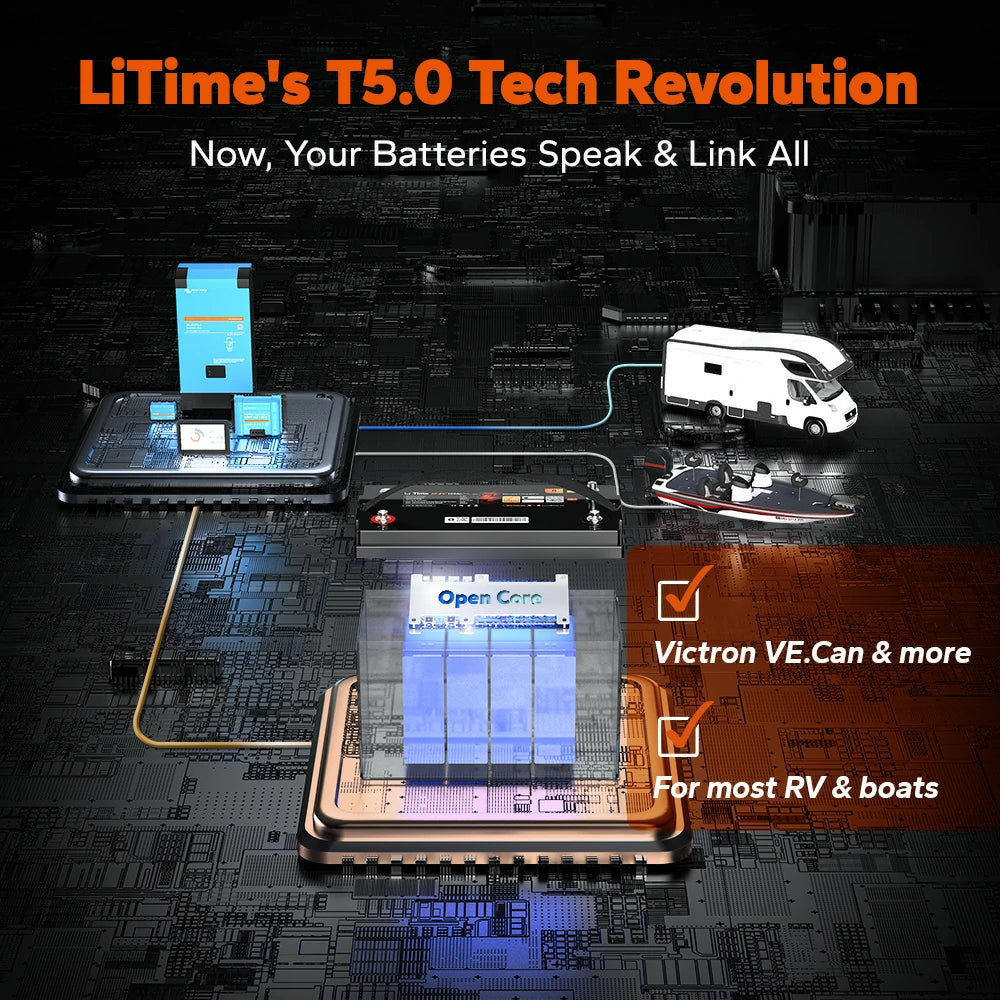
- Plug-and-play communication so the whole system sees battery status
- Predictive fault alerts that command inverters and chargers to cut current in milliseconds
- 1280Wh, 100A BMS, 21.6 lb in a Group 31 case
- Four charging paths: AC charger, solar MPPT, DC-DC alternator, generator
- IP65, 4P4S expansion, 5-year warranty
How to Upgrade an RV Solar Battery for a Solar System
Tools You'll Need
Insulated wrench and socket set, multimeter, torque wrench, cable lugs and crimper, heat shrink, DC-rated fuse or breaker, battery terminal protectors, gloves and eye protection, and a strap or lifting handle for the old pack.
Step-by-Step Replacement
- Shut down the solar array at the combiner or breaker, then disconnect shore power and the inverter.
- Photograph the existing wiring before touching anything.
- Disconnect negative, then positive, then the temperature sensor or communication cable.
- Remove the old battery and clean the tray.
- Install the battery securely in a clean, dry location with adequate clearance and environmental protection.
- Reconnect positive first, negative last, then torque terminals to spec.
- Reset the charge controller and inverter to LiFePO4 profiles.
- Reconnect solar and verify charging current, then confirm the BMS reads correctly in the app.
View More: Convert RV to Lithium Battery — The Ultimate LiTime Guide for RV Owners
For a visual walkthrough of the process, this replacement video is a useful reference:
How to Fix an RV Solar Battery That Isn't Charging
Start with the array: shade, dirt, snow, or a partially covered panel can collapse output, and a single failed MC4 connection breaks the string. Next check the charge controller — a lead-acid profile on a lithium bank will stop charging early, and a controller in float will show no current. Then inspect the DC side for a blown fuse, tripped breaker, or loose terminal.
If everything upstream is healthy, look at the battery: low-temperature protection may be blocking charge below 32°F, or the BMS may be in a protection state after an overload or deep discharge. A full disconnect-and-reconnect reset, followed by a proper LiFePO4 charger, usually resolves a latched BMS. Finally, verify voltage drop across long, undersized runs — a battery may be charging slowly rather than not at all.
FAQs About RV Solar Battery
Do batteries stop charging when solar gets full?
Yes. When the battery reaches its target charging voltage, the solar charge controller gradually reduces charging current according to its LiFePO4 charging profile. The BMS provides additional protection by disconnecting charging if the cells reach unsafe voltage or temperature limits.
Can I charge my RV solar battery from the grid overnight?
Yes. A shore-power connection through a LiFePO4-compatible converter or charger will recharge the bank overnight. Use a charger with the correct 14.4–14.6V profile rather than an old lead-acid converter, which may undercharge or hold the wrong float voltage. This is a practical strategy for cloudy trips: solar by day, pedestal by night.
Can a camper battery solar charge while being used?
Yes. An RV solar system can power connected DC loads while charging the battery at the same time. Solar energy supplies the system bus, while the battery stores excess energy or provides additional power when solar production cannot meet demand.