


The best lithium battery for an RV solar system is usually a LiFePO4 deep-cycle battery sized around your daily power use, inverter load, available solar input, and camping style. For many RVers, a 12V 100Ah lithium battery is the starting point; serious off-grid travelers often build a larger 200Ah to 600Ah bank for more usable energy, faster charging, and better performance than traditional lead-acid options.
- What is RV solar system? RV Solar Benefits
- Do I need lithium batteries for RV solar? Lithium VS Lead-acid
- How to choose the best rv solar lithium battery?
- Best Lithium Battery for RV Solar System Hot
- How capacity lithium battary do I need for RV solar system?
- How group size lithium battary do I need for solar RV setup?
- How to setup lithium batteries for RV solar?
What is RV solar system? RV Solar Benefits
An RV solar system uses roof-mounted or portable solar panels to collect sunlight, a charge controller to regulate power, and a battery bank to store energy for lights, fans, refrigerators, water pumps, outlets through an inverter, and other camping essentials. The battery is the heart of the system because solar panels only make power when conditions allow, while the battery keeps your RV running after sunset, in shade, or during cloudy weather.
The biggest benefit is independence. A good solar setup lets you camp longer without plugging into shore power or running a generator as often. It can also make everyday travel easier because your house battery stays topped up while you drive, park, cook, work, and sleep.
Key RV solar benefits include:
- More boondocking freedom: Stay at dry campsites, public lands, or quiet locations without relying on hookups.
- Lower generator use: Solar can reduce noise, fuel use, and maintenance.
- Better battery health: A properly configured solar controller charges batteries in controlled stages.
- Power where you need it: Run 12V loads directly and use an inverter for selected AC devices.
- Scalable design: Start with one battery and a modest panel array, then expand as your needs grow.

Do I need lithium batteries for RV solar? Lithium VS Lead-acid
You do not strictly need lithium batteries for RV solar, but lithium is often the better choice when you want more usable capacity, lighter weight, faster charging, and less routine maintenance. Lead-acid batteries can work for small weekend systems, yet they are heavier and generally should not be deeply discharged as often as LiFePO4 batteries.
For RV solar, lithium usually means lithium iron phosphate, or LiFePO4. This chemistry is popular in RV and marine applications because it is designed for deep-cycle use and commonly includes a battery management system, often called a BMS, to help protect against unsafe voltage, temperature, and current conditions.
Here is the practical difference:
| Feature | LiFePO4 lithium | Lead-acid |
|---|---|---|
| Usable capacity | Higher usable energy from the same Ah rating | Lower practical usable capacity |
| Weight | Usually much lighter | Usually heavier |
| Charging | Can accept higher charge rates when configured correctly | Slower and more voltage-sensitive |
| Maintenance | Typically low maintenance | Flooded types may need watering and ventilation |
| Cold charging | Needs low-temperature protection | More tolerant of cold charging |
| Upfront cost | Higher | Lower |
If you camp with only lights, a fan, and phone charging, lead-acid may be enough. If you run a 12V fridge, laptop, Starlink-style internet, CPAP, induction cooking, or an inverter, lithium batteries for RV solar are usually easier to live with.
How to choose the best rv solar lithium battery?
To choose the best rv solar lithium battery, match the battery to your real loads, charging sources, installation space, and safety requirements—not just the biggest amp-hour number on the label. A battery that fits your compartment, communicates clearly, protects itself in cold weather, and supports your inverter will outperform a larger battery that is poorly matched to the system.
Start with battery chemistry and voltage
For most RV owners, LiFePO4 is the preferred lithium chemistry. A 12V battery bank is common because many RVs already use 12V DC systems. Larger or high-power builds may use 24V or 48V architecture, but that usually requires more planning, compatible chargers, and often a more custom installation.
If your RV already has 12V lights, pumps, fans, and appliances, a 12V LiFePO4 battery is the simplest upgrade path. If you are designing from scratch and plan to run large inverter loads, talk with a qualified installer before moving to higher voltage.
Check the BMS and low-temperature protection
A quality battery management system is essential. Look for protection against overcharge, over-discharge, overcurrent, short circuit, and temperature extremes. If you camp in freezing conditions, choose a battery with low-temperature charge cutoff or internal heating.
This matters because LiFePO4 batteries should not be charged below the manufacturer’s specified temperature range. A solar controller may keep sending power on a cold morning, so the battery’s BMS or a properly configured charge system needs to prevent damaging cold charging.
Match continuous discharge to your inverter
Amp-hours tell you storage capacity, but discharge rating tells you how much power the battery can safely deliver at once. A 2,000W inverter on a 12V system can pull very high current, especially under surge loads. One small battery may not support that demand, even if it has enough total capacity on paper.
Before buying, compare:
- Battery continuous discharge current
- Battery surge current rating
- Inverter wattage and surge requirement
- Cable size, fuse size, and busbar rating
- Number of batteries allowed in parallel
Look for monitoring and service support
Bluetooth monitoring is not required, but it is useful. It helps you see state of charge, voltage, charge current, discharge current, and alerts without guessing. LiTime 12V 100Ah smart LiFePO4 documentation, for example, lists a 12.8V nominal voltage and 100Ah rated capacity, which are common baseline specs shoppers compare when evaluating the best battery for rv solar.
Support also matters. Choose batteries with accessible manuals, clear charge settings, and warranty terms you can understand before purchase.
Best Lithium Battery for RV Solar System
The best Lithium Battery for RV Solar System use is not one single model for every camper. The best battery for solar rv depends on whether you are a weekend traveler, full-time RVer, van builder, or heavy inverter user.
Best overall choice: LiTime 12V 100Ah LiFePO4 battery
A 12V 100Ah LiFePO4 battery is the most flexible starting point. It is large enough for basic off-grid camping but small enough to fit many RV compartments. You can often install two or more in parallel if the manufacturer allows it, giving you a modular path to a larger system.
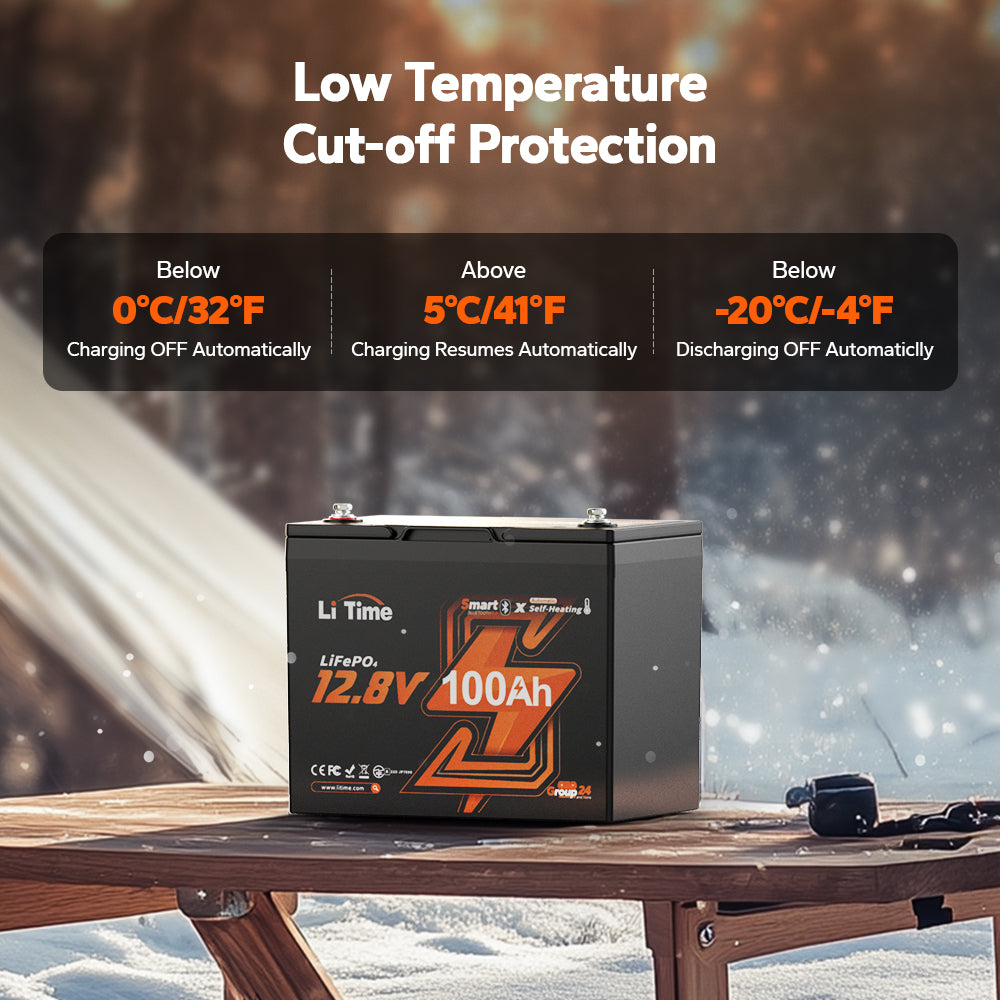
This is often the best rv solar battery for travelers who want to replace lead-acid batteries without redesigning the entire RV electrical system. Look for a built-in BMS, low-temperature charge protection, clear charge parameters, and enough discharge current for your inverter.
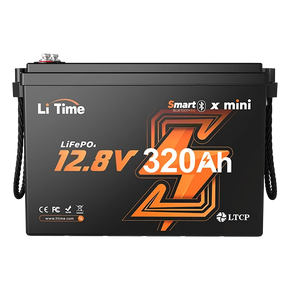
Best for long boondocking: LiTime 320Ah LiFePO4 battery
If you dry camp for multiple days, a 320Ah battery can be more convenient than several smaller batteries. It reduces wiring complexity and gives you more overnight reserve. This range is a strong fit for 12V refrigerators, fans, lights, water pumps, laptops, and moderate inverter use.
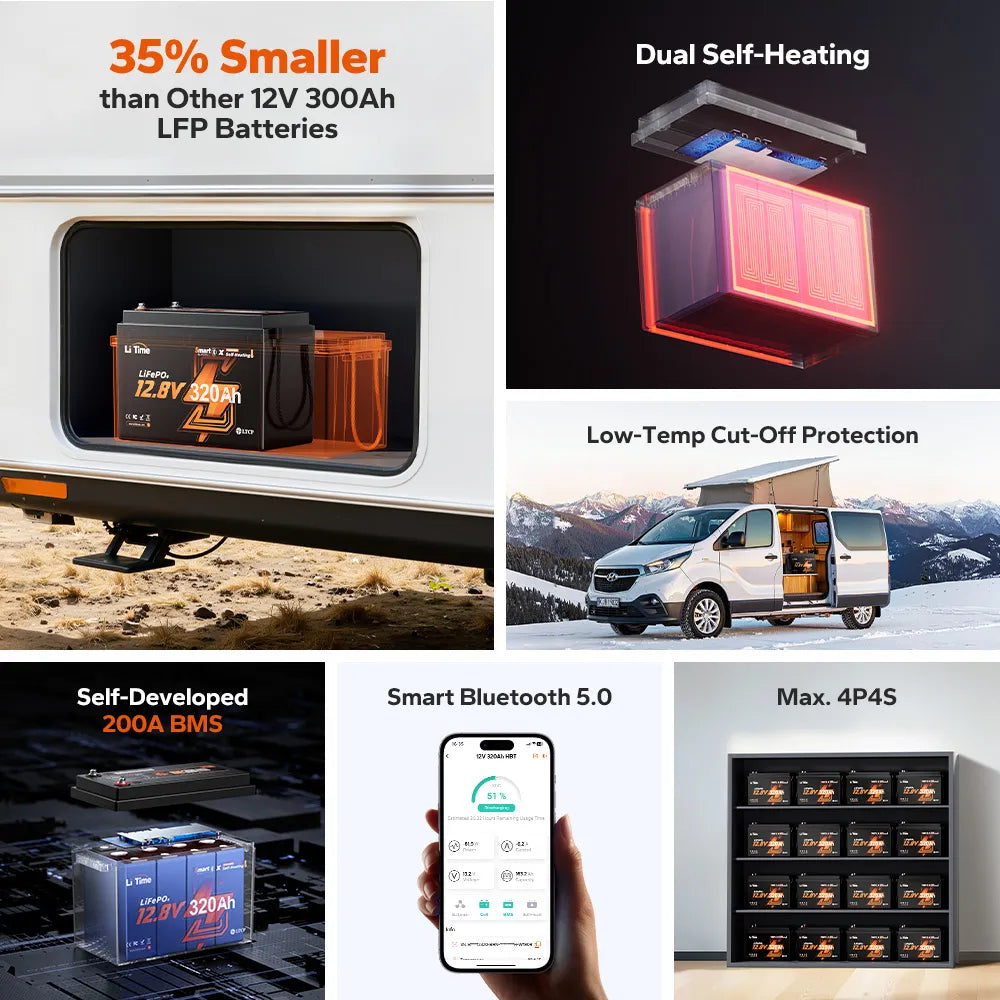
A larger single battery is not always better, though. Multiple smaller batteries can offer redundancy: if one battery fails or disconnects, the others may still provide power. Always follow the manufacturer’s parallel wiring limits.
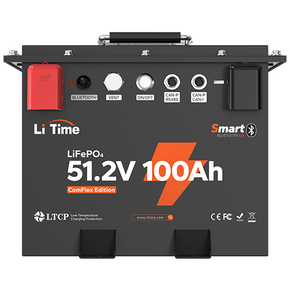
Best for premium integrated systems: LiTime ComFlex batteries
Some RVers prefer an integrated power ecosystem where the battery, inverter/charger, solar controller, shunt, and monitoring tools are designed to work together. LiTime Lithium Battery ComFlex series includes 12V, 24V and 48V LiFePO4 options.
This route can be excellent for complex RV builds, but it is not always the simplest drop-in replacement. It suits owners who value system-level monitoring and are comfortable designing the full electrical package.
Best practical buying checklist
Before choosing the best batteries for solar rv use, confirm:
- Capacity: Enough amp-hours for your daily energy use.
- Discharge rating: Enough current for inverter loads.
- Charging compatibility: Solar controller, converter, alternator charger, and inverter/charger support lithium settings.
- Temperature protection: Especially for cold-weather camping.
- Fit: Battery dimensions, terminal orientation, and compartment ventilation.
- Expansion: Manufacturer allows the series or parallel setup you want.
- Documentation: Clear manual, wiring guidance, and support.
How capacity lithium battary do I need for RV solar system?
The capacity you need depends on how many watt-hours you use per day and how many days of reserve you want. A simple formula is: daily watt-hours ÷ battery voltage = amp-hours needed, then add extra capacity for cloudy weather, inverter losses, and battery reserve.
For example, if your RV uses about 1,200Wh per day on a 12V system, the basic math is 1,200 ÷ 12 = 100Ah. In real life, you would likely want more than 100Ah because inverters waste some energy, solar production changes, and you may not want to drain the battery to the limit every night.
Use this quick sizing guide:
- 100Ah lithium: Weekend camping, lights, fan, phone charging, small water pump, occasional laptop.
- 200Ah lithium: 12V fridge, device charging, lights, fans, modest inverter use.
- 300Ah to 400Ah lithium: Longer boondocking, work-from-RV setups, CPAP, more cooking or entertainment loads.
- 500Ah+ lithium: Full-time off-grid style use, larger inverter loads, or multiple cloudy-day reserves.
Solar panel size matters too. A big battery bank with too little solar may never fully recharge during normal travel. A balanced system pairs the best battery for rv solar system use with enough solar wattage and charging sources to refill it consistently.
How group size lithium battary do I need for solar RV setup?
RV battery group size refers to the physical case size, not the energy capacity by itself. In RVs, common replacement spaces may fit Group 24, Group 27, Group 31, GC2, or custom lithium case sizes, but you must measure your compartment instead of relying only on the group label.
Lithium batteries can pack more usable energy into a smaller and lighter case than many lead-acid batteries, but terminals, handles, hold-downs, and cable bend radius still matter. A battery that technically fits may be difficult to wire safely if the terminals are crowded against a wall or lid.
Measure these before ordering:
- Compartment length, width, and height
- Door or hatch opening size
- Terminal clearance above the battery
- Cable routing space
- Hold-down or strap locations
- Distance to busbars, fuses, and disconnects
If you are upgrading from lead-acid, do not assume the best battery for rv solar will be the exact same group size. The best fit is the one that installs securely, leaves room for safe wiring, and delivers the capacity you need.
How to setup lithium batteries for RV solar?
To set up lithium batteries for RV solar, plan the full charging path before connecting anything. The battery, solar charge controller, converter/charger, inverter/charger, alternator charger, fuses, disconnects, and wire sizes all need to work together.
A typical setup follows this flow:
Step 1: Calculate loads first. List every device, its wattage, and expected daily runtime.
Step 2: Choose battery capacity. Size the bank for daily use plus reserve.
Step 3: Select solar panels. Match panel wattage to roof space and recharge goals.
Step 4: Use an MPPT solar charge controller. Set it to the battery manufacturer’s lithium charge profile.
Step 5: Upgrade charging equipment if needed. Many older RV converters are designed for lead-acid batteries and may not fully charge lithium.
Step 6: Add proper protection. Use correctly sized fuses, breakers, disconnects, and cables.
Step 7: Install a battery monitor. A shunt-based monitor gives more reliable state-of-charge information than voltage alone.
Step 8: Test gradually. Start with small loads, verify charging, then test inverter loads.
If your RV charges from the alternator, consider a DC-DC charger. Lithium batteries can accept higher current than lead-acid batteries, and a DC-DC charger helps control alternator charging while providing the correct lithium profile.
FAQs about RV solar lithium battery
Do batteries stop charging when solar gets full?
Yes, a properly configured solar charge controller stops or greatly reduces charging when the battery reaches its target voltage and charge stage. The controller does not simply keep forcing full power into the battery. With lithium, the controller should be set to the manufacturer’s recommended charge voltage, and the battery’s BMS provides an additional layer of protection.
Can Solar panel charge lithium battery while RV is driving?
Yes, solar panels can charge a lithium battery while the RV is driving as long as the panels, charge controller, wiring, and battery are connected correctly. Driving does not stop the panels from producing power. If you also charge from the alternator, use compatible equipment so solar charging and alternator charging work safely together.
Can I mix lithium and lead-acid batteries for RV solar?
It is generally not recommended to mix lithium and lead-acid batteries in the same rv house battery bank. They charge and discharge differently, which can cause poor performance and uneven battery behavior. If you want lithium performance, design the house bank around lithium from the start.
Conclusion
The best lithium battery for an RV solar system is the one that fits your camping style, power demand, charging equipment, and installation space. A 12V 100Ah LiFePO4 battery is a strong starting point for many RVers, while 200Ah to 600Ah systems better support extended boondocking and larger inverter loads. LiTime RV batteries perfectly fit all you need.
Before you buy, calculate your daily energy use, confirm your charger settings, check cold-weather protection, and make sure the battery’s discharge rating matches your inverter. With the right planning, lithium batteries for rv solar can make your RV quieter, more independent, and easier to enjoy off-grid.

