


A refrigerator is one of the few appliances that truly needs to keep running when the grid goes down. The right backup power for fridge use protects groceries, frozen food, medication, and daily routines without forcing you to rely on noisy outdoor equipment. LiTime Lares K1 is designed specifically as refrigerator backup power, giving homeowners an indoor, plug-in way to keep cold storage powered during outages.
- Why Does a Refrigerator Need Backup Power?
- What Is the Best Backup Power for a Refrigerator?
- How Much Power Does a Refrigerator Need to Keep Running?
- Refrigerator Backup Power: LiTime Lares K1
- How Long Can Backup Power Run a Refrigerator?
- What Size Battery Do You Need to Power a Refrigerator?
- FAQs About Refrigerator Backup Power
Why Does a Refrigerator Need Backup Power?
A refrigerator needs backup power because food safety depends on stable cooling, and outages can become expensive quickly. When power stops, the fridge is no longer actively removing heat; every door opening, warm room, and long outage shortens the safe window. A power backup use helps bridge that gap by keeping the compressor cycling as needed to keep the food stays cold during outages.
Food safety guidance is clear: an unopened refrigerator typically keeps food cold for about 4 hours, while a full freezer may hold temperature for about 48 hours, or about 24 hours if half full. Those timelines assume the doors stay closed, which is not always realistic in a busy household. Backup power for refrigerator use is especially valuable during storms, rolling blackouts, wildfire shutoffs, winter outages, and any situation where the restoration time is uncertain.

Refrigerator backup power is not only about groceries. Many families also store baby formula, insulin, temperature-sensitive prescriptions, pet food, breast milk, or meal-prepped food for the week. A reliable battery backup for refrigerator and freezer loads can reduce waste, lower stress, and keep the kitchen functional when other parts of the home are temporarily offline.
What Is the Best Backup Power for a Refrigerator?
The best backup power for a fridge system that can handle compressor startup surge, deliver enough usable watt-hours for the outage length you expect, and operate safely where you plan to use it. For many homes, that means a refrigerator-focused battery system rather than a general-purpose emergency tool. The right choice depends on runtime, installation, noise, ventilation, fuel needs, and whether you want automatic switchover.
Refrigerator Battery Backup vs. Portable Power Station vs. Generator
Each option can work, but they solve the problem differently:
| Option | Best for | Key advantages | Trade-offs |
|---|---|---|---|
| Refrigerator battery backup | Indoor, appliance-specific protection | Quiet operation, no fuel, often simpler for fridge-focused use | Runtime depends on battery size and connected loads |
| Portable power station | Flexible emergency power | Can power multiple small devices and move between rooms | May require manual setup and careful capacity planning |
| Generator | Longer outages and high loads | Can supply large amounts of power with enough fuel | Must run outdoors, creates noise, requires fuel storage and safe exhaust clearance |
A generator can be useful during extended outages, but it is not convenient for every interruption. It requires fuel, outdoor placement, and safe operation away from windows and doors. A portable power station is flexible, but the user usually has to move it, plug in the fridge, and monitor the load. A dedicated refrigerator backup power system is more targeted: it stays ready, keeps the fridge connected, and focuses on the appliance that most needs continuous power.
How Do You Choose the Best Backup Power for Your Fridge?
Choose the best backup power for fridge protection by matching the system to your refrigerator’s real energy use and your household’s outage risk. Start with the refrigerator’s EnergyGuide label, user manual, or nameplate, then check both running watts and startup watts. Compressors often need a short surge of power when they start, so a backup system should have enough peak output, not just enough continuous output.
Use this checklist before buying:
- Capacity: Look at watt-hours, not just watts. Watt-hours estimate how long the battery can support the load.
- Output: Confirm the continuous and peak watt ratings can handle compressor startup.
- Transfer time: If you want automatic protection, look for UPS-style switchover.
- Indoor suitability: Battery systems are generally better for indoor kitchen use than fuel-burning generators.
- Expandability: If your area has multi-day outages, choose a system that can add battery capacity.
- Recharge options: AC charging is convenient; solar input can help when the grid remains down.
- Appliance priority: Decide whether you only need the refrigerator or also want to run a freezer, coffee maker, router, or small kitchen appliance.
How Much Power Does a Refrigerator Need to Keep Running?
A refrigerator’s power demand has two parts: running power and startup surge. Running power is what the fridge uses while the compressor is operating; startup surge is the brief higher demand when the compressor kicks on. A backup system must satisfy both, because a unit that handles average running watts may still fail if it cannot handle the surge.

Energy use varies by size, age, efficiency, room temperature, door openings, and whether the unit includes an ice maker or through-door dispenser. ENERGY STAR notes that certified top-freezer models can use around 360 kWh per year, while actual models vary by design and capacity. That yearly number is useful because it can be converted into daily use: 360 kWh per year is roughly 1 kWh per day. Larger or older refrigerators may use more, so always check your own model rather than relying on an average.
You can also estimate daily energy use from your refrigerator’s rated power. First, check the rating label inside the refrigerator, on the back panel, or near the compressor. It usually lists the voltage and current, such as 120V and 1.2A. If wattage is not shown directly, calculate it as:
Power (W) = Voltage (V) × Current (A)
For example, a refrigerator rated at 120V and 1.2A has a running power of about 144W. Because the compressor does not run continuously, you then need to estimate how many hours it actually operates each day. If it runs for about 8 hours per day, daily energy use can be estimated as:
Daily energy use (kWh) = Power (W) × Operating hours ÷ 1,000
Using the example above: 144W × 8 hours ÷ 1,000 = 1.15 kWh per day
Refrigerator Backup Power: LiTime Lares K1
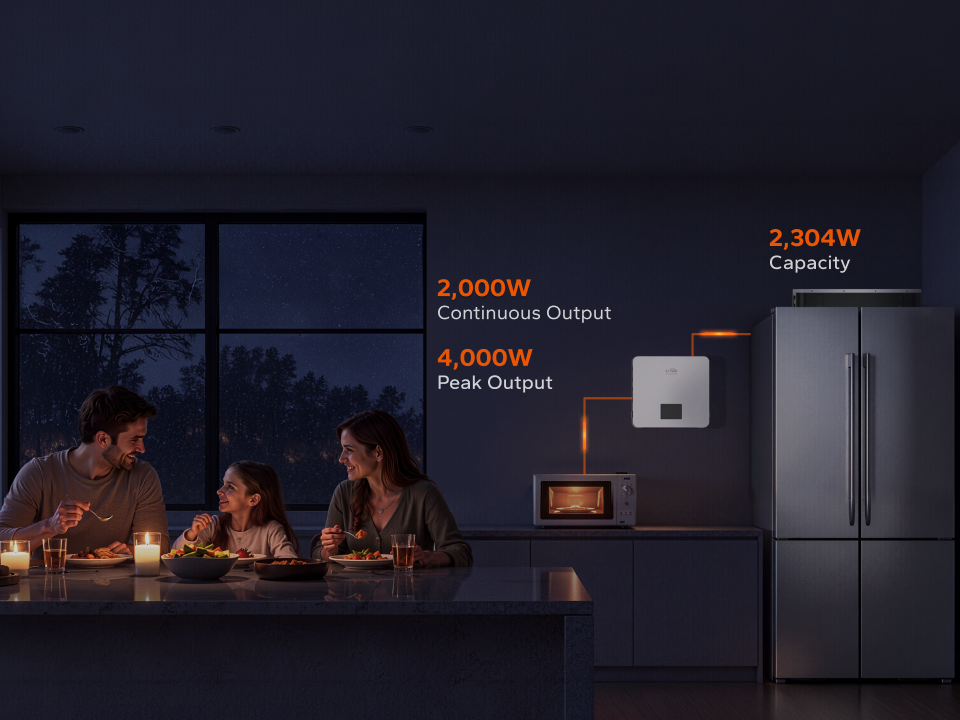
LiTime Lares K1 as a plug-in home battery backup for refrigerators and kitchen essentials. It uses a 2,304Wh LiFePO₄ battery, provides 2,000W continuous output, and supports 4,000W peak output for short startup surges. It also includes UPS-style switching in 10 milliseconds or less, which helps keep the fridge powered automatically when grid power fails.

Lares K1’s pure sine wave output, 120V AC output, and surge capability make it a strong fit for a standard home refrigerator setup, while its two AC outlets can support a fridge plus another compatible kitchen essential as long as total load stays within the system ratings.
The system has a slim profile, supports wall or floor installation, and can place the battery and inverter charger together or separately. AC charging up to 1,500W, solar charging up to 800W, Wi-Fi and Bluetooth app control, a touchscreen, and expansion from 2,304Wh to 9,216Wh with compatible battery packs.
Key benefits include:
- Automatic fridge backup: Helps avoid manual plug-swapping during an outage.
- Kitchen-focused output: Designed for refrigerators, freezers, and select kitchen essentials.
- Expandable capacity: Useful if your local outages often last longer than one day.
- Indoor operation: Quiet battery backup avoids the noise and fumes associated with generators.
- Solar recharge option: Helpful when grid power is unavailable for extended periods.
- LiFePO₄ chemistry: A practical choice for stationary backup power where long cycle life and thermal stability matter.
How Long Can Backup Power Run a Refrigerator?
Backup runtime depends on battery capacity, refrigerator energy use, inverter efficiency, ambient temperature, door openings, and extra connected loads. A smaller efficient refrigerator may run much longer than a large side-by-side model in a hot kitchen. Adding a freezer, microwave, coffee maker, or toaster oven will reduce runtime because those loads draw from the same battery.
One 2,304Wh Lares K1 battery can provide more than 24 hours of backup for a refrigerator using about 2 kWh per day. With expansion to four battery packs, estimated runtime of about 99 hours under its stated assumptions, including refrigerator-only use and 90% inverter efficiency. Real-world runtime will vary, so the best estimate comes from your refrigerator’s measured or labeled daily kWh use.
A simple runtime formula is:
- Find usable battery watt-hours.
- Multiply by expected inverter efficiency.
- Divide by the refrigerator’s daily watt-hours.
- Reduce the estimate if you plan to power anything else.
Example: if a battery provides 2,304Wh and the system operates around 90% efficiency, usable energy is roughly 2,074Wh. A refrigerator using 2,000Wh per day could run for about a day under ideal refrigerator-only conditions. If you add other appliances, runtime drops.
What Size Battery Do You Need to Power a Refrigerator?
The right battery size depends on how long you want the refrigerator to run. For short outages, a modest battery may be enough to cover several hours. For overnight protection, plan around one full day of refrigerator energy use. For storm seasons or multi-day outages, choose an expandable system or a much larger battery bank.
Use this quick sizing guide:
- Step 1: Find daily consumption. Check the EnergyGuide label or measure with a plug-in energy meter.
- Step 2: Convert kWh to Wh. 1 kWh equals 1,000Wh.
- Step 3: Add efficiency margin. Inverters consume some energy, so add a buffer.
- Step 4: Include startup surge. Confirm the system’s peak output can start the compressor.
- Step 5: Decide your target runtime. Multiply daily use by the number of backup days you want.
For a refrigerator using 1.2 kWh per day, one day of backup requires at least 1,200Wh before losses. For a model using 2 kWh per day, plan closer to 2,000Wh before losses. This is why a 2,304Wh system like Lares K1 is well matched to many refrigerator backup scenarios, especially when the refrigerator is the priority load.
FAQs About Refrigerator Backup Power
How Many Hours Will a Refrigerator Stay Cold Without Power?
A refrigerator will usually stay safely cold for about 4 hours if the door remains closed. A full freezer can hold temperature for about 48 hours, while a half-full freezer may last about 24 hours. After that, food safety depends on temperature, time, and whether perishable foods stayed at or below safe limits, so a thermometer is the best way to make decisions. Learn more on How Long can A Refrigerator Go Without Power?
How Do You Power a Fridge with a UPS?
To power a fridge with a UPS, plug the UPS into a wall outlet, connect the refrigerator to the UPS output, and keep the system charged so it can switch to battery during an outage. The UPS must be rated for the refrigerator’s running watts and startup surge. Many office-style UPS units are too small for refrigerators, so choose a system designed for appliance loads, with enough watt-hours for the runtime you need.
Conclusion
Reliable backup power for fridge use is one of the most practical home preparedness upgrades you can make. Refrigerators have limited safe time without electricity, and a long outage can put food, medication, and daily routines at risk. The best backup power for refrigerator protection should handle compressor surge, provide enough watt-hours, operate safely indoors, and stay ready without complicated setup.
LiTime Lares K1 stands out because it is purpose-built for refrigerator backup power: it offers 2,304Wh capacity, 2,000W continuous output, 4,000W peak output, automatic UPS-style switching, AC and solar recharge options, and expandable capacity for longer outages. If you want a battery backup for refrigerator and freezer needs that fits into the kitchen more naturally than a generator, LiTime Lares K1 is a strong option to consider.

