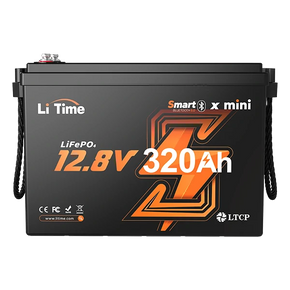


A high-quality 12 volt deep cycle RV battery serves as the lifeblood of off-grid RV camping and full-time road living. Unlike conventional vehicle batteries built for fleeting ignition power, premium 12V deep cycle RV batteries deliver consistent, long-duration electricity to sustain your RV’s essential onboard gear—including interior lights, refrigerators, water pumps, ventilation systems, and compact kitchen appliances.
Whether you enjoy casual weekend getaways or embrace full-time RV travel, selecting a well-matched 12V deep cycle battery is pivotal to stable off-grid power and prolonged equipment longevity.
- Part1: What Is a 12 Volt Deep Cycle RV Battery?
- Part2: What type of 12Volt deep cycle battery is best for RV?
- Part3: How to choose 12 Volt deep cycle RV battery size?
- Part4: Best 12 Volt deep cycle RV batteries [Top3]
- Part5: What kills a 12V deep cycle battery for RV?
- Part6: FAQS about 12 Volt RV deep cycle battery
- Conclution
Part1: What Is a 12 Volt Deep Cycle RV Battery?
A 12 volt deep cycle RV battery is a specialized rechargeable battery engineered for continuous, repeated deep discharge and charging cycles. It serves as the primary house battery for most standard RV electrical systems, providing stable 12V DC power to support daily onboard electrical loads.
12V deep cycle battery VS starting battery for RV?
The biggest feature that distinguishes deep cycle batteries from ordinary starting batteries is their discharge tolerance. Deep cycle RV batteries can safely discharge 50% to 100% of their total capacity repeatedly without permanent damage, perfectly matching the long-hour power consumption needs of RV camping. Built to withstand vibration, temperature changes, and frequent cyclic use during outdoor travel, these batteries are essential for dry camping, shore power disconnection, and daily off-grid RV operation.
Read More: [Full Guide] Starting Battery vs. Deep-Cycle & Dual-Purpose Battery
Part2: What type of 12Volt deep cycle battery is best for RV?
Four mainstream 12V deep cycle battery types are widely used in RV scenarios, including flooded lead-acid, AGM, gel, and LiFePO4 lithium batteries.
1. Flooded Lead-Acid Deep Cycle Battery
Flooded lead-acid batteries are the most traditional and widely used deep cycle battery option for entry-level RV setups. Featuring mature, time-tested technology and universal compatibility, they serve as a budget-friendly power solution for occasional campers with basic off-grid needs.
Advantages
- Ultra-low upfront cost and excellent cost accessibility for budget RV users
- Proven stable performance and strong surge tolerance for basic RV electrical loads
- Easily accessible worldwide with mature after-sales and replacement support
Disadvantages
- Requires frequent manual maintenance, including regular distilled water refills and ventilation checks
- Bulky and heavy structure that increases overall RV travel load
- Short cycle lifespan and poor deep-discharge resistance, unable to support long-term off-grid cycling
- Gradually outdated for full-time RVing and frequent dry camping scenarios
2. AGM Deep Cycle Battery
AGM (Absorbed Glass Mat) batteries are sealed, maintenance-free lead-acid batteries optimized for modern RV environments. With electrolyte fixed in fiberglass mats, they avoid leakage risks and deliver improved durability compared with flooded batteries, acting as a balanced mid-tier choice for most RV campers.
Advantages
- Completely sealed and spill-proof, requiring zero daily maintenance
- Superior vibration and corrosion resistance, ideal for bumpy RV road travel
- Supports moderate deep discharge and faster charging than flooded lead-acid batteries
- Safe for enclosed RV installation with no gas emission risks
Disadvantages
- Higher upfront cost than traditional flooded batteries
- Limited cycle life and deep-discharge capability compared with lithium batteries
- Sensitive to overcharging, requiring dedicated matched chargers
- Poor performance in long-duration continuous off-grid camping
Read More: AGM vs. Lithium Batteries: Which is Better for RV and Marine
3. Gel Deep Cycle Battery
Gel deep cycle batteries adopt gelled electrolyte to achieve exceptional environmental stability and safety. Fully sealed and corrosion-resistant, they are specially designed for low-power, long-static discharge scenarios, performing steadily in extreme temperature and humid conditions.
Advantages
- Excellent high and low-temperature adaptability for harsh outdoor environments
- Ultra-low self-discharge rate, perfect for long-term idle storage
- 100% sealed construction with zero leakage and strong corrosion resistance
- Extremely safe for low-power, long-duration static RV power supply
Disadvantages
- Slow charging speed and low charging efficiency
- Extremely sensitive to overcharging, prone to permanent cell damage with improper voltage
- High market price with low cost performance
- Cannot support high-power RV appliances, limiting overall camping versatility
4. LiFePO4 Lithium Deep Cycle Battery
LiFePO4 lithium batteries represent the cutting-edge deep cycle power solution for modern RVs, comprehensively solving the inherent defects of traditional lead-acid batteries. With outstanding cycle performance, lightweight design, and maintenance-free operation, they have become the mainstream upgrade choice for premium and full-time RV camping. LiTime LiFePO4 deep cycle batteries further optimize cell stability and outdoor adaptability, perfectly matching complex RV travel and off-grid scenarios.

Advantages
- Ultra-long lifespan with 4000+ full deep cycles and up to 10-year service life
- Supports 100% safe deep discharge without permanent capacity attenuation
- Ultra-lightweight construction greatly reduces RV load weight
- Built-in intelligent BMS ensures all-round safety protection for outdoor use
- Superior long-term cost performance despite initial investment
Disadvantages
- Higher upfront purchase cost compared with conventional lead-acid batteries
- Requires dedicated lithium-specific chargers for optimal charging efficiency
Part3: How to choose 12V deep cycle RV battery size?
Choosing the ideal 12V deep cycle battery for RV requires thoughtful consideration of two core dimensions: physical group size for precise installation compatibility and ampere-hour (Ah) capacity for reliable off-grid endurance.
1. Physical Group Size Selection
Common RV battery group sizes include Group 24, Group 27, and Group 31, with standardized BCI dimensions to fit factory RV battery trays. Group 24 is compact and lightweight for small RVs; Group 27 is a universal mid-size compatible with most RV models; Group 31 has a larger installation volume for high-capacity single-battery setups.
2. Capacity Size Selection by Camping Scenarios
Light weekend camping: 12V 100Ah battery. It fully supports basic loads such as interior lights, mobile charging, and mini refrigerators for 1–2 days of off-grid use.
Frequent dry camping: 12V 150Ah–200Ah battery. Suitable for 2–3 days of off-grid self-sufficient power, stably running water pumps, fans, and daily kitchen equipment.
Full-time & high-power off-grid camping: 12V 200Ah+ or multi-battery parallel system. Meets long-term RV living and high-power load demands including air conditioners and large inverters
If single-battery capacity cannot meet your needs, you can expand power via parallel / series connection wiring.
Part4: Best 12 Volt deep cycle RV batteries [Top3]
After comprehensive evaluation of performance, cycle life, safety, user feedback, and cost performance, the following three 12V deep cycle batteries stand out as the most worthy choices for RV owners in 2026.
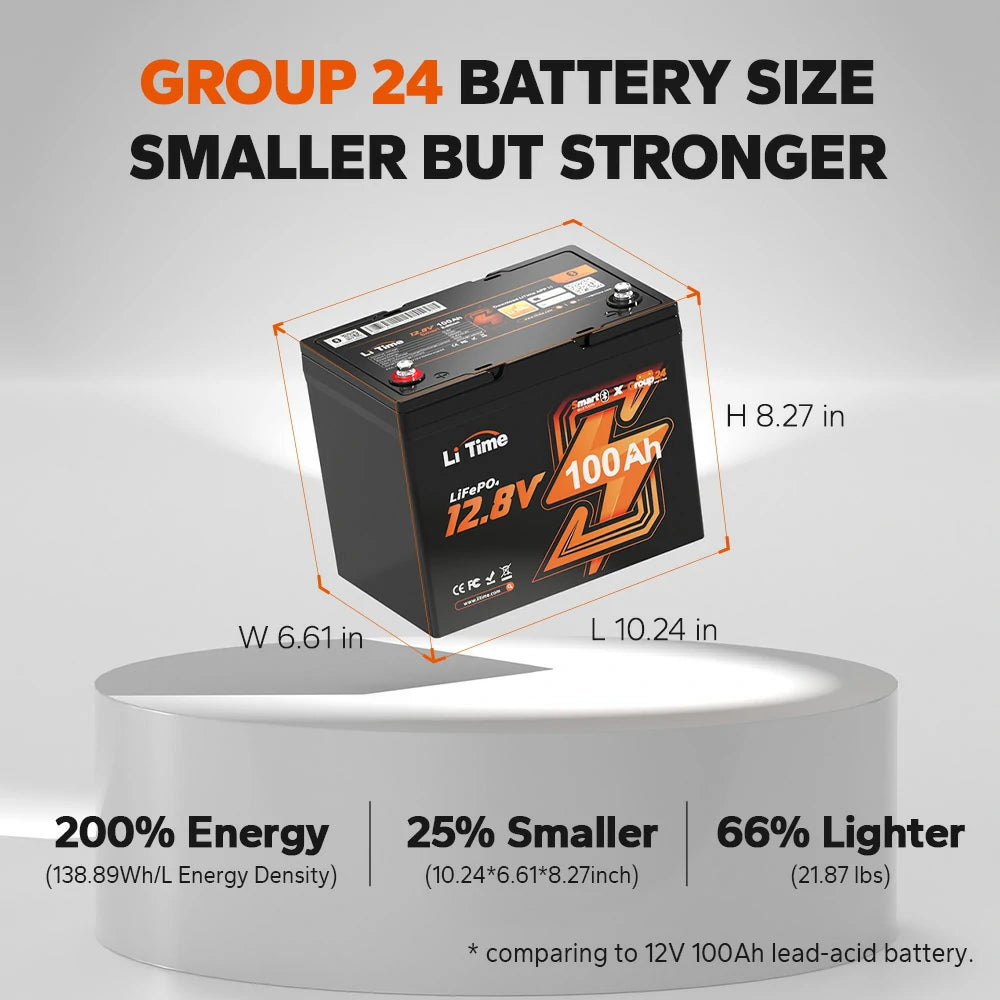
1. LiTime 12V 100Ah Group 24 Smart Bluetooth LiFePO4 Battery
Best for: Weekend camping, small RVs, tight compartments, entry-level upgrade
- Compact Group 24 size: L10.24 × W6.61 × H8.27 in
- Smart Bluetooth 5.0: Real-time monitoring via LiTime App (SOC, voltage, current, temperature, cycles)
- Low-temp protection: Stops charging below 32°F / 0°C, stops discharging below -4°F / -20°C
- High safety: 100A BMS with 20+ protections; IP65 waterproof & dustproof
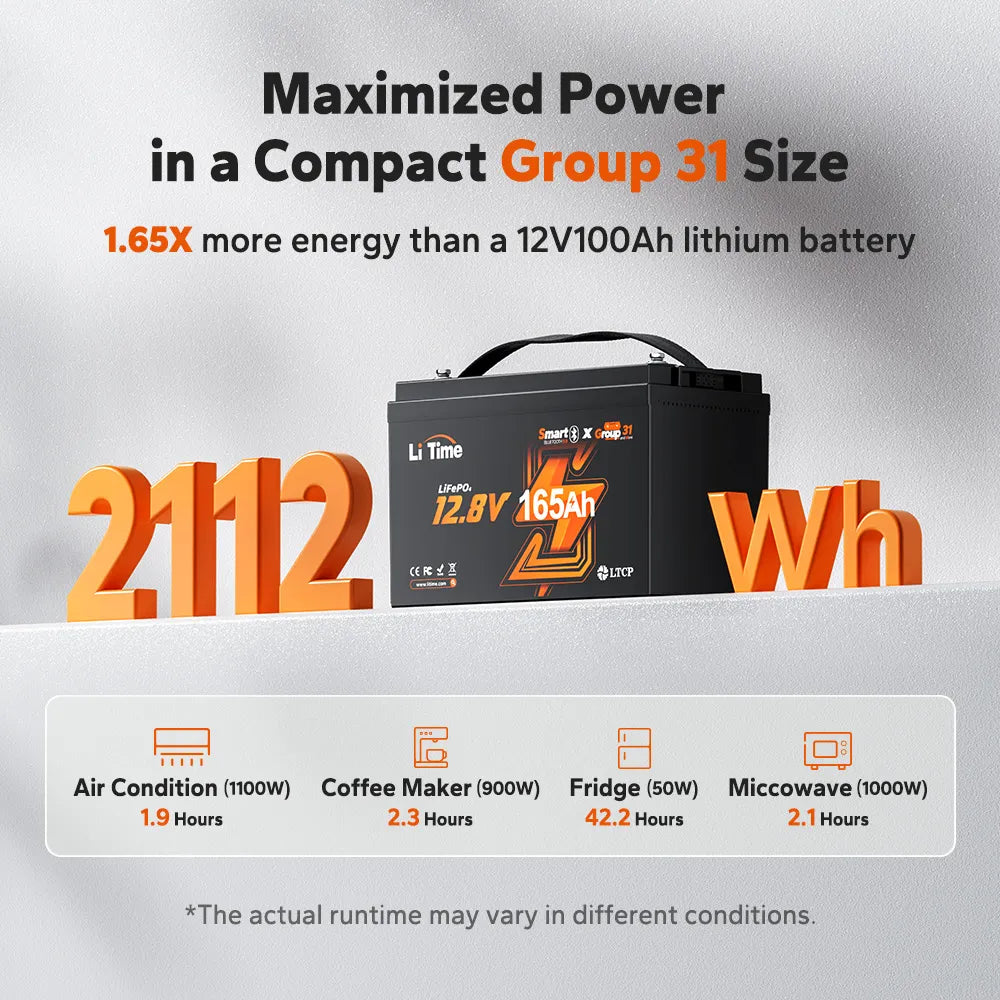
2. LiTime 12V 165Ah Bluetooth LiFePO4 Battery
Best for: Frequent dry camping, medium-large RVs, balanced capacity & size
- Built-in Bluetooth 5.0: One-click connection, full status monitoring & control
- Powerful 165A BMS: Stable for medium loads, 825A 1s peak discharge
- Low self-discharge: ~2% per month, perfect for seasonal storage
- Wide compatibility: Fits Group 31 compartments; supports series/parallel expansion
3. LiTime 12V 320Ah Mini Bluetooth LiFePO4 Battery
Best for: Full-time RVing, high-power loads, limited space
- Ultra-high energy density: 320Ah / 4096Wh in a compact “mini” body
- Space & weight saving: 31% smaller, 55% lighter than standard 300Ah LiFePO4
- Smart Bluetooth 5.0: Remote monitoring, system check, one-tap shutoff
- Heavy-duty 200A BMS: 2560W continuous, 1000A 1s peak discharge for AC, inverter, microwave
- All-weather safe: Low-temp cut-off, IP65, salt-spray & moisture resistant
Part5: What kills a 12 Volt deep cycle battery for RV?
Most 12V deep cycle RV batteries fail prematurely due to improper use and daily maintenance negligence. Mastering these common damage causes can effectively extend your battery’s service life.
- Frequent over-discharging: Draining the battery to extremely low voltage for a long time will cause irreversible damage to internal plates, resulting in permanent capacity attenuation.
- Long-term undercharging and sulfation: Incomplete charging leaves lead-acid batteries in a deficit state, forming sulfate crystals on the plates, which hinders energy storage and accelerates battery aging.
- Extreme temperature exposure: High temperature accelerates internal chemical aging, while low temperature reduces battery available capacity and affects normal charging efficiency.
- Parasitic power drain and idle storage: Long-term standby power consumption of RV electrical equipment slowly drains the battery. Storing batteries in a depleted state for months will cause scrapping.
- Mismatched chargers and irregular wiring: Using incorrect voltage chargers or messy wiring leads to overcharging, short circuits, and unstable current output, damaging battery performance.
Part6: FAQS about 12 Volt RV deep cycle battery
What's the difference between a marine RV battery and a deep cycle battery?
Marine batteries are dual-purpose batteries that support both starting and deep cycling, designed for humid and high-vibration marine environments. They feature enhanced corrosion resistance and shock resistance. Standard RV deep cycle batteries focus purely on stable long-term discharge for house loads, with better cyclic durability and higher usable capacity than marine dual-purpose batteries.
How to charge a 12 Volt deep cycle RV lithium battery?
12V LiFePO4 deep cycle RV batteries support three mainstream, safe charging methods for RV scenarios: shore power charging, solar charging, and alternator driving charging.
1. Shore Power Charging: Use a dedicated lithium charger to convert campground AC power to 14.6V DC power. It enables stable constant-current and constant-voltage charging, fully restoring battery capacity safely, perfect for daily stationary charging and pre-trip power replenishment.
2. Solar Charging: Ideal for off-grid dry camping, this method pairs with a lithium-compatible MPPT controller to adjust charging power intelligently per sunlight conditions. It delivers high-efficiency green power and auto-stops when fully charged, suiting long-term outdoor RV activities.
3. Alternator Chargin: Equipped with a professional battery isolator, the RV alternator stabilizes output power during driving to replenish battery energy. It effectively supplements power consumption and reserves sufficient electricity for subsequent off-grid camping.
Read More: [Full Guide] How To Charge RV Batteries Safely
Which 12V RV battery lasts the longest?
LiFePO4 lithium batteries are the longest-lasting 12V deep cycle battery option on the market that support 4000+ full deep cycles and a steady 8–10 year service life.
Is a group 31 battery better than a group 24 for RV?
It depends on your RV’s space and power needs. Group 24 batteries are compact, lightweight, and perfect for small RVs and light camping use. Group 31 batteries have larger physical size and allow higher single-unit capacity, suitable for large RVs and full-time off-grid use.
Read More: Deep Cycle Group 24 VS Group 31 Battery
How to bring a dead 12V deep cycle battery back to life?
For dead flooded lead-acid batteries, you can try adding distilled water and using a low-current desulfation charger for cyclic repair. For dead AGM and gel batteries, the repair success rate is low once plates are severely sulfated. For "dead" lithium batteries, most failures are caused by BMS protection triggered by low voltage. You can reconnect a dedicated lithium charger to reset the BMS and restore normal use.
Read More: How to Jumpstart a Dead Lithium LiFePO4 Battery?
Conclusion
A high-quality 12 volt deep cycle RV battery is indispensable for comfortable and reliable outdoor RV camping. From traditional flooded, AGM, and gel batteries to modern high-performance LiFePO4 lithium batteries, each option fits different budgets and usage scenarios.
Reasonable battery type selection, accurate size matching, standardized charging methods, and scientific daily maintenance can maximize your battery’s lifespan and power performance. For RV enthusiasts pursuing long-term cost performance and worry-free off-grid power, LiTime provide stable, safe, and durable 12V lithium power support, accompanying every wonderful outdoor RV journey.
