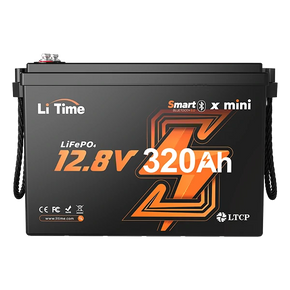


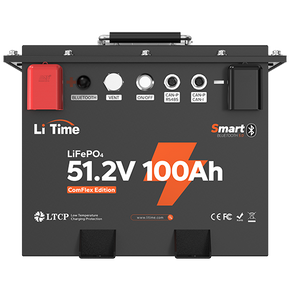

A reliable travel trailer battery is the backbone of every off-grid camping experience. It powers interior lights, refrigerators, water pumps, fans, and small electronics when you disconnect from shore power. Many new RV and trailer owners struggle to distinguish battery types, select the correct capacity, or maintain their units for long-term use.
This complete guide covers core definitions, selection criteria to help you choose the best travel trailer battery.
- Part1: What Is a Travel Trailer Battery?
- Part2: How to choose the best battery for a Travel Trailer?
- Part3: The Best Battery for a Travel Trailer
- Part4: Travel Trailer Battery Runtime and maintenance
- Part5: How to charge a Travel Trailer Battery?
- Part6: FAQs About Travel Trailer Deep Cycle Battery
- Conclusion
Part1: What Is a Travel Trailer Battery?

A travel trailer battery is a dedicated deep-cycle energy storage unit designed to supply consistent low-voltage power for trailer house systems. Unlike car batteries built for short ignition bursts, travel trailer batteries support repeated deep charging and discharging cycles, delivering steady power over hours or even days during dry camping. They ensure your trailer’s daily electrical appliances work normally without connecting to campground shore power or vehicle engines.
House Battery vs Starting Battery
Most trailer owners confuse house batteries with starting batteries, but they serve completely different functions. A starting battery is engineered for instant, high-current bursts to ignite vehicle or trailer engines. It only works for a few seconds and cannot sustain long-hour discharge; deep cycling will quickly damage its internal structure.
A house battery (deep cycle battery) is built for travel trailer daily use. It provides stable, low continuous power for lights, kitchen appliances, and living systems. It tolerates frequent deep discharge and repeated cycling, which matches the power consumption habits of trailer camping, making it the ideal power source for trailer house loads.
Travel Trailer vs RV vs Camper Battery
Although travel trailers, RVs, and campers all use 12V/48V DC deep cycle batteries, their application scenarios differ slightly. Travel trailer batteries focus on lightweight, compact installation and basic household load support, ideal for towable mobile camping spaces. RV batteries usually require larger capacity to support integrated high-power equipment. Camper batteries prioritize portability and flexible replacement for small camping units.
The good news is that mainstream deep cycle batteries feature universal compatibility, fitting travel trailers, standard RVs, and campers for versatile outdoor power use.
Part2: How to choose the best battery for a Travel Trailer?
Selecting the right travel trailer battery depends on three core factors: battery type, suitable size/capacity, and matching quantity. Blindly pursuing large capacity or low price will cause power waste or insufficient off-grid endurance. Below is a systematic selection guide for travel trailer batteries.
What type of battery is best for travel trailer?
There are four mainstream battery types widely used for travel trailers, including flooded lead-acid, AGM, gel, and lithium LiFePO4 batteries. Each type differs significantly in lifespan, maintenance requirements, durability, and camping adaptability. The detailed comparison table below helps you quickly identify their differences and pick the ideal option:
| Battery Type | Core Advantages | Main Disadvantages |
|---|---|---|
| Flooded Lead-Acid | Low upfront cost, easy accessibility, high surge current output | Heavy weight, short cycle life, requires regular water replenishment and ventilation, cannot withstand frequent deep discharge |
| AGM Battery | Maintenance-free, leak-proof, shock-resistant, suitable for enclosed spaces | Low energy density, poor deep-discharge tolerance, shorter service life than lithium batteries, higher cost than flooded types |
| Gel Battery | Completely sealed, excellent temperature resistance, stable performance, no leakage risk | Expensive price, low discharge rate, weak overload capacity, easy aging under high-load use |
| LiFePO4 Lithium Battery | Ultra-lightweight, 4000+ long cycle life, 100% deep discharge support, high energy density, intelligent BMS protection, low maintenance | Higher initial purchase cost |
Out of these four common battery types, LiFePO4 lithium batteries are hands down the best pick for most travel trailer campers. While they cost a bit more upfront, their ultra-long lifespan and maintenance-free design save you plenty of time and money on replacements and routine upkeep down the line. They deliver consistent, reliable power for casual weekend getaways, frequent dry camping, and long-term off-grid stays, making them the most practical and worthwhile upgrade for modern travel trailer setups.
Read More: AGM vs. Lithium Batteries: Which is Better for RV and Marine
What size battery for my travel trailer?
When selecting a travel trailer battery, prioritizing the correct physical group size is the first and most critical step for seamless installation. Group size refers to the standardized external dimensions of a battery, defined by BCI, which determines whether the battery fits your trailer’s factory battery tray, battery box, or reserved installation compartment. It has nothing to do with battery capacity or performance, focusing solely on space compatibility.
Travel trailers primarily rely on three universal, compatible group sizes: Group 24, Group 27, and Group 31. In general, a larger group number means bigger external dimensions and heavier weight, catering to different trailer installation spaces:
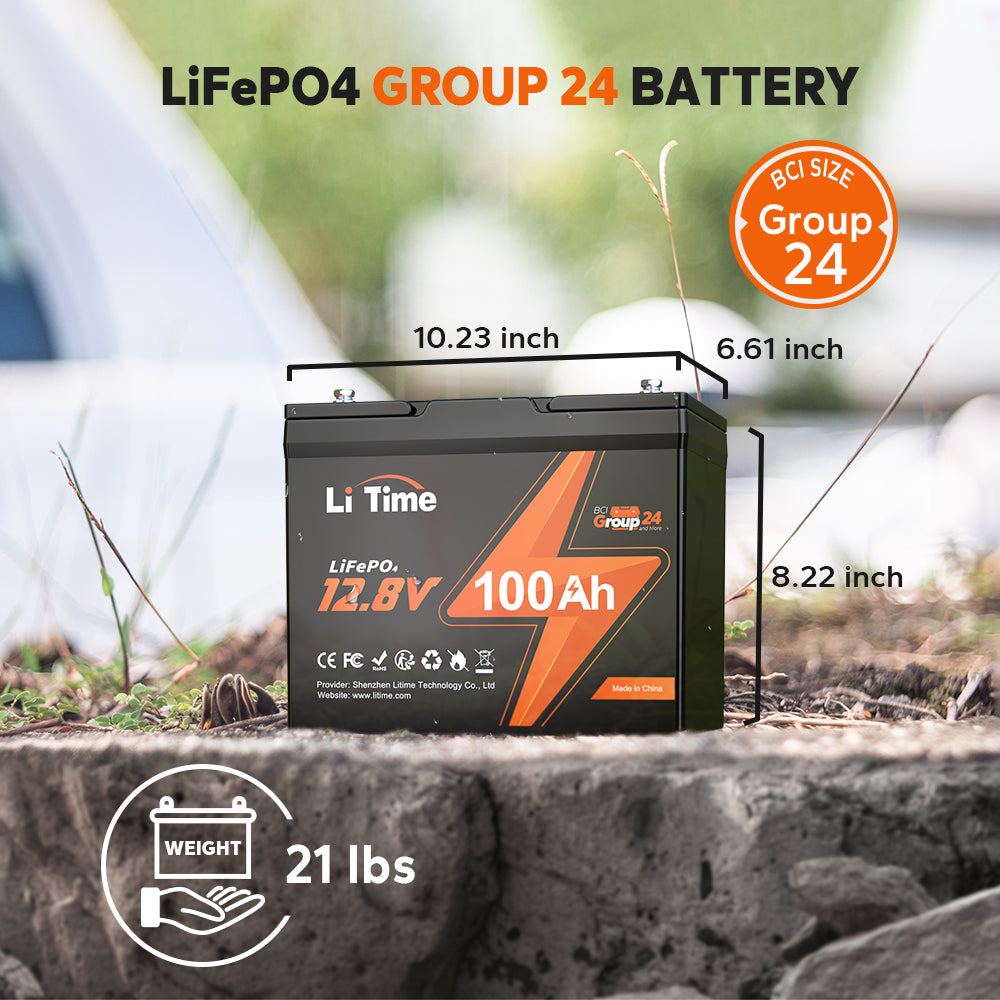
Group 24: The most compact mainstream size. Boasting a lightweight and space-saving design, it is perfectly tailored for small travel trailers with limited compartment space and single-battery installation setups, ideal for compact trailer layouts.
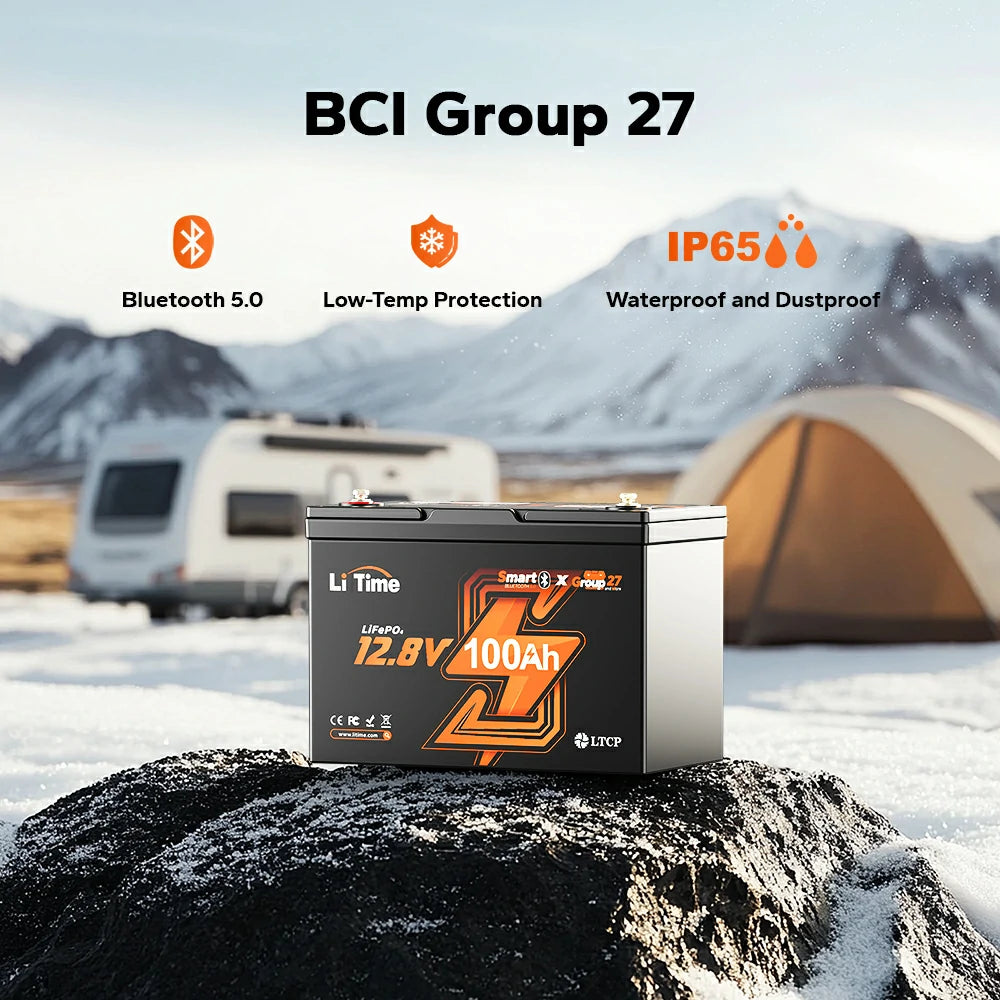
Group 27: A versatile mid-size specification. Slightly larger than Group 24, it features enhanced structural stability while maintaining great compatibility. It fits nearly all standard travel trailer battery trays and serves as the most universal physical size for most ordinary campers.
Group 31: The largest of the three common sizes. Its expanded external dimension provides ample internal space for high-capacity cell configuration. It is suitable for large travel trailers with sufficient installation space and users who prefer a single, high-capacity battery setup without parallel expansion.
Read More: Battery Group Size Dimensions Complete Guide
How many travel trailer batteries do I need?
Once you confirm the right physical group size for your travel trailer battery, the next critical step is choosing the ideal battery capacity and quantity based on your camping habits and power consumption. Battery capacity, measured in Ampere-hours (Ah), dictates your off-grid power runtime, while the number of batteries directly supports different load levels. Below are precise, scenario-based capacity and quantity recommendations to suit all common travel trailer camping needs.
1. Light Casual Camping (Single Battery Setup)
Applicable scenarios: Short weekend getaways, 24-hour off-grid use, powering only basic low-wattage devices including interior lights, phone chargers, and mini refrigerators.
Recommended configuration: 1 × 12V 100Ah battery
A single 100Ah battery is the most practical setup for beginner and casual campers. It provides sufficient power to run all essential low-power trailer appliances for one full day off-grid. It fits standard Group 24 and Group 27 battery trays perfectly, requires no complicated wiring or modification, and delivers reliable, hassle-free daily power with minimal maintenance.
2. Frequent Dry Camping (Medium Capacity Setup)
Applicable scenarios: Regular off-grid camping, 2–3 days of self-sufficient power use, running continuous loads such as water pumps, ventilation fans, and small kitchen appliances.
Recommended configuration: 1 × 12V 150Ah–200Ah battery
For campers who frequently stay off-grid for multiple days, a single high-capacity battery is the optimal choice. Ranging from 150Ah to 200Ah, this capacity range greatly extends off-grid runtime compared with a standard 100Ah battery. It steadily supports continuous operation of daily camping equipment, eliminating frequent recharging and fully meeting medium-intensity outdoor power demands.
3. Long-Term & High-Power Off-Grid Camping (High-Capacity Setup)
Applicable scenarios: Full-time trailer living, multi-day off-grid camping, or operating high-wattage devices including trailer air conditioners, large inverters, and microwave ovens.
Recommended configuration: 1 × 12V 200Ah+ Group 31 battery or multi-battery combined system
High-power and long-term off-grid use requires ultra-high capacity to sustain heavy loads. A single 200Ah+ Group 31 battery provides robust single-unit power storage for most full-time camping needs. For extreme power consumption scenarios, a multi-battery combined system delivers more stable and long-lasting power output to support all high-power trailer electrical systems.
* Flexible Capacity & Voltage Expansion via Series and Parallel Connections
If single-battery capacity cannot meet your off-grid endurance or high-power demands, series and parallel connection methods allow flexible system upgrades without replacing existing batteries. These two mainstream wiring modes serve completely different expansion purposes and are adaptable to all travel trailer power systems.
- Parallel Connection (Capacity Expansion): Parallel connection links multiple batteries of the same voltage and capacity positive-to-positive and negative-to-negative. This wiring method keeps the system voltage unchanged while stacking total battery capacity, effectively extending off-grid runtime. It is the best solution for users who want longer power standby time without upgrading their trailer’s original 12V electrical system. Most standard trailer batteries support multi-unit parallel expansion, ensuring balanced current output and stable system operation.
- Series Connection (Voltage Upgrade): Series connection connects batteries positive-to-negative to stack system voltage, while retaining the single battery’s original capacity. A higher system voltage reduces circuit current and power loss, solving overheating and insufficient power issues when driving high-wattage equipment. For travel trailers equipped with large inverters and air conditioners, a 48V series system (4 × 12V batteries) provides professional-grade high-power load capacity.
Read More: Batteries in Parallel vs Series: How to Correctly Connect Your LiFePO4 Batteries
2.4 What Battery Voltage Does Your Travel Trailer Need?
12V system: Most travel trailers use the system for onboard equipment such as lights, water pumps, fans, refrigerators, control boards, and other low-voltage appliances.
24V or 48V battery systems: Some larger or customized off-grid travel trailers may use the system to reduce current and improve efficiency when powering high-load equipment through an inverter.
Do not select a higher-voltage battery simply for more power. The battery voltage must match the overall travel trailer electrical architecture to avoid equipment incompatibility or damage.
2.5 What Features Should a Travel Trailer Battery Have?
Beyond capacity, modern travel trailer batteries can include features that make daily use safer and more convenient.
- Bluetooth monitoring: The features allow you to check battery SOC, voltage, current, temperature, and operating status from a smartphone without opening the battery compartment. This is especially useful for batteries installed under seats, inside storage compartments, or in hard-to-reach locations.
- Heating & low-temperature protection: For winter camping, heating or self-heating and low-temperature charging protection are valuable features to help maintain safer charging conditions during cold-weather trips.
- Dust and water resistance rating: If the battery is installed in an exposed or semi-exposed compartment, also check its dust and water resistance rating. A well-protected enclosure can provide better resistance to road spray, moisture, dust, and outdoor conditions encountered during towing and camping.
2.6 How Easy Is the Battery to Install and Carry?
Travel trailer batteries should be easy to install, replace, and carry, especially when battery compartments have limited space. Before buying, check the battery’s dimensions, terminal position, weight, and compatibility with the existing battery tray or box.
Part3: The Best Battery for a Travel Trailer
Comprehensively considering safety, lifespan, portability, and cost performance, LiFePO4 deep cycle batteries stand out as the ultimate all-around power solution for travel trailers. For trailer owners seeking reliable, worry-free power, LiTime offers tailored, scene-specific LiFePO4 models that perfectly match diverse travel trailer camping needs, with standardized group sizes for seamless installation.
LiTime 12V 100Ah Group 24 LiFePO4 Battery
LiTime 12V 100Ah Group 27 LiFePO4 Battery
LiTime 12V 165Ah Group 31 LiFePO4 Battery
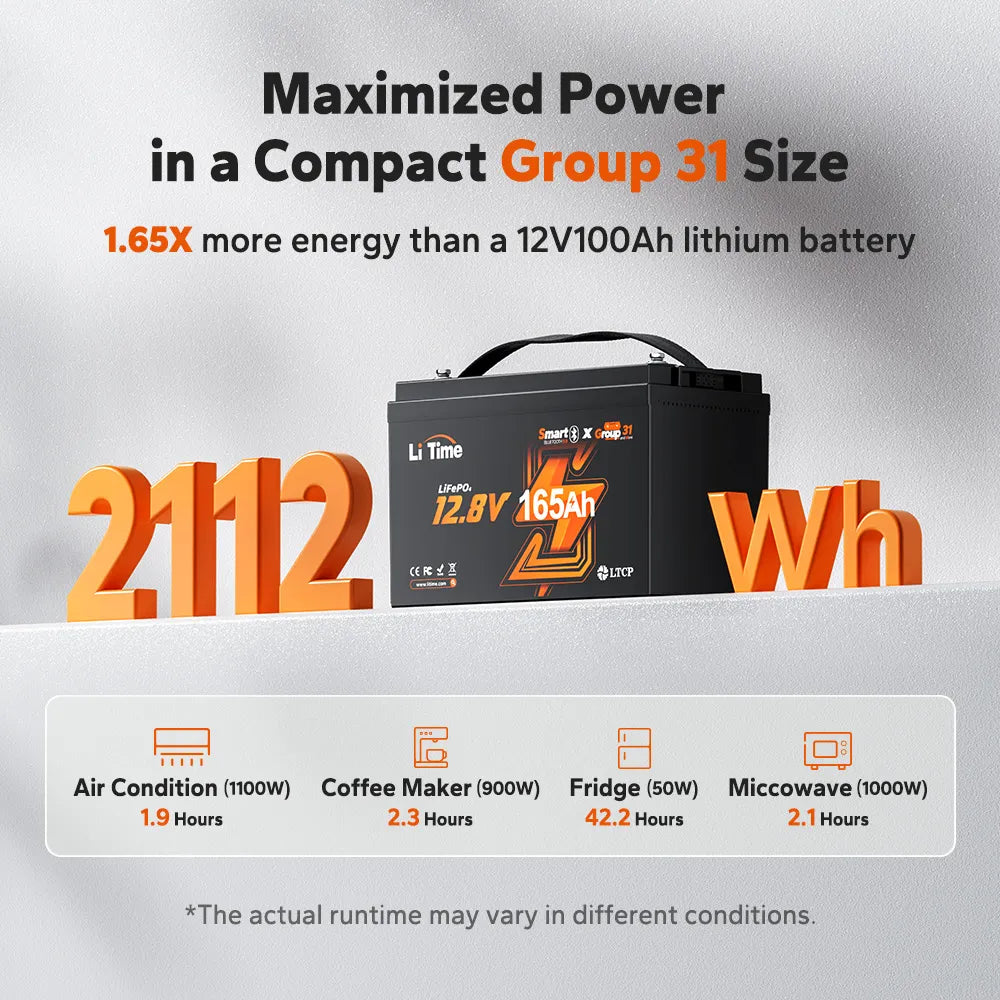
All LiTime travel trailer batteries support flexible parallel expansion (up to 16 units) for customizable capacity upgrades. With a 10-year service life and 100% deep discharge availability, these standardized, scenario-matched models eliminate the hassle of repeated replacements.
Part4: Travel Trailer Battery Runtime and maintenance
Battery runtime is determined by capacity, load power, and discharge depth. A standard 100Ah 12V battery can support basic trailer loads for 8–12 hours, while a 150Ah model extends runtime to 12–20 hours. Unlike lead-acid batteries that lose massive capacity with deep discharge, quality LiFePO4 batteries maintain stable voltage output even at 100% DoD, effectively extending actual usable runtime.
Proper daily maintenance is essential to maximize your travel trailer battery’s lifespan and maintain stable off-grid performance. Modern lithium batteries greatly cut down tedious upkeep work compared with traditional lead-acid batteries, yet following these simple routine tips can deliver longer service life and more reliable power output:
- Keep the battery clean and dry: Always maintain a dry, dust-free battery surface. Moisture and dirt buildup may cause poor contact or potential short circuits, especially after bumpy towing or outdoor humid camping.
- Avoid long-term full discharge during storage: Never leave the battery fully drained for weeks or months. Long-term deep discharge will cause irreversible capacity loss and accelerate battery aging, greatly shortening its usable lifespan.
- Check wiring regularly: Travel trailer towing generates constant vibration. It is necessary to routinely inspect wire connections and terminal tightness to prevent loose contacts, power drops, or abnormal heat generation.
- Store batteries in a suitable environment: During idle seasons or cold winter months, store the battery in a cool, dry, and well-ventilated place. Quality lithium batteries like LiTime are built with intelligent low-temperature protection and real-time self-monitoring systems, effectively adapting to temperature changes and reducing manual maintenance burdens.
Part5: How to charge a Travel Trailer Battery?
Travel trailer batteries support multiple flexible charging methods to adapt to different camping scenarios, and mainstream lithium batteries are fully compatible with all mainstream charging modes.
Shore power charging: The most common method when parking at campgrounds. Plug in the shore power port to automatically charge the battery, suitable for daily supplementary charging.
Vehicle alternator charging: Charge the trailer battery while towing, replenishing power during travel for next camping use.
Solar panel charging: The best solution for off-grid dry camping. Portable solar panels continuously charge the battery during the day, realizing self-sufficient outdoor power. Premium lithium batteries support solar priority charging and adaptive MPPT regulation, improving solar charging efficiency.
Generator & AC outlet charging: Ideal for emergency power supplementation during prolonged overcast weather or insufficient solar power.
Read More: 5 Ways about Charging a Camper Battery, Time Chart & Troubleshooting
Part6: FAQs About Travel Trailer Deep Cycle Battery
Do I need a deep cycle battery for my travel trailer?
Yes, deep cycle batteries are a must for travel trailers. Travel trailer house systems require long-term, steady power discharge, which starting batteries cannot support. Only professional deep cycle batteries resist repeated cyclic discharge and maintain stable performance, making them the ideal choice for reliable daily trailer power supply.
Can I use a regular car battery for my travel trailer?
No. Regular car starting batteries are only designed for instantaneous ignition power output. Long-term low-power deep discharge will cause irreversible damage to the internal plates, leading to capacity attenuation and battery scrapping. They cannot replace professional travel trailer deep cycle batteries. To avoid frequent replacement and safety risks, always choose dedicated deep cycle batteries for your travel trailer.
Do travel trailer batteries charge when the camper is plugged in?
Yes. When your travel trailer is plugged into campground shore power, the built-in converter will automatically charge the house battery while supplying power to household loads. Lithium batteries support smart floating charge management, automatically stopping charging when fully charged to avoid overcharging damage, protecting battery health during long-term shore power connection.
Read More: Should I Disconnect My RV Battery When Plugged In?
Conclusion
A qualified travel trailer battery determines the comfort and reliability of your outdoor camping experience. Deep cycle lithium batteries have gradually replaced traditional lead-acid batteries as the mainstream choice for modern travel trailers, thanks to their long lifespan, lightweight body, low maintenance, and high safety.
From type selection, capacity matching, multi-scenario charging to daily maintenance, every detail affects your battery’s service life and use experience. For campers seeking reliable, cost-effective outdoor power, LiTime LiFePO4 batteries for travel trailer deliver stable performance, flexible scalability, and comprehensive safety protection, serving as a trustworthy power companion for various trailer camping adventures.

