


The best Victron-compatible LiFePO4 battery depends on what “compatible” needs to mean in your system.
If you only need a 12V lithium battery that a Victron charger and inverter can charge and discharge, all four brands in this comparison can work when the equipment is programmed correctly. If you want the battery management system to send state of charge, voltage, current, temperature, alarms, and charge limits directly to a Cerbo GX or other GX device, the field becomes much narrower.
For that second, more demanding definition, LiTime’s 12V 320Ah ComFlex and Epoch’s 12V 334Ah MC Essential are the clearest direct-integration choices in this group. Epoch offers the higher continuous-current rating and longer stated warranty. LiTime counters with a smaller and lighter enclosure, IP65 protection, broader named protocol support, user-adjustable minimum SOC reserve, 30-day history.
Battle Born remains the premium support-led option, especially for buyers who value U.S. assembly and an established RV installer ecosystem. Its smart battery platform, however, uses the separate Battle Born HUB for multi-battery aggregation. Renogy’s 12V 300Ah Core is the value-oriented choice for conventional Victron installations, but its official product page does not document native battery-to-GX communication. In that configuration, a Victron SmartShunt or BMV monitor normally becomes the system’s state-of-charge source.
Table of Contents
- Quick Verdict
- What is Electrical Compatibility vs Data Integration?
- Batteries Compared: LiTime ComFlex vs Battle Born, Epoch and Renogy
- 1. LiTime 12V 320Ah ComFlex: Best for Multi-Protocol Integration
- 2. Epoch 12V 334Ah MC Essential: Best for High-Current Loads
- 3. Battle Born 270Ah GC3 Smart Heated: Best for Support and U.S. Assembly
- 4. Renogy 12V 300Ah Core: Best for a Conventional Shunt-Based System
-
Which Battery Is Easiest to Integrate With Victron?
- Conclusions
- Frequently Asked Questions
Quick Verdict
| Best for | Our pick | Why |
|---|---|---|
| Broadest native system integration | LiTime 12V 320Ah ComFlex | Officially names CAN, RS485, Victron, RV-C, and NMEA 2000; also supports Bluetooth, OTA, SOC reserve, history, and up to 16 batteries in a communicating 12V bank. |
| Highest single-battery output | Epoch 12V 334Ah MC Essential | 300A continuous discharge, 600A for 10 seconds, Victron communications, heating, and 2A active balancing. |
| Premium support and U.S. assembly | Battle Born 270Ah GC3 Smart Heated | U.S.-assembled battery, 10-year warranty, smart monitoring, and a mature RV-focused support network. |
| Simple, lighter-value battery bank | Renogy 12V 300Ah Core | Compact 55.1-pound package, 200A BMS, IP65 enclosure, 4S4P expansion, and lower pricing than premium smart platforms. |
Overall recommendation: Choose LiTime ComFlex when communication breadth, compact installation, environmental protection, and integration cost matter most. Choose Epoch when one battery must support the highest continuous inverter load and the installation is dry and protected. Choose Battle Born when service, U.S. assembly, and installer familiarity justify the premium. Choose Renogy when native GX communication is not required and a shunt-based Victron design is acceptable.

LiTime LiHeat™ 12V 320Ah ComFlex Smart Lithium Battery
Designed for smart integration, Victron GX communication, RV-C, NMEA 2000, Bluetooth monitoring, heating, and compact high-capacity 12V energy storage.
View ProductThe Most Important Distinction: Electrical Compatibility vs Data Integration
“Victron compatible” is used loosely in battery marketing. It can describe three very different levels of compatibility:
- Electrical compatibility: A Victron charger or inverter/charger can be programmed with suitable LiFePO4 charge voltages and current limits.
- External monitoring: A SmartShunt or BMV monitor measures current at the bank and reports calculated state of charge to a GX device.
- Managed-battery communication: The battery BMS sends data and operating limits to the GX system over a supported CAN connection.
The third level offers the deepest integration. A GX device can use BMS-reported values rather than relying only on a shunt calculation. In a correctly supported managed-battery system, the battery can also communicate charge-voltage and current limits to the wider system. This does not make an installation automatically safe or plug-and-play: cable pinout, termination, GX firmware, battery firmware, inverter settings, fusing, and commissioning still matter.
This comparison therefore does not award “native Victron communication” merely because a battery can be connected to a Victron inverter.
Batteries Compared: LiTime ComFlex vs Battle Born, Epoch and Renogy
To determine which battery is easiest to integrate into a Victron-based energy system, we selected the closest high-capacity 12V LiFePO₄ model from each brand:
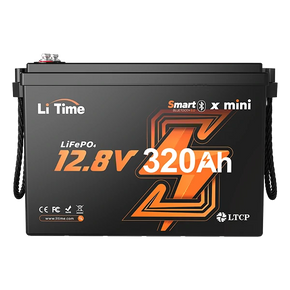
- LiTime 12V 320Ah Mini Bluetooth Lithium Battery for RV, Off-Grid, Marine and Truck
- 12V 334Ah MC Essential Series LiFePO4 Battery (4.28kWh)—Epoch
- 270Ah 12V GC3 Smart Heated LiFePO4 Deep Cycle Battery Kit —Battle Born.
- 12V 300Ah LiFePO4 Battery w/ Low-Temperature Protection —Renogy.
These batteries are not identical in capacity, output, enclosure design or communication architecture. The comparison therefore does not use a simple feature count.
Instead, it evaluates how easily each battery can become part of a complete Victron energy system:
- Can the BMS communicate directly with a Victron GX device?
- Is a SmartShunt, proprietary hub or protocol adapter required?
- Can multiple batteries report as one coordinated bank?
- Which battery data can appear in the system interface?
- Can the battery connect to RV-C or NMEA 2000 networks?
- How much installation and configuration work is required?
A battery that works with a Victron inverter is not necessarily a managed Victron battery. Most LiFePO₄ batteries can be used with appropriately configured Victron charging equipment, but only supported communication models can send BMS data and operating limits directly to a GX device.
Specification and Integration Comparison
| Specification | LiTime ComFlex 320Ah | Epoch MC Essential 334Ah | Battle Born GC3 Smart Heated 270Ah | Renogy Core 300Ah |
|---|---|---|---|---|
| Nominal voltage | 12.8V | 12.8V | 12V class | 12.8V |
| Rated capacity | 320Ah | 334Ah | 270Ah | 300Ah |
| Nominal energy | 4,096Wh | Approx. 4,275Wh | Approx. 3,456Wh | 3,840Wh |
| Continuous discharge | 200A | 300A | Not clearly stated on the cited product page; verify the current datasheet | 200A |
| Approximate DC output at nominal voltage | 2,560W | 3,840W | Cannot be calculated responsibly without a confirmed continuous-current rating | 2,560W |
| Weight | 59.97 lb | 75 lb | 80.8 lb | 55.1 lb |
| Dimensions | 14.49 × 7.44 × 10.04 in | 15.35 × 8.07 × 11.02 in | 22.83 × 7.09 × 13.15 in | 15.12 × 7.64 × 9.96 in |
| Enclosure rating | IP65 | IP21 | IP65 | IP65 |
| Internal heating | Yes | Yes | Yes | No on the linked low-temperature-protection model; a separate self-heating version is available |
| Phone monitoring | Bluetooth 5.0 through LiTime App | Bluetooth through Epoch App | Wireless monitoring through Battle Born App | Not listed for the linked Core 300Ah model |
| Battery communication | CAN and RS485 | Victron communications | Dragonfly IntelLigence communication | No native battery-to-Victron communication documented for the linked model |
| Named system compatibility | Victron GX, RV-C and NMEA 2000 | Victron ecosystem | Battle Born smart ecosystem; verify the exact interface required for Victron GX | Conventional Victron installation through voltage settings and external monitoring |
| Additional hardware consideration | Correct communication cable and termination required | Correct Victron communication cable and configuration required | Battle Born HUB required for systems with two or more smart batteries | SmartShunt or BMV normally required for system-level SOC monitoring |
| Maximum published expansion | 16P1S with battery communication; up to 4P4S in standard installations | Up to 16 batteries in parallel; series operation is not listed for this model | Manufacturer states that batteries can be expanded in parallel and used in systems up to 48V; smart-bank monitoring requires the HUB | Up to 4S4P |
| Published cycle life | Confirm using the current LiTime technical documentation | 4,500+ cycles | 3,000–5,000 cycles | 5,000 cycles at 80% DoD |
| Published warranty | 5 years | 11 years | 10 years | 5-year prorated warranty |
| Listed price when checked | $929.99 | $1,299 | $2,699 sale price | From $879.99 for the linked low-temperature-protection version |
| Primary advantage | Broad multi-protocol integration | High current and native Victron communication | U.S. assembly and support ecosystem | Lightweight, flexible and cost-conscious |
| Main limitation | 200A BMS is below Epoch’s 300A rating | IP21 enclosure and higher weight | Higher price, lower capacity and additional HUB architecture | No documented native BMS-to-GX communication |
Prices are subject to change depending on promotions on the official website and fluctuations in raw material costs; therefore, this article accepts no responsibility for pricing, and the prices quoted are based on research conducted at the time of publication. The final system cost may also include communication cables, terminators, hubs, splitters, displays, busbars, fuses, isolating switches and installation labour costs.
1. LiTime 12V 320Ah ComFlex: Best for Multi-Protocol Integration
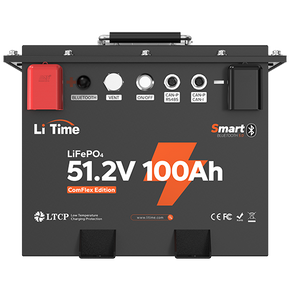
LiTime designed the ComFlex around integration rather than treating communication as an accessory. Its two communication ports support CAN and RS485, while the product page names Victron, RV-C, and NMEA 2000 compatibility. That combination is unusually broad for a single 12V drop-in-style battery.
The system value is not limited to displaying a battery percentage. In a compatible installation, the same battery platform can serve an RV-C-equipped motorhome, a Victron GX energy system, or an NMEA 2000 marine environment. That flexibility matters to RV builders and boat owners who do not want the battery to become an isolated data silo.
The physical design is another advantage. At 14.49 × 7.44 × 10.04 inches and 59.97 pounds, the ComFlex holds 4.096kWh in a smaller enclosure than the other two directly communicating batteries compared here. Its IP65 rating also makes it more tolerant of dust and water jets than Epoch’s IP21 model, although IP65 does not mean submersible and does not remove the need for a secure, code-compliant compartment.
LiTime adds several useful operational controls:
- Bluetooth 5.0 monitoring;
- over-the-air firmware updates;
- a user-set minimum SOC reserve;
- 30 days of operating history and up to 300 event records;
- low-temperature protection and self-heating;
- one-button shutdown for an individual battery or communicating bank;
- support for as many as 16 batteries in a communicating 16P1S system.

Where LiTime Leads
LiTime offers the strongest combination of communication breadth, compactness, weather resistance, and entry price. It is particularly compelling for a customer who already owns a Cerbo GX, uses an RV-C panel, or wants battery data on a compatible marine display.
Where LiTime Does Not Lead
Its 200A continuous BMS is lower than Epoch’s 300A rating. One ComFlex battery is therefore a natural match for inverter loads up to roughly 2,560W on the DC side before considering inverter loss, wiring limits, temperature derating, and surge behavior. Buyers planning a 3,000W-class inverter at sustained high output should perform a full current calculation and may need multiple batteries.
LiTime LiHeat™ 12V 320Ah ComFlex Smart Lithium Battery
Broad communication support, compact 4.096kWh capacity, Bluetooth app monitoring, self-heating, and smart system integration for RV and marine energy systems.
View Product2. Epoch 12V 334Ah MC Essential: Best for High-Current Loads
Epoch is the closest technical competitor to LiTime in this comparison. The 12V 334Ah MC Essential stores 4.28kWh, includes internal heating and Bluetooth, and explicitly advertises plug-and-play Victron communications with automatic master-battery detection.
Its decisive advantage is output. Epoch publishes a 300A continuous-discharge rating and a 600A peak rating for 10 seconds. At 12.8V, 300A represents about 3,840W of DC power before inverter losses. That gives a single Epoch battery more headroom for a properly designed 3,000W inverter system than a single 200A-BMS battery.
Epoch also specifies 2A active balancing, up to 16 batteries in parallel, 4,500-plus cycles, and an 11-year warranty. These are meaningful strengths, not footnotes.
Where Epoch Leads
Epoch is the strongest option here for high continuous current from one battery. It also has the longest published warranty and a clear Victron-communications claim. Buyers running air-conditioning, induction cooking, or other large inverter loads may value the 300A BMS more than the smallest possible enclosure.
Where Epoch Does Not Lead
The battery weighs 75 pounds and is larger than LiTime ComFlex. More importantly, Epoch rates this model IP21 and describes it as best suited to dry, protected interior locations. That is acceptable under a dinette, bed, or electrical cabinet, but less forgiving in a damp or exposed compartment.
Epoch’s page lists Victron communication, but it does not claim the same RV-C, RS485, and NMEA 2000 coverage on this model’s public page. Buyers who require those specific networks should not assume support from the word “Victron.”

3. Battle Born 270Ah GC3 Smart Heated: Best for Support and U.S. Assembly
Battle Born approaches the problem as a premium system brand. The 270Ah GC3 Smart Heated battery uses Dragonfly IntelLigence for wireless monitoring and system connectivity, is assembled in the United States, and carries a 10-year warranty.
Its strongest argument is confidence around the ownership experience: a long presence in the RV market, technical educational content, installer familiarity, and a support-focused reputation. For a buyer who wants assistance designing and commissioning an entire Victron-based power system, those factors may be worth more than capacity per dollar.
The smart architecture is different from LiTime’s. Battle Born states that systems with two or more smart batteries require the separate Battle Born HUB, and its app documentation describes the HUB as the aggregation point for multi-battery data. The cited product page showed the HUB as an additional $127 item when bundled. That is not inherently worse—a central gateway can be useful—but it should be included in the integration budget and wiring plan.
Where Battle Born Leads
Battle Born leads for buyers who prioritize U.S. assembly, a 10-year warranty, brand support, and an established RV power-system ecosystem. Its smart heated model is more than a basic drop-in battery and supports system-wide monitoring through the company’s platform.
Where Battle Born Does Not Lead
At 270Ah, it provides about 3.46kWh—roughly 16% less nominal energy than LiTime’s 4.096kWh. It is also the largest, heaviest, and most expensive battery in this comparison based on the cited listings. Its official product page describes system connectivity but does not make the same direct, model-page claim of native Victron GX battery communication that LiTime and Epoch publish. Buyers should verify the exact interface path and required hardware for their intended Victron installation rather than assuming that “smart” means direct CAN-to-GX integration.

4. Renogy 12V 300Ah Core: Best for a Conventional Shunt-Based System
Renogy’s 12V 300Ah Core is a practical high-capacity battery rather than the strongest native-communication candidate. The cited model provides 3.84kWh, a 200A BMS, IP65 protection, a compact 15.12 × 7.64 × 9.96-inch enclosure, and a weight of 55.1 pounds. Renogy lists 5,000 cycles at 80% depth of discharge and supports configurations up to 4S4P.
The Core product family includes low-temperature-cutoff and self-heating variants, so the exact SKU matters. The product page displayed different prices and features for the standard and self-heating versions.
Where Renogy Leads
Renogy is the lightest model compared and offers flexible series-parallel expansion. It can make sense when the buyer wants a straightforward 12V, 24V, or 48V bank and is comfortable using Victron’s own SmartShunt or BMV monitor as the GX system’s battery monitor.
Where Renogy Does Not Lead
The official page for the compared 300Ah Core does not document CAN/RS485 battery communication or native data integration with a Victron GX device. That means it should not be presented as equivalent to LiTime ComFlex or Epoch on managed-battery integration. A Victron inverter may still work perfectly well with it after correct programming, but the installation is using electrical compatibility and external monitoring—not necessarily BMS-to-GX communication.

Which Battery Is Easiest to Integrate With Victron?
For a new system where direct battery data is a priority, the final choice is mainly between LiTime ComFlex and Epoch MC Essential.
Choose LiTime ComFlex if you need:
- a smaller, lighter communicating battery;
- IP65 protection;
- Victron plus RV-C or NMEA 2000 flexibility;
- an adjustable minimum SOC reserve;
- stored battery history and event records;
- a lower initial battery price;
- communication-aware expansion to a large 12V bank.
Choose Epoch MC Essential if you need:
- 300A continuous discharge from one battery;
- more than 4.2kWh in one enclosure;
- 2A active balancing;
- an 11-year stated warranty;
- Victron communications in a dry interior installation.
Choose Battle Born if you need:
- U.S. assembly;
- a 10-year warranty;
- a support-led premium system purchase;
- the Dragonfly Intelligence ecosystem and do not object to a separate HUB for a multi-battery smart bank.
Choose Renogy Core if you need:
- low weight and flexible 4S4P expansion;
- a conventional lithium bank monitored by a Victron SmartShunt or BMV;
- IP65 protection;
- lower system cost than premium integrated platforms;
- no requirement for native BMS-to-GX data.
Real Integration Cost: What the Battery Price Does Not Show
Comparing battery prices alone can produce the wrong answer. A complete Victron installation may require:
- a Cerbo GX or another GX device;
- the correct manufacturer-approved CAN cable and termination;
- a SmartShunt or BMV when the battery does not supply supported SOC data;
- a gateway or battery hub;
- busbars, Class T or other correctly selected fusing, disconnects, and matched cables;
- firmware updates and commissioning time;
- professional installation when required by the vehicle, vessel, insurer, or local rules.
A cheaper battery that needs a shunt is not automatically poor value; Victron shunts are widely used and can create a clear, serviceable design. Conversely, native communication is not automatically cheaper if it requires a proprietary gateway. The correct comparison is the installed system cost and the quality of the resulting data—not just the battery’s checkout price.
What to Verify Before Connecting Any Third-Party Battery to Victron
Before ordering, obtain written confirmation for the exact battery SKU and answer these questions:
- Does the battery use a protocol supported by the intended GX firmware?
- Which GX port is used, and is a special or crossover cable required?
- What is the required RJ45 pinout and termination arrangement?
- Does the GX receive SOC, current, voltage, temperature, alarms, and charge/discharge limits?
- Can the BMS control or limit charging through DVCC in the proposed design?
- What happens if communication is lost?
- How are multiple batteries aggregated, and is a separate master, hub, or combiner required?
- Are all batteries required to run the same firmware?
- Does the manufacturer support series operation, parallel operation, or both for that model?
- Which charge-voltage, current-limit, and low-temperature settings remain the installer’s responsibility?
Victron maintains documentation for third-party managed batteries, but absence from a published compatibility list does not prove that a battery cannot work electrically. It means the buyer should distinguish a manufacturer’s claimed integration from a Victron-tested or documented managed-battery implementation.
Read More: Ultimate Guide to System-Level Communication: How This 12V LiFePO4 Battery Saves You $2200
LiTime Newsletter
Subscribe for LiTime Updates & Exclusive Offers
Subscribe to get exclusive LiTime offers, limited-time discounts, new product updates, and practical battery tips delivered to your inbox.
Conclusions
There is no honest universal winner.
LiTime 12V 320Ah ComFlex is the best overall fit for an RV or marine owner who wants broad native communication, compact 4.096kWh storage, cold-weather support, app controls, and room to expand. Its combination of CAN/RS485 hardware, named Victron/RV-C/NMEA 2000 support, IP65 enclosure, and system-management features is unusually complete at its listed price.
Epoch 12V 334Ah MC Essential is the better choice for maximum single-battery output. Its 300A continuous rating, active balancing, direct Victron claim, and 11-year warranty justify serious consideration, provided the IP21 battery can live in a dry compartment.
Battle Born is the premium service and U.S.-assembly choice, but buyers should price the complete smart system and verify exactly how it will exchange data with their Victron equipment. Renogy Core is the sensible conventional-bank choice, but it should be evaluated as an electrically compatible, shunt-monitored battery rather than assumed to offer native GX communication.
The decision becomes straightforward once the system designer answers one question: do you need a battery that merely works with Victron power equipment, or a battery that actively participates in the Victron data and control system?
Frequently Asked Questions
What is the best Victron-compatible LiFePO4 battery?
LiTime ComFlex is the strongest all-around option in this comparison for buyers who want compact 12V storage plus native CAN/RS485 communication and named support for Victron, RV-C, and NMEA 2000. Epoch’s 334Ah MC Essential is stronger when a single battery must provide up to 300A continuously. The best choice depends on the exact GX device, inverter load, installation environment, and required protocol.
Can any LiFePO4 battery work with a Victron inverter?
Many 12V LiFePO4 batteries can work electrically with a compatible Victron inverter/charger when voltage, charge profile, current limits, wiring, and protection are configured correctly. That does not mean every battery can communicate its BMS data directly to a GX device.
Do I need a SmartShunt if my battery communicates with Cerbo GX?
Not always. A supported managed battery can provide SOC, voltage, current, temperature, and limits directly to the GX system. Some installers still use a shunt for independent measurement or troubleshooting. Follow the battery and Victron integration documentation for the specific system.
Is CAN communication the same as Bluetooth monitoring?
No. Bluetooth usually connects one battery or battery system to a nearby phone app. CAN can carry battery data and operating limits to other energy-system components. The presence of a CAN connector alone does not guarantee protocol compatibility.
Is LiTime ComFlex better than Epoch?
LiTime is smaller, lighter, IP65-rated, less expensive at the checked list price, and names a broader group of supported protocols. Epoch has more capacity, a 300A continuous BMS, 2A active balancing, and a longer published warranty. LiTime is stronger for compact multi-protocol systems; Epoch is stronger for high current from one battery.
Is Battle Born worth the higher price?
It can be for buyers who value U.S. assembly, a long warranty, technical support, and a familiar RV installer ecosystem. Buyers focused mainly on energy capacity, compactness, or native protocol breadth may find stronger value elsewhere.

