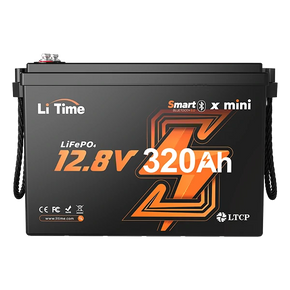


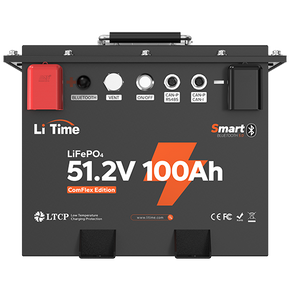

A kayak trolling motor battery has to do more than run the motor. It must deliver the correct voltage and enough current, provide power for the trip and the return to the launch, and fit a kayak’s limited space and load capacity. A lighter battery can make carrying and rigging easier, but choosing the smallest battery without checking motor draw or runtime can leave you short of power on the water.
For many 12V kayak trolling motors, a 50Ah LiFePO4 battery is a practical short-trip option when its continuous current rating covers the motor. A 100Ah battery gives more energy for longer outings and is the better electrical match for certain 50–55 lb motors that draw more than 50A. The right choice depends on the exact motor, not thrust alone. This guide first matches battery requirements to motor classes, then recommends LiTime batteries for specific Minn Kota, Newport, and MotorGuide models.
Kayak Trolling Motor Battery Requirements by Thrust, Voltage, and Capacity
The best kayak trolling motor battery depends on more than motor thrust. Your kayak’s hull size, fully loaded weight, fishing style, water conditions, desired runtime, and available battery space all determine whether a lightweight 12V 50Ah battery, a longer-running 12V 100Ah battery, or a 24V system makes sense.
For most kayak anglers, a 12V 100Ah LiFePO4 battery is the most versatile choice for 40–55 lb thrust motors and all-day fishing. A 12V 50Ah battery is better for lightweight kayaks and shorter trips, while 24V batteries are generally reserved for larger, heavily rigged fishing kayaks, tandem kayaks, and kayak-skiff hybrids.
Minn Kota recommends selecting trolling motor thrust based on fully loaded boat weight, including passengers, gear, batteries, and the motor. Its general guideline is at least 2 lb of thrust per 100 lb of fully loaded weight, with extra thrust recommended for wind, current, or challenging water conditions.
| Kayak Type | Typical Setup | Suitable Trolling Motor | Battery Voltage | Recommended Battery |
|---|---|---|---|---|
| Lightweight recreational kayak | Narrow hull, minimal gear, short trips | 20–30 lb thrust | 12V | 12V 50Ah LiFePO4 |
| Standard single fishing kayak | Fishing gear, fish finder, moderate-distance trips | 30–45 lb thrust | 12V | 12V 50Ah or 100Ah LiFePO4 |
| Large fishing or pedal kayak | Wide, stable hull with heavy fishing gear | 45–55 lb thrust | 12V | 12V 100Ah LiFePO4 |
| Tandem kayak | Two anglers, more equipment, higher loaded weight | 45–55 lb thrust | 12V | 12V 100Ah–150Ah LiFePO4 |
| Heavy-duty or modified fishing kayak | Motor-ready platform, long-distance fishing | 55–80 lb thrust | 12V or 24V | 12V 100Ah or 24V 50Ah–100Ah |
| Kayak-skiff or hybrid kayak | Large hull, reinforced motor mount, high payload | 70–80 lb thrust | 24V | 24V 50Ah–100Ah LiFePO4 |

What to Look for When Buying a Kayak Trolling Motor Battery
Voltage and continuous discharge current
A 12V motor needs a 12V battery system; a 24V motor needs a 24V system. Battery Ah describes capacity, while its BMS continuous discharge rating in amps describes the current it can deliver for ongoing operation. Both must be checked. The LiTime 12V 50Ah TM Bluetooth battery, for example, lists a 50A continuous rating; the 12V 100Ah TM Bluetooth lists 100A. A brief peak-current rating does not replace the continuous rating.
Capacity and the trip you actually take
More Ah at the same voltage generally means more stored energy and potential runtime. Decide how far you will travel under power, how long you will troll, and how much energy you want to keep for the return. Current draw changes with speed, wind, current, hull load, and propeller conditions. A motor’s maximum draw is important for electrical matching, but it is not necessarily its average draw during your trip.
Weight, dimensions, and kayak balance
A kayak has limited carrying capacity and storage space. The linked LiTime 12V 50Ah TM battery weighs approximately 11.27 lb and measures 7.68 × 6.54 × 6.77 in; the linked 12V 100Ah trolling motor battery model weighs approximately 22.2 lb and measures 13 × 6.77 × 8.5 in. Account for terminal and cable clearance, then count the paddler, motor, mount, battery, and all gear against the kayak’s rated load. Secure the battery where it maintains the kayak’s intended trim.
Battery type, monitoring, and charging
Choose a deep-cycle battery for sustained motor use rather than an ordinary car starting battery. LiFePO4 is often attractive on a kayak because of its weight and usable-energy characteristics; AGM may have a lower initial cost. Compare specific models rather than assuming every battery of one chemistry performs the same. Bluetooth monitoring, where provided on the exact model, helps check battery status, but it does not replace planning a return reserve.
A charger must suit the battery’s voltage, chemistry, and configuration. Also check low-temperature charging rules. The two LiTime 12V TM Bluetooth models linked above specify charge cutoff below 32°F (0°C); low-temperature protection does not mean the battery heats itself. Follow the manual for your exact variant.
Important Buying Notes
Check voltage before capacity
Always match the battery system voltage to the trolling motor:
- A 12V trolling motor requires a 12V battery system.
- A 24V trolling motor requires a 24V battery system.
-
A 36V trolling motor requires a 36V battery system.
A 24V motor cannot run correctly from one 12V battery. You can use either one purpose-built 24V LiFePO4 battery or two matching 12V batteries wired in series.
Check amp draw and BMS output
Battery capacity affects runtime, but the battery must also support the motor’s continuous current demand. Minn Kota’s wiring guide lists maximum amp draw figures of about 30A for certain 30 lb thrust motors, about 42A for 70 lb 24V motors, and about 56A for 80 lb 24V motors.
Choose a LiFePO4 battery that is clearly rated for trolling motors, marine propulsion, or high-discharge deep-cycle use. A battery designed only for low-current fish finders, lighting, or RV house loads may not be the right primary power source for a trolling motor.
If you build a 24V system with two 12V batteries, use batteries that are identical in model, capacity, age, chemistry, and state of charge. Do not mix lithium and lead-acid batteries, different Ah ratings, or batteries with substantially different usage histories. Minn Kota similarly cautions against mixing battery types in 24V and 36V trolling motor systems.
For most kayak anglers, the simplest rule is:
Lightweight kayak or short trips = 12V 50Ah
45–55 lb motor and all-day fishing = 12V 100Ah
Large, heavily loaded kayak platform = 24V 50Ah–100Ah
This approach helps match motor power and battery runtime without adding unnecessary battery weight to a kayak.

Recommended Reading
How To Choose A Proper LiFePO4 Lithium Battery Charger? – LiTime
How to Choose the Best Kayak Trolling Motor Battery
Step 1: Read the motor label. Record the exact model, voltage, and maximum amp draw. Do not choose a battery only from a “55 lb thrust” label; Newport’s Kayak Series 55 and Minn Kota Endura Max 55, for instance, publish different maximum draws.
Step 2: Check electrical fit. Match system voltage and select a battery whose continuous discharge rating supports the motor’s current demand, with an appropriate operating margin. For a 24V system built from two 12V batteries, confirm the batteries permit series connections and follow the maker’s matching and charging instructions. A single purpose-built 24V battery may simplify the installation.
Step 3: Estimate runtime and set a reserve. For a single-voltage setup, an initial estimate is:
Planning runtime (hours) = Ah budget for the trip ÷ estimated average motor current (A).
As an illustration, suppose the motor averages 20A and you budget 80% of the battery’s rated Ah for the trip, leaving the rest as a planning reserve. A 50Ah battery gives 40Ah ÷ 20A = about 2 hours; a 100Ah battery gives 80Ah ÷ 20A = about 4 hours. At a sustained 40A average, those figures become about one and two hours. The 80% budget is an example, not a required discharge limit or a field test. Real runtime changes with conditions, battery state, and other loads.
Step 4: Test physical fit. Measure the installation area and cable clearance. Check the fully loaded kayak against its rating, and confirm that the proposed battery location allows secure mounting and proper balance. The larger battery is useful only if the kayak can carry it safely.
Step 5: Plan charging and circuit protection. Use an appropriate LiFePO4 charger, cable size, and motor-approved fuse or breaker. Minn Kota’s wiring guide warns that longer wires or other devices on the circuit can change conductor and breaker requirements. Keep terminals protected and the battery away from pooling water. IP65 on the linked LiTime models does not mean submersible. Have a qualified marine technician review unfamiliar wiring.

Recommended Reading
Battery Recommendations for Kayak Trolling Motors
1. Lightweight Recreational Kayaks
Lightweight sit-inside kayaks, compact sit-on-top kayaks, and recreational paddling kayaks are best paired with smaller 12V trolling motors. These boats are usually designed for calm lakes, protected bays, and short trips, so adding an oversized battery can make the kayak stern-heavy and harder to handle.
Best setup
| Use Case | Trolling Motor | Recommended LiTime Battery |
|---|---|---|
| Casual lake cruising | 20–30 lb, 12V | LiTime 12V 50Ah TM Smart |
| Short fishing trips | 30 lb, 12V | LiTime 12V 50Ah TM Smart |
| Mostly paddling with occasional motor use | 20–30 lb, 12V | LiTime 12V 50Ah TM Smart |
A LiTime 12V 50Ah battery is a practical choice for a 20–30 lb thrust trolling motor. It provides enough power for short to moderate trips while keeping weight and installation demands manageable. LiTime also offers a 12V 50Ah kayak power kit aimed at compact kayak fishing setups, small trolling motors, and fish finders.
This setup works well when you want electric assistance for launching, returning to the ramp, moving between nearby fishing spots, or covering a short stretch of shoreline without carrying a large battery.
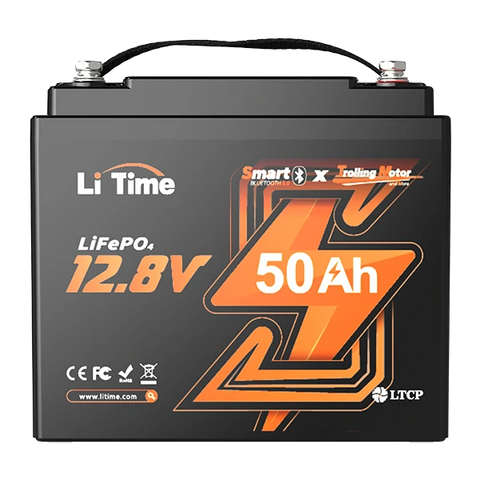
LiTime 12V 50Ah TM Smart
Compact power for lighter kayak setups and short-to-moderate fishing trips. It packs 640Wh energy, Bluetooth monitoring, low-temperature charging protection, IP65 waterproof protection, and a 50A BMS in an 11.27 lb battery built for 20–70 lb trolling motors.

2. Standard Single Fishing Kayaks
A standard fishing kayak often carries more than the paddler realizes: a fish finder, tackle boxes, rods, anchors, a crate, safety equipment, food, and sometimes a cooler. These kayaks commonly use 30–45 lb thrust motors.
For this category, the decision between a 50Ah and 100Ah battery depends mainly on trip length and conditions.
| Fishing Style | Trolling Motor | Recommended LiTime Battery | Best For |
|---|---|---|---|
| Short trips in calm water | 30–40 lb, 12V | 12V 50Ah TM Smart | Lower battery weight and basic runtime |
| Half-day fishing | 30–45 lb, 12V | 12V 50Ah or 100Ah TM | Moderate motor use |
| Frequent spot-hopping | 40–45 lb, 12V | 12V 100Ah TM | More reliable runtime |
| Fish finder plus trolling motor | 40–45 lb, 12V | 12V 100Ah TM Smart | Better power reserve and battery monitoring |
A 12V 50Ah battery can work for 33–55 lb kayak trolling motors under lighter-use conditions, but it provides less margin for wind, current, frequent high-speed operation, and a long return trip. For anglers who fish regularly or want confidence that they can get back to the launch, a 12V 100Ah battery is usually the better long-term choice.
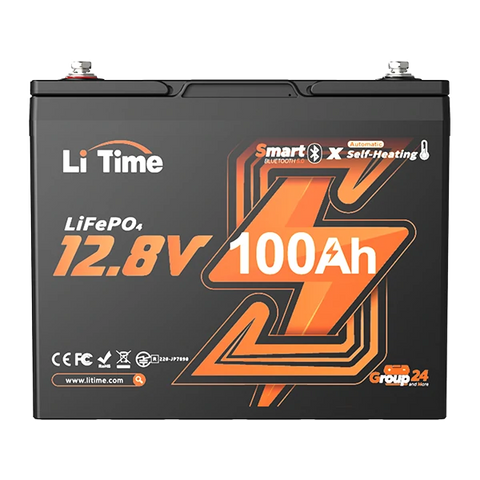
LiTime 12V 100Ah Group 24 Bluetooth Self-Heating Battery
A stronger cold-weather pick for anglers who want more reserve than 50Ah. Bluetooth monitoring, dual-mode self-heating, low-temperature protection, and a 100A BMS make it a practical upgrade for longer fishing days and colder launch conditions.
3. Large Fishing and Pedal Kayaks
Wide fishing kayaks and pedal-driven kayaks are often better suited to 45–55 lb thrust trolling motors. These boats have more stability, larger battery storage areas, and greater payload capacity, making a 12V 100Ah battery a strong match.
Best setup
| Kayak Setup | Trolling Motor | Recommended LiTime Battery |
|---|---|---|
| 12–14 ft fishing kayak | 45 lb, 12V | LiTime 12V 100Ah TM |
| Pedal kayak with motor mount | 45–55 lb, 12V | LiTime 12V 100Ah TM Smart |
| Motor-ready fishing kayak | 45–55 lb, 12V | LiTime 12V 100Ah TM Plus Smart |
| Windy lake or mild-current river fishing | 55 lb, 12V | LiTime 12V 100Ah TM Plus Smart |
A 12V 100Ah LiFePO4 battery is especially suitable for all-day kayak fishing, frequent repositioning, and 45–55 lb thrust motors. LiTime’s trolling motor-focused 12V 100Ah batteries are designed for deep-cycle propulsion use and are built with BMS protection intended for motor loads. LiTime estimates that a 100Ah battery may provide roughly 2–3.5 hours of trolling-motor runtime at full power; lower-speed operation generally extends runtime substantially.
For example, a 55 lb thrust motor may draw close to 50A at full power. A 100Ah battery may therefore provide around two hours of full-throttle operation, but kayak anglers rarely run continuously at maximum speed. At lower settings, the same battery can support several more hours of practical fishing use.

LiTime 12V 100Ah Group 27 Lithium Battery
A good all-day 12V choice when runtime and fit both matter. The Group 27 design fits RV and marine battery spaces, while Bluetooth 5.0 monitoring, 1200Wh usable energy, 100A BMS protection, IP65 protection, and low-temp safeguards help support longer kayak fishing trips.
4. Tandem Kayaks
Tandem kayaks need more battery reserve because their fully loaded weight is much higher. Two people, additional fishing equipment, safety gear, and a larger hull all increase drag and power demand. A 12V 45–55 lb thrust motor paired with a 12V 100Ah battery is usually the most balanced configuration.
| Tandem Kayak Use | Trolling Motor | Recommended LiTime Battery |
|---|---|---|
| Short recreational trips | 45 lb, 12V | LiTime 12V 100Ah TM |
| All-day fishing for two | 55 lb, 12V | LiTime 12V 100Ah TM Smart |
| Wind, current, or heavy gear | 55 lb, 12V | LiTime 12V 100Ah TM Plus Smart |
For tandem kayaks, prioritize usable runtime and safe return capacity over minimum battery weight. Even so, avoid placing the entire system at the stern. If the trolling motor is transom-mounted, placing the battery closer to the middle of the kayak can improve trim, reduce stern squat, and help maintain better handling in chop.
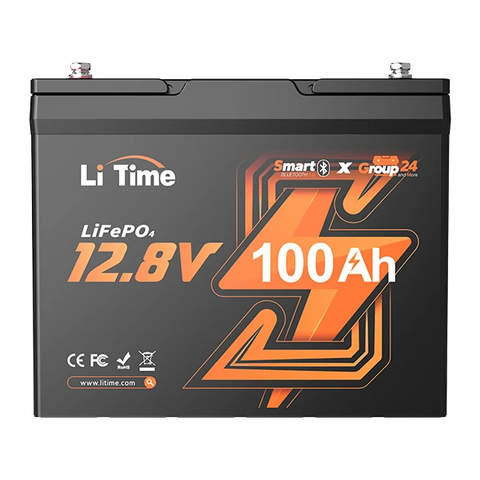
LiTime 12V 100Ah Group 24 Smart Bluetooth Battery
A balanced 12V 100Ah smart option for kayak anglers who want more runtime without moving to a larger 24V setup. Group 24 sizing, Bluetooth app monitoring, low-temperature charging cut-off, and Grade-A prismatic cells make it easy to manage power on the water.
5. Heavy-Duty and Modified Kayaks
A heavily modified fishing kayak, kayak-skiff, or hybrid kayak may be capable of handling a 24V trolling motor with 70–80 lb thrust. This is not a standard upgrade for every kayak. It requires a stable hull, adequate payload capacity, a reinforced motor mount, appropriate wiring, circuit protection, and careful weight distribution.
| Heavy-Duty Kayak Setup | Trolling Motor | Recommended LiTime Battery | Best Use |
|---|---|---|---|
| Large kayak with moderate 24V needs | 70–80 lb, 24V | LiTime 24V 50Ah TM Smart | Short to medium runs |
| Heavy fishing platform | 70–80 lb, 24V | LiTime 24V 100Ah TM Smart | All-day fishing |
| Kayak-skiff or hybrid hull | 70–100 lb, 24V | LiTime 24V 100Ah Group 31 TM Smart | Heavy loads and long range |
A 24V battery system can provide stronger performance in wind and current, but it also adds cost, weight, complexity, and installation requirements. Minn Kota generally associates 68–80 lb thrust motors with 24V systems.
For these larger platforms, a single LiTime 24V battery can be simpler than wiring two 12V batteries in series. It reduces the number of cables, terminals, and connection points that need to be protected from vibration and moisture. LiTime’s 24V 50Ah TM Smart is aimed at high-thrust marine propulsion needs, while LiTime 24V 100Ah Group 31 TM Smart models offer approximately 2,560Wh of stored energy for longer runtimes and higher-demand 70–100 lb thrust applications.
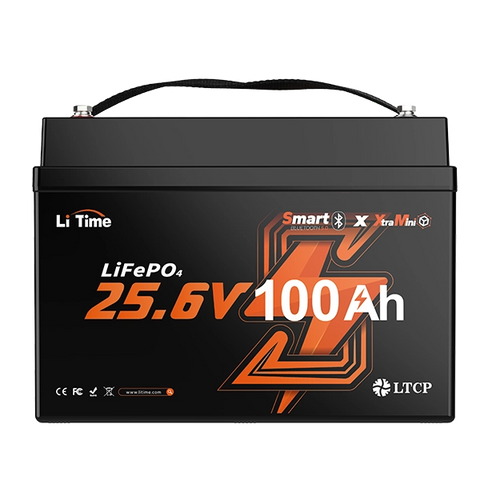
LiTime 24V 100Ah Group 31 Marine Lithium Battery
Built for serious 24V trolling motor setups. This Group 31 marine battery supports 70–100 lb trolling motors, replaces two 12V batteries, reduces wiring, delivers 2560Wh energy, and adds Bluetooth 5.0 monitoring for confident power management.
Conclusion
For a kayak trolling motor, choose in this order: exact motor voltage → maximum current versus battery continuous rating → trip energy and return reserve → kayak load and fit → charger and circuit protection. On a compact 12V motor, a LiTime 50Ah TM battery can keep the setup lighter for shorter trips. For a 50–55 lb motor that draws 50–52A, or a longer day under power, the LiTime 12V 100Ah TM is generally the more useful candidate if it fits your kayak. Browse LiTime trolling motor batteries with your motor manual and kayak load rating in hand.
FAQs
Is a 50Ah battery enough for a kayak trolling motor?
It can be for a compatible low-draw 12V motor and a shorter trip. Verify that the motor’s maximum draw is supported by the battery’s continuous discharge rating, then estimate runtime from your average draw and keep a return reserve. A 50Ah label by itself cannot guarantee a fixed trip length.
How long will a 100Ah battery run a kayak trolling motor?
There is no universal answer. With an illustrative 80Ah usage budget and 20A average motor draw, the estimate is four hours; at 40A average, it is two hours. Wind, speed, hull load, and other devices change the result. These are calculations under stated assumptions, not field-tested runtimes.
Can a 12V 50Ah LiTime battery run a 55 lb kayak motor?
Check the specific 55 lb motor. LiTime’s linked 12V 50Ah TM model lists 50A continuous discharge. That equals the Minn Kota Endura Max 55’s 50A maximum and is below the Newport Kayak Series 55 and MotorGuide Xi3 Kayak 55 figures of 52A. For those 52A examples, the linked LiTime 12V 100Ah TM is the better electrical candidate.
Can I use one battery for the trolling motor and fish finder?
Possibly, if the devices’ voltage requirements, combined current, wiring, and circuit protection are handled correctly. The fish finder reduces available trolling energy and may encounter motor-related electrical interference. Check both manuals; a separate electronics battery may be useful when interference or reserve is a concern.
Does a Newport NK180 or NK300 use the same battery as a trolling motor?
Do not assume so. Newport classifies its NK180 and NK300 as primary-propulsion electric kayak motors and specifies 24V and 36V systems, respectively. A LiTime trolling-motor battery page cautions that an electric outboard may require different surge performance; a LiTime marine solution page presents broader outboard use for one 24V battery. Resolve the exact pairing with both manufacturers before advertising it as compatible.

