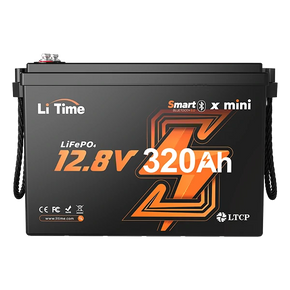


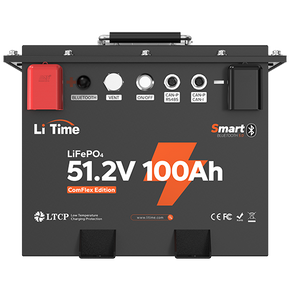

In a 24V 50Ah vs 60Ah vs 100Ah comparison, choose 50Ah for the lightest setup and shorter trips, 60Ah when you want 20% more runtime without moving to a large pack, and 100Ah for long days, frequent GPS-anchor use, heavy boats, wind, or current. Capacity is only half the decision. The battery's continuous BMS output must also meet the trolling motor's maximum current.
Quick Verdict: Which 24V Battery Size Should You Choose?
| Capacity | Nominal energy at 25.6V | Best for | Main advantage | Main limitation |
|---|---|---|---|---|
| 50Ah | 1,280Wh | Light boats, space-sensitive builds, short-to-medium trips, motors within BMS limit | Lowest weight and smallest case | Least runtime; some 50A packs do not cover a 56A motor maximum |
| 60Ah | 1,536Wh | Moderate trips where 50Ah feels tight but 100Ah is more than needed | 20% more energy than 50Ah | BMS and physical specs vary widely by brand |
| 100Ah | 2,560Wh | Long days, GPS anchor, heavy boats, 80–82 lb motors, wind and current | Twice the energy of 50Ah and more reserve | Larger, heavier, and usually more expensive |
The best choice is not based on thrust alone. First match voltage and current. Then calculate the energy needed for the trip. Finally, check fit, weight, charging time, and reserve.
What Changes Between 50Ah, 60Ah, and 100Ah?
At the same nominal voltage, amp-hours scale stored energy and estimated runtime.
- A 60Ah battery stores 20% more energy than a 50Ah battery.
- A 100Ah battery stores about 67% more energy than a 60Ah battery.
- A 100Ah battery stores twice the energy of a 50Ah battery.
For a typical 25.6V LiFePO4 pack:
Energy in watt-hours = 25.6V × amp-hours
That gives 1,280Wh, 1,536Wh, and 2,560Wh for the three sizes. Those are nominal values. Real usable energy can change with temperature, battery condition, BMS behavior, wiring loss, and the reserve you keep for the return trip.
Capacity does not set maximum current. One 60Ah battery may have a 50A BMS while another has an 80A BMS. Read the exact specification sheet rather than guessing from Ah.
Runtime Comparison at Common Trolling-Motor Loads
Use this same-voltage formula for a first estimate:
Ideal runtime in hours = battery capacity in Ah ÷ average current in A
The next table keeps 20% of rated capacity as an example return reserve. It assumes the motor is the only load.
| Average current | 50Ah runtime | 60Ah runtime | 100Ah runtime |
|---|---|---|---|
| 10A | 4.0 hours | 4.8 hours | 8.0 hours |
| 20A | 2.0 hours | 2.4 hours | 4.0 hours |
| 30A | 1.33 hours | 1.6 hours | 2.67 hours |
| 42A | 0.95 hours | 1.14 hours | 1.90 hours |
| 56A | 0.71 hours | 0.86 hours | 1.43 hours |
Why “eight hours of fishing” is not eight hours of motor runtime
An angler may spend eight hours on the lake while the motor runs hard for only one hour, lightly for two hours, and remains idle for the rest. Another angler may use GPS anchor all day in wind. Their battery needs are very different.
Estimate each operating mode:
- Record current while moving slowly along a bank.
- Record current while holding position.
- Record current during longer moves.
- Multiply each current by its operating time.
- Add the amp-hours and divide by the usable fraction you plan to consume.
Three Trip Examples That Make the Choice Clear
These examples use an 80% energy budget so that 20% remains as a planning reserve.
Scenario 1: Calm-water fishing with a 10A average
Four motor-hours at 10A use 40Ah.
Required rated capacity = 40Ah ÷ 0.8 = 50Ah
A 50Ah battery just meets the paper estimate. A 60Ah pack adds useful margin. A 100Ah pack gives the longest reserve but may be unnecessary if weight and space matter.
Scenario 2: Mixed use with a 20A average
Four motor-hours at 20A use 80Ah.
Required rated capacity = 80Ah ÷ 0.8 = 100Ah
The 100Ah option is the clear match. A 50Ah or 60Ah battery cannot meet this target without reducing motor time, reducing average load, or recharging.
Scenario 3: Heavy duty with a 30A average
Four motor-hours at 30A use 120Ah.
Required rated capacity = 120Ah ÷ 0.8 = 150Ah
None of the three single-battery sizes reaches this target. The owner needs a larger approved battery bank, less motor duty, or a shorter trip. Parallel expansion is an option only when the battery maker allows it and the system is designed correctly.
These examples show why 100Ah is not automatically “all day.” At high average current, even 100Ah can be too small.
Should You Choose 50Ah, 60Ah, or 100Ah?
LiTime 24V 50Ah vs a LiTime 24V 60Ah vs LiTime 24V 100Ah
| Specification | LiTime 24V 50Ah TM Smart | LiTime 24V 60Ah Group 24 LiFePO4 Battery | LiTime 24V 100Ah Group 31 TM Smart |
|---|---|---|---|
| Nominal voltage | 25.6V | Commonly 25.6V | 25.6V |
| Rated capacity | 50Ah | 60Ah | 100Ah |
| Nominal energy | 1,280Wh | 1,536Wh | 2,560Wh |
| Continuous discharge | 50A in current spec table | 60A | 100A |
| Approximate weight | 21.15 lb | 26.9lbs | 44.09 lb |
| Case size | Group 24; 10.24 × 6.61 × 8.31 in | L10.24 × W6.61 × H8.31 in (Group 24 Size) | Group 31; 13.11 × 6.93 × 9.45 in |
| Best use | Light, compact, shorter trips | Middle-ground capacity with verified BMS | Longer and harder 24V use |
Use current capability first and runtime second. The capacity comparison below assumes 25.6V LiFePO4 packs and a 20A average motor load.
| Battery size | Nominal energy | Ideal runtime at 20A | Runtime with 20% reserve | Best fit |
|---|---|---|---|---|
| 24V 50Ah | 1,280Wh | 2.5 hours | 2.0 hours | Lighter setup, shorter trips, motor within BMS rating |
| 24V 60Ah | 1,536Wh | 3.0 hours | 2.4 hours | Moderate trips with verified BMS headroom |
| 24V 100Ah | 2,560Wh | 5.0 hours | 4.0 hours | Long days, hard duty, higher reserve, or stronger motors |
When Is 50Ah the Best Choice?
Choose 50Ah when every one of these statements is true:
- Your motor is 24V.
- Its required maximum current is within the battery's continuous rating.
- Your calculated trip energy fits inside the chosen usable budget.
- Low weight and a compact Group 24 case are important.
- You can recharge between trips.
The LiTime 24V 50Ah TM Bluetooth battery is specified at 25.6V, 50Ah, 1,280Wh, and 50A continuous discharge. It can be a candidate for a compatible motor whose maximum draw does not exceed 50A. It should not be substituted for a 60Ah battery without recalculating runtime, and it is not an electrical match for a 56A maximum-load example.

LiTime 24V 50Ah Group 24 TM LiFePO4 Trolling Motor Battery with Bluetooth
A compact 25.6V, 50Ah, 1,280Wh Group 24 option with Bluetooth monitoring and a current specification table listing 50A continuous discharge. Recalculate runtime and check the exact motor maximum current before purchase.
When Is 60Ah the Best Choice?
Choose 60Ah when 50Ah is slightly short but 100Ah adds more weight, size, and cost than the trip requires. It makes sense for moderate use with a known average current and a BMS that covers the motor's maximum draw.
Before buying, verify:
- continuous and short-duration current ratings;
- energy in watt-hours;
- case dimensions and weight;
- low-temperature charge and discharge rules;
- allowed series or parallel expansion;
- charger voltage and charge current;
- water, dust, and corrosion protection claims; and
- whether the pack is designed for deep-cycle marine use.
For the full 60Ah decision, see Is a 24V 60Ah lithium battery enough for a trolling motor?.
The LiTime 24V 60Ah Group 24 trolling-motor battery is specified at 25.6V, 60Ah, 1,536Wh, and 60A continuous discharge. It offers 20% more capacity than the 50Ah model while keeping a compact Group 24 footprint, making it a balanced option for anglers who want more runtime without stepping up to a 100Ah battery. Its 60A continuous output can support compatible 24V trolling motors with a maximum current draw of 60A or less. Always confirm your motor's maximum amp draw before purchase.
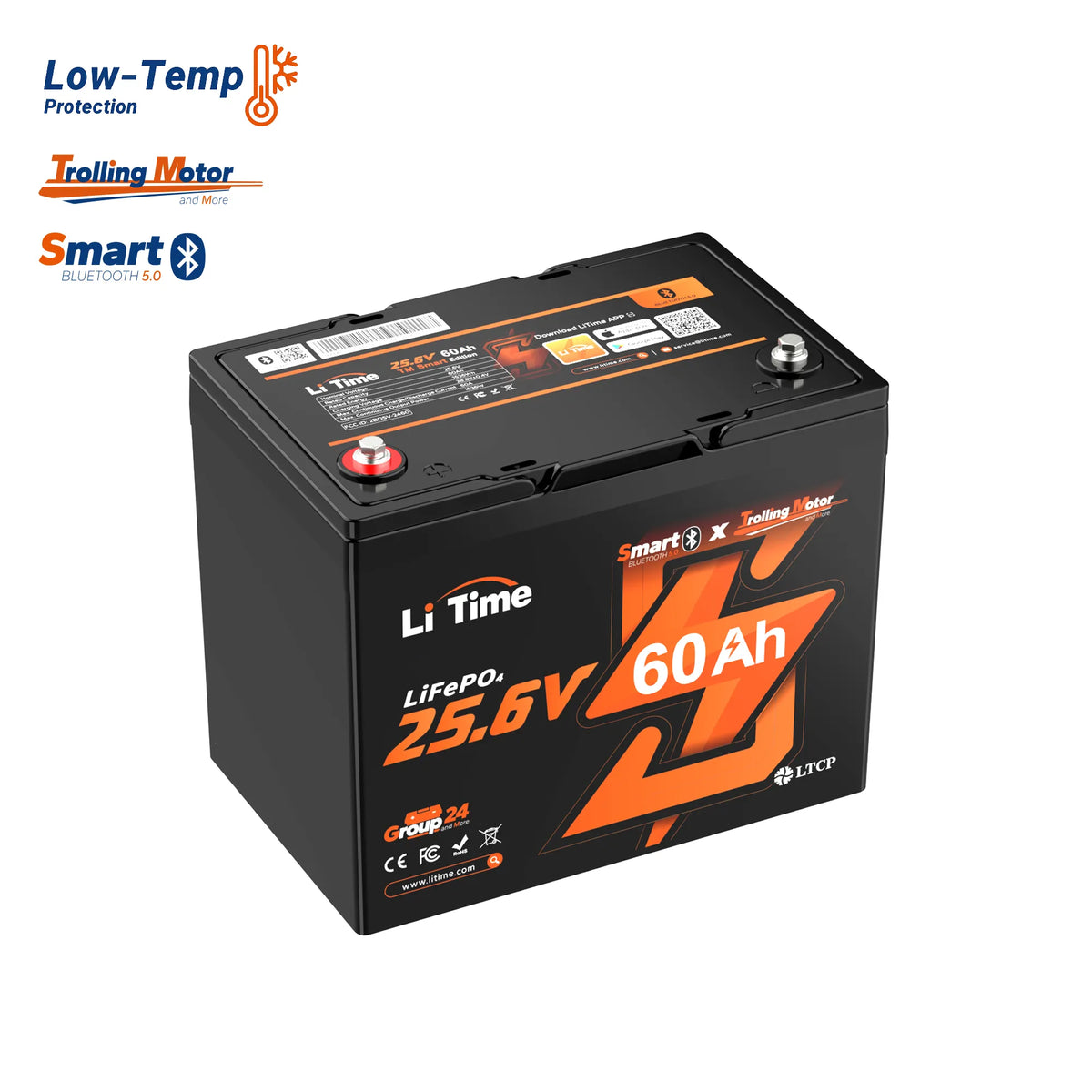
LiTime 24V 60Ah Group 24 LiFePO4 Trolling Motor Battery with Bluetooth
Built for 24V trolling motors, this 60Ah LiFePO4 battery delivers 1536Wh of energy and 60A continuous discharge for steady thrust on the water. One battery can replace two 12V batteries, helping reduce wiring, save space, and cut weight. With Bluetooth 5.0 monitoring, IP65 marine protection, low-temperature protection, and a compact Group 24 size, it is a practical upgrade for anglers who want simpler power and longer time on the water.
When Is 100Ah the Best Choice?
Choose 100Ah when runtime and margin matter more than minimum weight. It is the better fit for:
- 80–82 lb motors with maximum draw near 56A;
- long fishing days or tournament use;
- frequent GPS-anchor use;
- heavy bass boats, pontoons, and loaded skiffs;
- wind, waves, weeds, or current;
- long moves under electric power; and
- owners who want more reserve for aging and unexpected conditions.
The LiTime 24V 100Ah Group 31 trolling-motor battery is specified at 25.6V, 100Ah, 2,560Wh, and 100A continuous discharge. It offers twice the energy of the 50Ah model and much more current headroom for the 56A examples above. Confirm fit, charger, motor approval, and current product specifications before purchase.

LiTime 24V 100Ah Group 31 Bluetooth Lithium Battery for Trolling Motors
A 25.6V, 100Ah, 2,560Wh Group 31 marine battery with a 100A BMS and Bluetooth monitoring. It offers twice the nominal energy of the 50Ah reference and more current headroom for compatible high-demand 24V setups.
For broader selection criteria, see LiTime's trolling-motor battery size guide and marine battery kit guide.
Final Recommendation
For a compatible 70 lb motor and a light boat, start with 50Ah if compact size matters and the runtime calculation works. Move to 60Ah when you need a small 20% capacity increase and can verify the pack's BMS. Choose 100Ah for 80–82 lb motors, long days, heavy loads, GPS anchor, wind, current, and a larger reserve.
The purchase order is simple: match voltage, verify continuous current, calculate trip amp-hours, add reserve, and check fit. Do not let an Ah number or thrust range replace the exact electrical specifications.
Frequently Asked Questions
How much longer does 60Ah run than 50Ah?
At the same voltage and load, 60Ah offers 20% more ideal runtime. A motor averaging 20A has a reserve-adjusted estimate of 2.0 hours on 50Ah and 2.4 hours on 60Ah when keeping 20% in reserve.
How much longer does 100Ah run than 60Ah?
At the same load, 100Ah provides about 67% more ideal runtime than 60Ah. At a 20A average with a 20% reserve, the estimates are 4.0 hours and 2.4 hours.
Is a 50Ah battery enough for a 24V trolling motor?
It can be for a compatible motor, light boat, and shorter trip. The BMS must support the motor's maximum current, and the runtime calculation must include a reserve.
Is 60Ah enough for an 80 lb trolling motor?
Possibly. A published Minn Kota 80 lb example draws up to 56A. The 60Ah battery needs a continuous BMS rating of at least that value, and runtime at high load is limited.
Is 100Ah overkill for a 24V trolling motor?
Not for long trips, a heavy boat, frequent GPS-anchor use, or strong wind and current. It may be more battery than needed for a light boat making short calm-water trips.
Which size is best for Spot-Lock?
Choose from real duty cycle. Occasional calm-water use may fit 50Ah or 60Ah. Frequent holding in wind or current makes 100Ah the safer choice.
Does a bigger Ah battery make the motor faster?
Not by itself. Voltage and motor design control speed and thrust. More amp-hours mainly extend runtime, provided the battery can supply the required current without excessive voltage drop or BMS shutdown.
Does 100Ah mean a 100A BMS?
No. Capacity and maximum current are separate ratings. Always read the BMS continuous discharge specification. The LiTime 24V 100Ah model in this article happens to list both 100Ah capacity and a 100A BMS.
Can a 50Ah battery with a 60A short-term rating run a 56A motor?
Only if the motor's real demand stays within the exact duration and conditions of that short-term rating, which may be difficult to guarantee. Use the continuous rating for a conservative compatibility check unless both makers confirm the pairing.
Which battery is lightest?
In this comparison, LiTime's 24V 50Ah battery is about 21.15 lb. A 60Ah model varies by brand. LiTime's 24V 100Ah Group 31 model is about 44.09 lb.
Can I connect two 24V 50Ah batteries in parallel to make 100Ah?
Only if the battery maker permits parallel use. Use matching batteries, equal-length cables where required, and the specified overcurrent protection. When allowed, the bank remains 24V and becomes 100Ah.
Can these batteries start an outboard engine?
Do not use a deep-cycle trolling-motor battery for engine starting unless the battery and engine makers explicitly approve it. Starting and deep-cycle batteries have different jobs.
Sources
- Minn Kota: Trolling Motor Wiring and Battery Guide
- MotorGuide: Tour and Tour Pro Specifications
- LiTime: 24V 50Ah TM Bluetooth Battery
- LiTime: 24V 100Ah Group 31 Trolling-Motor Battery
- LiTime: Trolling-Motor Battery Size Guide
- LiTime: Trolling-Motor Wiring Guide
- eCFR: 33 CFR Part 183 Subpart I—Electrical Systems

