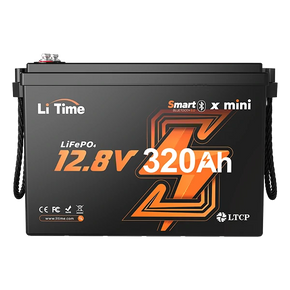


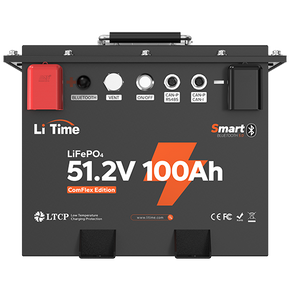

A 24V 60Ah lithium battery can be enough for a trolling motor if the motor is a 24V model, its maximum current does not exceed the battery's continuous BMS rating, and your real energy use fits within 60Ah plus a return reserve. It is a practical size for many 70 lb motors and shorter or moderate-use trips. It can be marginal for an 80–82 lb motor, long GPS-anchor use, heavy boats, strong wind or current, and frequent high-speed operation. In those cases, a 24V 100Ah battery is usually the safer choice.
Is a 24V 60Ah Battery Enough? Use This Quick Test
The table below uses published motor data and a planning reserve of 20%. Runtime at maximum current is a calculation.
| 24V motor example | Published maximum draw | 60Ah battery output needed | Estimated runtime at maximum draw with 20% reserve | Verdict |
|---|---|---|---|---|
| Minn Kota 70 lb class | 42A | At least 42A continuous | About 1.14 hours | Often suitable when normal use is well below maximum |
| Minn Kota 80 lb class | 56A | At least 56A continuous | About 0.86 hours | Electrically possible with the right BMS, but limited for hard use |
| MotorGuide Tour Pro 82 lb | 56A | At least 56A continuous | About 0.86 hours | Better for moderate duty than long high-power runs |
| Minn Kota QUEST 24V | 60A | At least 60A continuous | About 0.80 hours | Borderline; check the exact motor and battery manuals |
Minn Kota's current wiring chart lists 42A maximum draw for its 70 lb 24V class and 56A for its 80 lb 24V class. It lists 60A for a 24V QUEST system. MotorGuide's Tour Pro 82 lb specifications also list 56A at 24V. These are maximum figures. Minn Kota notes that maximum draw occurs only at times and should not be treated as a continuous average.
That distinction matters. Most anglers do not run at full power for the entire trip. A battery that lasts less than one hour at maximum draw may still last several hours when the motor spends much of the day at low speed, making short moves, or cycling in anchor mode. Only your time-weighted average current can produce a useful runtime estimate.

What Does “24V 60Ah” Actually Mean?
A typical 24V-class LiFePO4 battery has a nominal voltage of 25.6V. At 60Ah, its nominal energy is:
25.6V × 60Ah = 1,536Wh
The ratings describe different things:
- Voltage must match the motor's required system voltage.
- Amp-hours describe charge capacity and help estimate runtime.
- Watt-hours describe stored energy and help compare systems across voltages.
- BMS continuous current limits how much current the battery can supply over time.
- Peak or surge current applies only for the stated short duration. It does not replace the continuous rating.
Do not confuse 60Ah with 60A. A 60Ah battery might use a 50A, 60A, 80A, or other BMS. LiTime 24V 60Ah Group 24 LiFePO4 Trolling Motor Battery BMS is 60A.
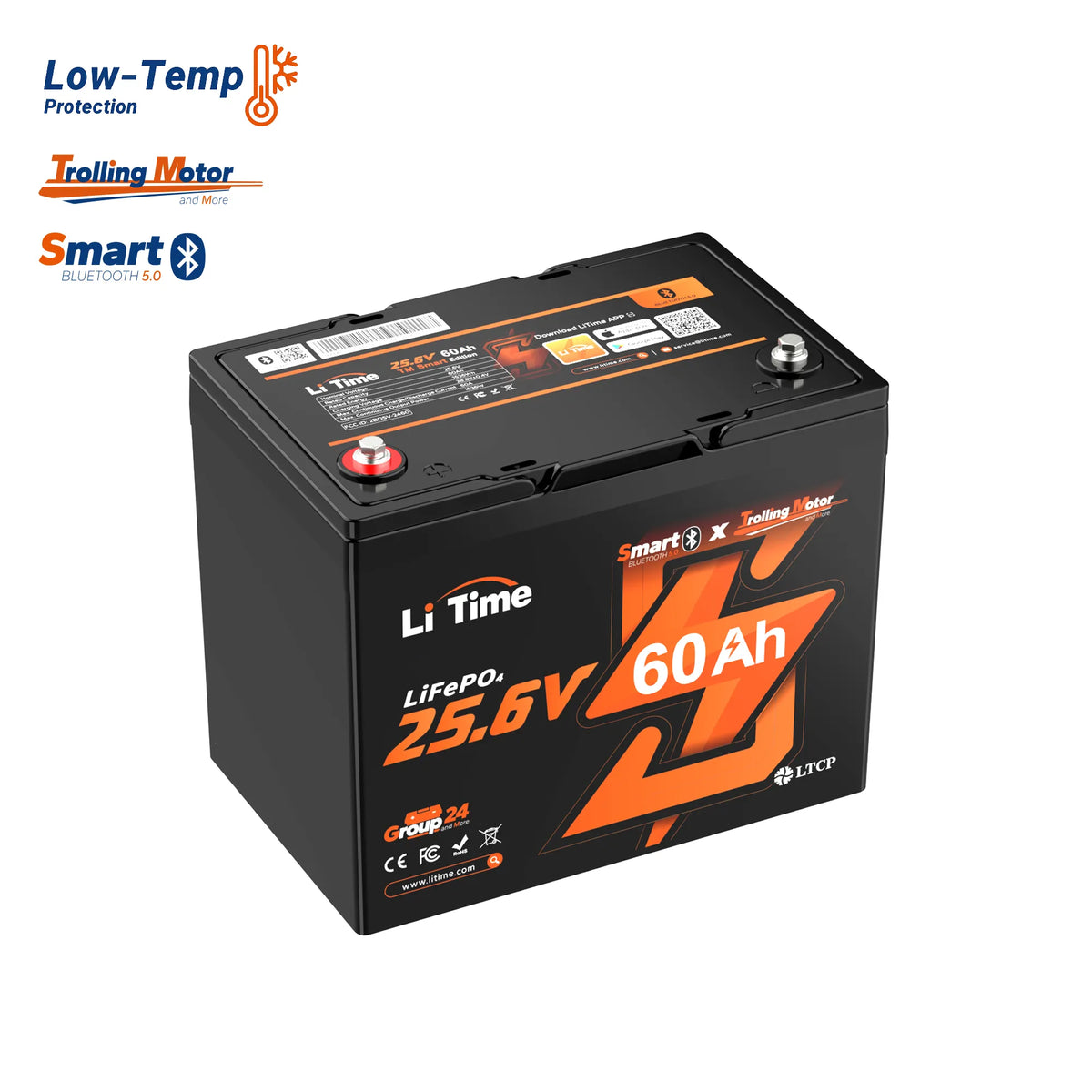
LiTime 24V 60Ah Group 24 LiFePO4 Trolling Motor Battery with Bluetooth
Built for 24V trolling motors, this 60Ah LiFePO4 battery delivers 1536Wh of energy and 60A continuous discharge for steady thrust on the water. One battery can replace two 12V batteries, helping reduce wiring, save space, and cut weight. With Bluetooth 5.0 monitoring, IP65 marine protection, low-temperature protection, and a compact Group 24 size, it is a practical upgrade for anglers who want simpler power and longer time on the water.
How Long Will a 24V 60Ah Lithium Battery Run a Trolling Motor?
Start with this simple same-voltage formula:
Ideal runtime in hours = battery capacity in Ah ÷ average motor current in A
For trip planning, set aside a return reserve:
Planning runtime = capacity × chosen usable fraction ÷ average current
The following table uses a 20% reserve, so the planned energy budget is 48Ah. The reserve is an example, not a rule for every boat.
| Average motor current | Ideal runtime from 60Ah | Runtime with 20% reserve |
|---|---|---|
| 10A | 6.0 hours | 4.8 hours |
| 15A | 4.0 hours | 3.2 hours |
| 20A | 3.0 hours | 2.4 hours |
| 30A | 2.0 hours | 1.6 hours |
| 42A | 1.43 hours | 1.14 hours |
| 56A | 1.07 hours | 0.86 hours |
| 60A | 1.0 hour | 0.8 hours |
These figures assume the motor is the only load and that average current stays fixed. Real runtime also changes with hull drag, boat weight, propeller condition, weeds, wind, waves, current, steering, battery temperature, wiring loss, battery age, and BMS behavior.
A better trip estimate
Record current during typical actions:
- Note the current while moving slowly along a bank.
- Note it while holding position in your usual wind.
- Note it during longer moves between fishing spots.
- Estimate how long you spend in each mode.
- Multiply each current by its hours, then add the results.
For example, two hours at 10A, one hour at 20A, and 30 minutes at 40A use about 60Ah:
(2 × 10) + (1 × 20) + (0.5 × 40) = 60Ah
That plan consumes the full rated capacity on paper. It leaves no return reserve and no allowance for other losses. A larger battery or lighter duty would be wise.
Is 60Ah Enough for a 70 lb Trolling Motor?
It often can be. Minn Kota lists 42A as the maximum draw for its 70 lb 24V class. A 24V 60Ah battery must therefore support at least the motor's published maximum current. With a 20% reserve, the full-power planning estimate is about 1.14 hours.
Normal fishing may last much longer because average draw can be far below 42A. A light aluminum boat on a calm lake may spend most of the day at low output. A heavy boat fighting current can use energy far faster.
A 60Ah battery is most credible here when:
- the BMS continuous rating meets or exceeds the motor's maximum draw;
- trips are short or moderate in length;
- the boat is not heavily loaded;
- high power is used only for brief moves;
- the battery is charged after each trip; and
- the operator keeps a planned return reserve.
Is 60Ah Enough for an 80 or 82 lb Trolling Motor?
It may work, but the current rating and duty cycle become critical. Minn Kota's 80 lb class and MotorGuide's Tour Pro 82 lb models list 56A maximum draw at 24V. A battery with only a 50A continuous BMS is not an adequate electrical match for that maximum load, even if the case says 60Ah.
With a BMS rated for at least the motor's maximum current, the motor can be compatible in principle. Runtime is the next limit. A 60Ah pack offers only about 51 minutes at 56A when the plan keeps 20% in reserve.
Choose 100Ah instead when you often:
- run at high power for long moves;
- use GPS anchor or Spot-Lock in wind or current;
- fish from a heavy bass boat, pontoon, or loaded skiff;
- start before sunrise and return late;
- fish tournaments or places where losing motor power has serious consequences; or
- want more capacity for battery aging and unexpected conditions.
Does GPS Anchor or Spot-Lock Change the Answer?
Yes, because anchor modes can turn a light-load day into a high-duty day. On calm water, the motor may pulse only now and then. In strong wind or current, it may steer and apply thrust often. The same battery can therefore last very different lengths of time on two trips.
Do not size the battery from the hours spent fishing alone. Estimate the share of that time the motor will actually work. If anchor mode is central to your fishing style, review real current history through a battery monitor or smart battery. A 100Ah class gives more room for hard-to-predict duty cycles.
Why the BMS Rating Matters as Much as 60Ah
The BMS protects a lithium battery against conditions such as excess current, low voltage, and temperature limits. If motor demand exceeds the pack's continuous rating, the BMS may shut the battery down. That can stop the motor even when the battery still has stored energy.
Check all four current values before purchase:
- The motor's maximum amp draw.
- The battery's continuous discharge rating.
- The battery's surge rating and allowed duration.
- The breaker or fuse requirement in the motor manual.
The breaker does not raise the battery's output ability. A 60A breaker cannot turn a 50A BMS into a 60A source. The BMS, cable, connector, breaker, and motor must all suit the same circuit.
One 24V 60Ah Battery or Two 12V 60Ah Batteries?
Both arrangements can create a 24V 60Ah bank when the equipment allows them.
One 24V 60Ah battery
A single battery uses fewer cables, terminals, trays, and charge channels. It can save space and reduce connection points. It also creates one battery-level point of failure.
Two 12V 60Ah batteries in series
Series wiring adds the voltages while capacity stays the same:
12V 60Ah + 12V 60Ah in series = 24V 60Ah, not 24V 120Ah
Use batteries that are approved for series connection. They should match in model, chemistry, capacity, BMS design, age, and state of charge. LiTime's trolling-motor wiring guide also calls for identical batteries in a series string. Follow the battery maker's charging and balancing instructions.
Do not mix a starting battery with a deep-cycle battery. Do not mix old and new packs or different capacities. The weakest battery can limit the entire series bank.
What Else Must You Check Before Installing It?
Use the right charger
Use a charger approved for the battery chemistry, nominal voltage, and maker's charge-voltage range. A charger labeled only “24V” is not automatically right for every 24V battery.
Follow the motor's breaker and wire table
Cable length changes the required wire size. Measure the full circuit as the maker directs. Use marine-grade connections, protect cables from abrasion, and keep terminals tight and dry.
Confirm the battery's use case
A deep-cycle trolling-motor battery is not an engine-starting battery unless its maker explicitly rates it for cranking. Do not use surge current alone to justify engine starting.
Count other loads separately
If a fish finder, lights, pumps, or USB outlets share the bank, subtract their energy use. Sensitive sonar may also experience motor interference. LiTime's guide to sharing a battery between a fish finder and trolling motor explains the wiring and interference tradeoffs.
Test under real load
After installation, test the motor through its speed range in a controlled setting. Watch battery current, voltage, temperature, and state of charge. Check cables and terminals for heat. Stop if the BMS trips, connectors heat up, voltage falls abnormally, or the motor maker's warnings appear.
The Bottom Line
A 24V 60Ah lithium battery is enough for many 24V trolling-motor owners who use moderate power, take shorter trips, and run a 70 lb class motor. It may also work with an 80–82 lb motor, but only when the battery's continuous BMS rating meets the motor's maximum current. Runtime at hard load will be limited.
Choose 100Ah when you want a full-day margin, use GPS anchor often, carry a heavy load, fight wind or current, or run near maximum power for long periods. The best answer comes from two separate checks: current compatibility and an energy budget with a return reserve.
Frequently Asked Questions
How long will a 24V 60Ah battery run a trolling motor?
Divide 60Ah by the motor's average current. At 10A, the ideal estimate is six hours. At 20A, it is three hours. With a 20% planning reserve, those estimates become 4.8 and 2.4 hours. Actual runtime varies with boat and water conditions.
Can a 24V 60Ah battery run an 80 lb trolling motor?
Possibly. Minn Kota and MotorGuide examples in the 80–82 lb class list 56A maximum draw. The battery must support at least that continuous current. A 50A BMS is not enough for a 56A maximum-load requirement.
Is 60Ah enough for a 70 lb trolling motor?
Often, yes. A published Minn Kota 70 lb example has a 42A maximum draw. A compatible 60Ah battery can suit moderate use, but runtime still depends on average current, boat load, wind, and reserve.
Is a 24V 60Ah battery the same as two 12V 60Ah batteries?
They can provide the same nominal bank voltage and capacity when two approved 12V 60Ah batteries are wired in series. The single-battery setup uses fewer connections. Check each maker's series-wiring rules.
Do two 12V 60Ah batteries in series make 120Ah?
No. Series wiring adds voltage, not amp-hour capacity. The result is a 24V 60Ah bank. In energy terms, the watt-hours of both batteries are combined.
What BMS rating does a 24V 60Ah trolling-motor battery need?
Its continuous discharge rating must meet the exact motor's maximum current requirement. Also verify short surge behavior, temperature limits, and all battery and motor instructions.
Is 100Ah better than 60Ah for a trolling motor?
It provides about 67% more capacity than 60Ah at the same voltage. It is better for long trips, high duty, heavy boats, current, wind, and a larger return reserve. It also costs and weighs more.
Does Spot-Lock use more battery?
It can in wind or current because the motor may steer and apply thrust often. In calm water it may use much less. Measure real average current if anchor mode is a major part of the trip.
Can the fish finder use the same 24V battery?
Only if the fish finder accepts the battery's full voltage range. Many marine electronics are 12V devices. Do not connect a 12V-only unit directly to a 24V bank; use compatible separate power or a correctly specified converter.
Can I start an outboard engine with a 24V 60Ah deep-cycle battery?
Not unless the battery and engine makers explicitly approve that use. A trolling-motor battery is normally designed for deep cycling, not engine cranking.
What charger should I use for a 24V 60Ah LiFePO4 battery?
Use a LiFePO4 charger whose output and charge profile match the battery maker's specifications. Check voltage, charge current, low-temperature behavior, and BMS recovery requirements.
Can I connect two 24V 60Ah batteries in parallel for 120Ah?
Only if the battery maker permits parallel connection. Use matching batteries, required cables and protection, and the maker's setup procedure. When allowed, parallel wiring keeps voltage at 24V and increases capacity to 120Ah.
Sources
- Minn Kota: Trolling Motor Wiring and Battery Guide
- MotorGuide: Tour and Tour Pro Specifications
- LiTime: 24V 50Ah TM Bluetooth Battery
- LiTime: 24V 100Ah Group 31 Trolling-Motor Battery
- LiTime: Trolling-Motor Battery Size Guide
- LiTime: Trolling-Motor Wiring Guide
- eCFR: 33 CFR Part 183 Subpart I—Electrical Systems

