


If you're tired of the back-breaking weight, short lifespan, and constant maintenance of traditional lead-acid batteries, you're in the right place. The energy world has been revolutionized by LiFePO4 (Lithium Iron Phosphate) technology, offering a modern solution that's lighter, safer, more powerful, and lasts dramatically longer.
LiTime is at the forefront of this revolution, but choosing the right battery can still be tricky. We're here to help. This guide will take a deep dive into three of LiTime’s top-rated 12V 100Ah batteries: the ultra-compact Mini, the convenient Group 24, and the all-weather Self-Heating Group 24. By the end, you'll know with confidence which one is the perfect power source for your specific adventure.
- Understanding the Basics: What Do "Group 24" and "BMS" Mean?
- Head-to-Head: A Detailed Feature Comparison
- Key Comparison Point 1: Physical Footprint (Size & Weight)
- Key Comparison Point 2: Installation & Form Factor
- Key Comparison Point 3: Cold Weather Performance
- Key Comparison Point 4: Smart Monitoring (Bluetooth)
- Application Showdown: Which LiTime Battery is Right for Your Setup?
- Frequently Asked Questions (FAQ)
- Conclusion: Making Your Final Decision
Understanding the Basics: What Do "Group 24" and "BMS" Mean?
Before we compare, let's clarify two key terms.
- What is a BCI Battery Group Size? You'll see numbers like "Group 24" on many batteries. This isn't a measure of power, but of physical size. The Battery Council International (BCI) created these standard dimensions to ensure batteries from different brands fit into the same vehicle or battery box. Choosing a Group 24 LiFePO4 battery means it will be a "drop-in replacement" for an old Group 24 lead-acid battery.
- What is a BMS? The Battery Management System (BMS) is the battery's brain. This vital internal component constantly monitors the battery's health and protects it from potential damage. It prevents over-charging, over-discharging, over-heating, and short circuits. The advanced BMS in LiTime batteries is what ensures their incredible safety and longevity.

Head-to-Head: A Detailed Feature Comparison
While all three batteries deliver 12V 100Ah of clean power, their designs serve very different purposes.
| Feature | LiTime 12V 100Ah Mini | LiTime 12V 100Ah Group 24 | LiTime 12V 100Ah Self-Heating Group 24 |
|---|---|---|---|
| Primary Advantage | Most Compact & Lightweight | Easy Drop-in Replacement | All-Weather Charging |
| Dimensions | 10.24" x 5.24" x 8.96" | 10.24" x 6.61" x 8.27" | 10.24" x 6.61" x 8.27" |
| Weight | 19 lbs | 21.87 lbs | 22.71 lbs |
| Self-Heating | No | No | Yes |
| Bluetooth | Optional | Optional | Included |
Key Comparison Point 1: Physical Footprint (Size & Weight)
Winner: LiTime Mini
The Mini’s name says it all. At only 19 lbs, it's about 15% lighter than its Group 24 siblings and boasts a significantly smaller footprint. This isn't just a minor convenience; it's a game-changer where every inch and ounce counts. This weight saving can free up valuable payload capacity in an RV and its compact size allows for more flexible installation in tight compartments or custom battery boxes.
.webp)
Key Comparison Point 2: Installation & Form Factor
Winner: LiTime Group 24
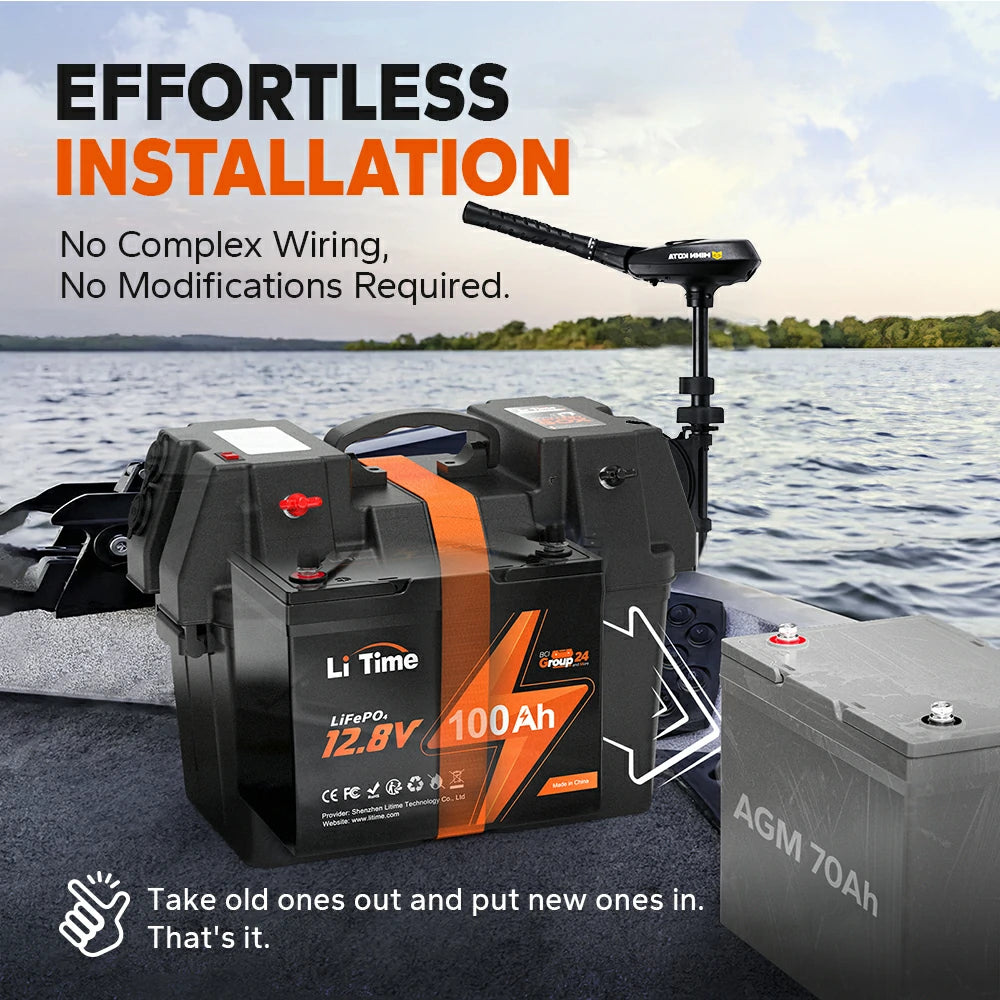
If you are upgrading from an old lead-acid battery, the Group 24 models are your best friend. They are built to the standard BCI Group 24 dimensions, meaning you can simply pull your old, heavy battery out and drop the new, lightweight LiTime battery into the existing tray or box. No modifications, no custom brackets, no hassle.
Key Comparison Point 3: Cold Weather Performance
Winner: LiTime Self-Heating Group 24
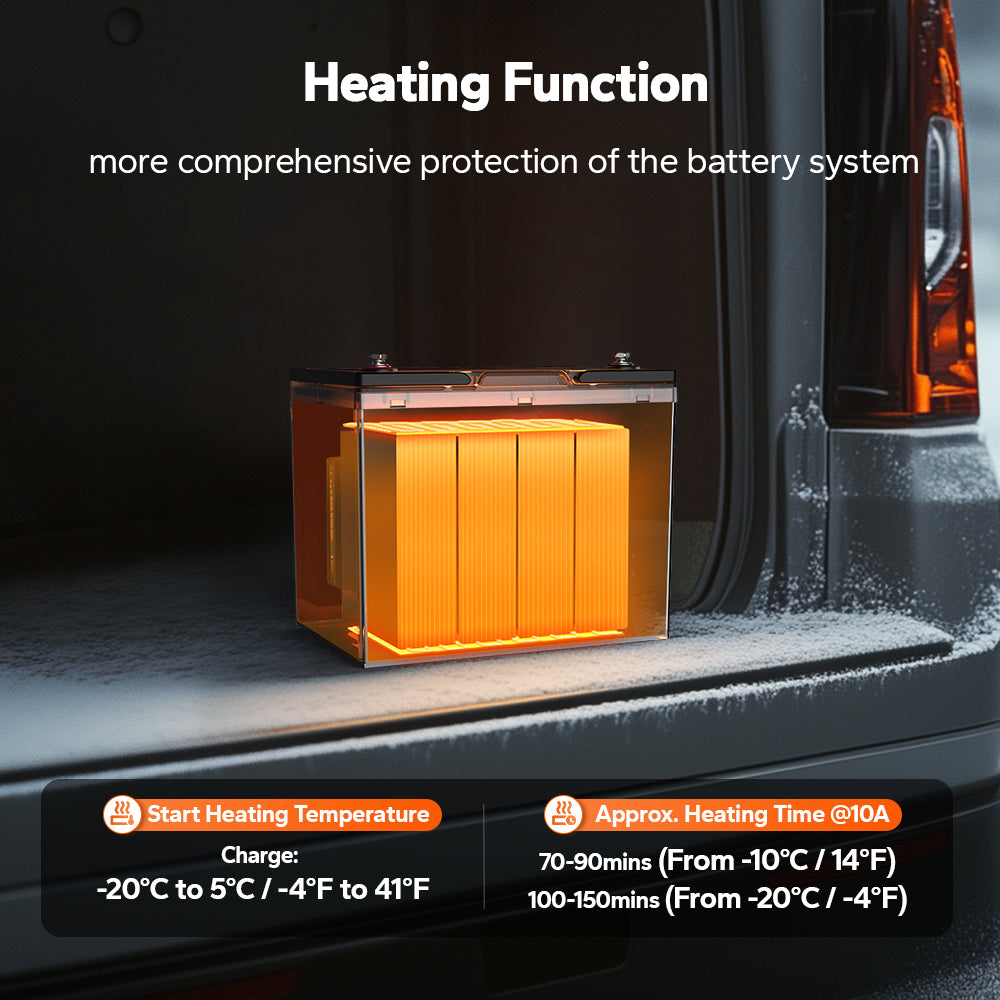
This is arguably the most critical difference. A fundamental limitation of all standard LiFePO4 batteries is that they cannot be charged in temperatures below freezing (0°C or 32°F) without risking permanent cell damage. The Self-Heating Group 24 completely eliminates this problem. Its intelligent BMS automatically detects freezing temperatures and uses the incoming charger power to gently warm the internal cells first. Once they reach a safe temperature, the BMS seamlessly switches over to charging the battery. This is a non-negotiable feature for reliable, all-season power.
Key Comparison Point 4: Smart Monitoring (Bluetooth)
Winner: All "Smart" Models
Both the Mini and Group 24 batteries are available with an optional Bluetooth upgrade, while the Self-Heating model includes it standard. This feature is a must-have for serious users. The LiTime smartphone app connects to your battery and gives you real-time data on State of Charge (SoC), voltage, current draw, and temperature. This takes all the guesswork out of your power management, helping you plan your energy usage and monitor your battery’s long-term health.
Application Showdown: Which LiTime Battery is Right for Your Setup?
Let's put these batteries into real-world scenarios to find your perfect match.
For the RV & Van Life Enthusiast:
- If you're replacing an old Group 24 lead-acid battery in your RV's factory-built compartment, the Group 24 offers the easiest, most straightforward installation.
- If you're designing a custom camper van build and need to fit a powerful battery into a tight, unconventional space, the Mini gives you the most design flexibility.
- If you plan to camp in the mountains, chase ski-season powder, or travel in late autumn, the Self-Heating Group 24 is the only choice that guarantees you can recharge your system when the temperatures plummet.
For the Marine Captain (Boats, Trolling Motors, Kayaks):
- For kayaks or small fishing boats where weight is paramount, the ultra-light Mini is the clear winner.
- For larger boats with standard battery compartments, the Group 24 provides a seamless, drop-in power upgrade for your trolling motor and electronics.
- If you're an avid ice-fisher, the Self-Heating Group 24 is essential for keeping your fish finder and other electronics running and rechargeable on the ice.
For the Off-Grid Homesteader:
- All three models can be connected up to 4 in series for a 48V system or 4 in parallel for a 400Ah bank. However, if your cabin or homestead is located in a region with cold winters, investing in the Self-Heating Group 24 is crucial for the reliability of your solar power system.
Frequently Asked Questions (FAQ)
Q1: Can I use my old lead-acid battery charger?
No. To ensure safety, performance, and longevity, you must use a charger specifically designed for LiFePO4 batteries. A lead-acid charger uses a different charging profile that can damage a lithium battery.
Q2: How long will these batteries actually last?
With a cycle life rated at over 4,000 cycles to 100% Depth of Discharge, these batteries are built to last over a decade, even with frequent use. For an average weekend user, this could translate to a 15-20 year service life.
Q3: Are LiTime LiFePO4 batteries safe?
Absolutely. LiFePO4 is the safest and most chemically stable lithium battery chemistry. This, combined with the multi-layered protection of the advanced internal BMS, makes them exceptionally safe for all applications.
Q4: Can I use these batteries to start my engine?
No. These are deep-cycle batteries designed to provide sustained, steady power over a long period. They are not designed to deliver the massive, short burst of energy required for engine starting. You can visit LiTime Marine Starting Batteries for specific need.
Q5: Do they support series or parallel connection?
Yes, all LiTime 12V LiFePO4 batteries can be connected to build a larger battery bank, supporting up to 4 in series and 4 in parallel (4S4P).
For the safety and longevity of your system, it is crucial that you only connect identical batteries. Please follow these conditions:
- All batteries must have the same capacity (Ah) and BMS (A).
- All batteries must be the same model from the same brand (e.g., do not mix a Mini with a Group 24).
- All batteries should be purchased within a close timeframe (e.g., one month) to ensure they are from a similar batch.
For more detailed instructions, please see our guide on Matters Needing Attention in Parallel and Series Connections.
Conclusion: Making Your Final Decision
Your perfect LiTime battery is waiting. To make the final choice, just answer these three simple questions:
1. Is minimizing space and weight your absolute top priority?
→ Your choice is the LiTime 12V 100Ah Mini.
2. Do you need a simple, hassle-free drop-in replacement for a standard-sized battery?
→ Your choice is the LiTime 12V 100Ah Group 24.
3. Will you EVER need to charge your battery in freezing temperatures?
→ Your choice is the LiTime 12V 100Ah Self-Heating Group 24.
By matching your unique needs to the specific strengths of each battery, you can invest with confidence and unlock a new level of reliable, lightweight, and long-lasting power for your adventures.

