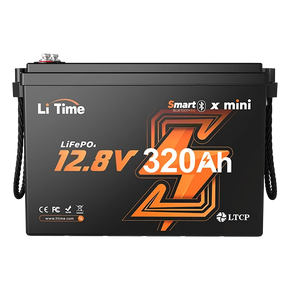


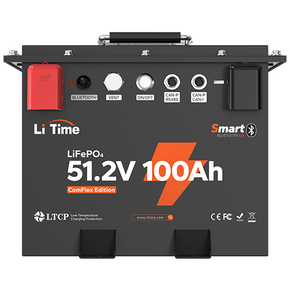

The best 12V 100Ah lithium battery for a trolling motor combines suitable power delivery with features that fit your fishing routine. LiTime’s Group 27 Bluetooth is a practical choice for everyday small-boat fishing, while the TM Plus offers additional support for changing loads. The OBM suits compatible electric outboard applications, and the Group 24 Self-Heating Bluetooth adds charging convenience for cold-weather anglers.
Table of Contents
Which 12V 100Ah Lithium Battery Fits Your Trolling Motor?
For everyday fishing, convenient monitoring and manageable installation are valuable starting points. Frequent repositioning, electric outboard use, and cold-weather charging introduce different priorities. These four LiTime batteries address those needs while retaining a rated 100Ah capacity.
| Fishing scenario | Recommended LiTime battery | Key advantages |
|---|---|---|
| Everyday fishing on small boats | 12V 100Ah Group 27 Bluetooth | Bluetooth monitoring, 100A continuous discharge, Group 27 case |
| Frequent positioning and changing loads | 12V 100Ah TM Plus | Time-limited higher-current support, smart BMS, Bluetooth |
| Fishing boats with electric outboards | 12V 100Ah OBM | Electric-propulsion applications, Bluetooth, flexible system configurations |
| Cold-weather fishing and charging | 12V 100Ah Group 24 Self-Heating | Built-in heating, Bluetooth, Group 24 format |
LiTime 12V 100Ah Group 27 Bluetooth — For Everyday Fishing on Small Boats
The LiTime 12V 100Ah Group 27 Bluetooth is a practical option for lake and pond fishing with a compatible 12V trolling motor. It fits the routine of moving between nearby spots, working along a shoreline, and making occasional position adjustments.

Its 100A continuous discharge capability supplies compatible motor loads, while Bluetooth monitoring makes battery-status checks convenient throughout the trip. Seeing consumption between moves can help anglers understand how their fishing habits affect remaining power.
The battery measures 12.09 × 6.81 × 8.86 inches and weighs approximately 22.85 lbs. Its shorter case provides an alternative to the 13-inch Group 31 models, particularly where compartment length is limited. Low-temperature protection and an IP65 enclosure round out its features for outdoor use.
For recreational anglers, the appeal is straightforward: 100Ah capacity, accessible battery information, and a case format that suits a range of small-boat installations.
LiTime 12V 100Ah TM Plus Bluetooth — For Frequent Positioning and Changing Loads
The LiTime 12V 100Ah TM Plus Bluetooth is worth considering for fishing that involves frequent repositioning or GPS anchor-hold operation. These activities can create changing motor loads as the boat responds to wind and current.

Its 100A smart BMS includes low-temperature protection and overload auto-recovery. LiTime also specifies 150A output for up to three minutes, providing additional current capability for temporary demanding loads. Bluetooth monitoring brings battery information to your phone during use.
A relevant scenario is fishing around structure, where the motor repeatedly adjusts boat position while the angler concentrates on casting. The battery’s load-handling features are useful considerations for a motor operating within its documented electrical limits.
The Group 31 case measures 13 × 6.77 × 8.5 inches and weighs approximately 22.6 lbs. Its combination of monitoring and marine-focused protection makes it a strong candidate for a dedicated trolling setup.
LiTime 12V 100Ah OBM — For Fishing Boats with Electric Outboards
The LiTime 12V 100Ah OBM serves boaters exploring electric propulsion as part of their fishing setup. This includes boats using a compatible electric outboard to travel between the launch and fishing areas.

The battery provides 1280Wh of nominal energy, a 100A BMS, Bluetooth monitoring, and IP65 protection. Its documented temporary higher-current capability also supports compatible propulsion loads.
Several core specifications overlap with the TM Plus. The OBM’s place in this selection comes from its electric-outboard application focus, giving boaters another relevant option when planning an electric propulsion system.
For higher-voltage outboards, supported series configurations combine multiple batteries to supply the required system voltage. Motor demand, battery-bank configuration, and charging equipment work together as parts of that installation.
The OBM supplies sustained electric propulsion rather than gasoline-engine starting.
LiTime 12V 100Ah Group 24 Self-Heating Bluetooth — For Cold-Weather Fishing and Charging
The LiTime 12V 100Ah Group 24 Self-Heating Bluetooth adds a useful feature for anglers who fish through autumn and winter: built-in heating for cold-weather charging.
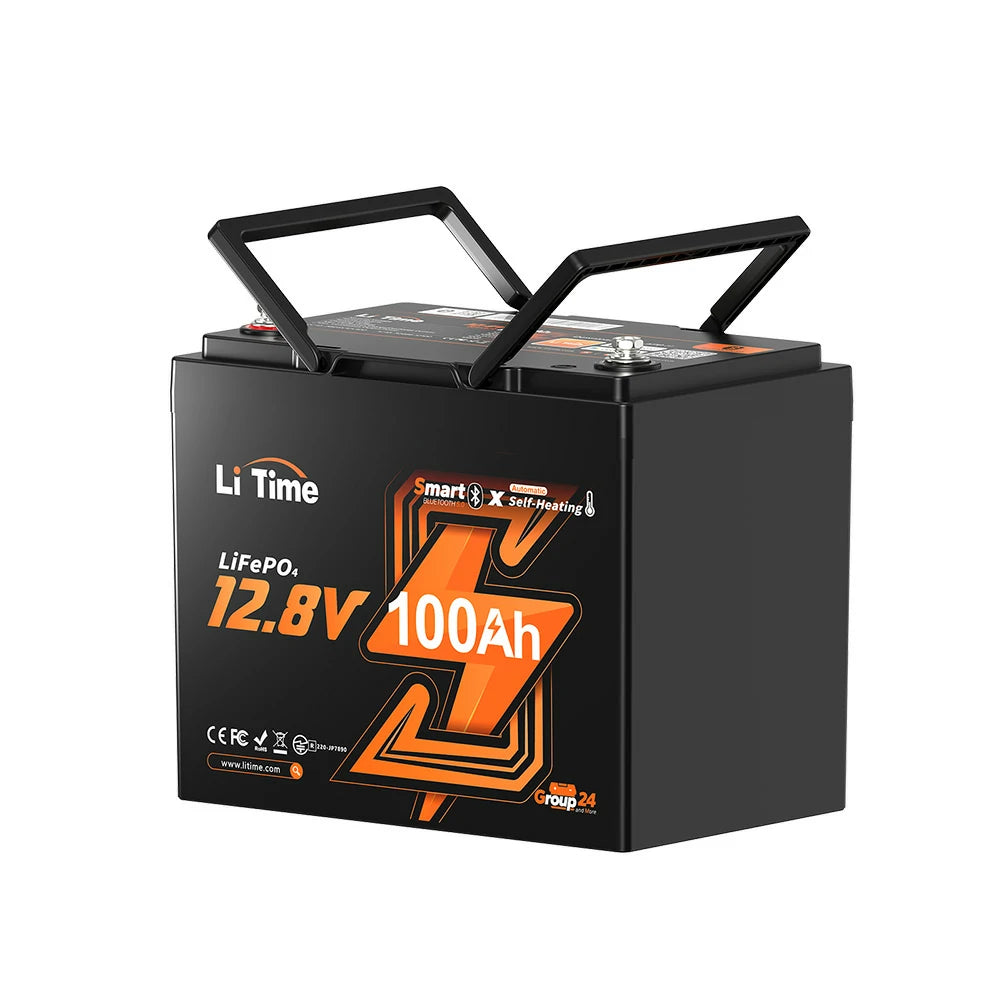
Consider a boat or removable battery kept in an unheated garage or boat shed. After a cold outing, the battery itself may remain below its normal charging temperature even after the fishing gear has been packed away.
The self-heating system warms the battery under supported charging conditions. LiTime specifies a minimum 10A charging current for the heating function, alongside Bluetooth monitoring and trolling-motor applications.
Its main advantage is charging convenience in cold conditions. Ordinary low-temperature protection pauses charging when the battery is too cold; self-heating provides a way to warm it before charging proceeds.
For seasonal anglers, this distinction can be more useful than choosing solely by enclosure size or monitoring features.
What Makes a Good Trolling Motor Battery?
A good trolling motor battery combines sufficient capacity, appropriate current delivery, and practical features for the way you fish. Understanding these characteristics makes the differences between models easier to evaluate.

Capacity and Current Serve Different Purposes
Amp-hours describe charge capacity; amps describe current. A 100Ah rating helps estimate operating time, while the continuous discharge rating describes the current a battery can supply over time.
For example, a motor averaging 20A uses approximately 20Ah in one hour. A temporary higher-current rating serves a different purpose: it describes a load the battery supports for a specified period.
The motor’s operating voltage and current requirements therefore provide a more useful electrical comparison than thrust alone.
Protection and Monitoring Add Everyday Value
Bluetooth makes battery information easier to access, especially when the battery sits beneath a seat or inside a compartment. Low-temperature charging protection helps manage cold conditions, while self-heating adds a separate charging benefit.
IP65 enclosures provide dust and water-jet protection for outdoor installations. Their role is protection from exposure around the boat; they are not designed for submersion.
These features complement the installation’s mounting, wiring, terminal protection, and circuit protection.
How Long Will a 100Ah Lithium Battery Run a Trolling Motor?
A 100Ah lithium battery can provide several hours of motor operation, with duration determined primarily by average current draw and the capacity used. LiTime’s guide to how long a 100Ah battery will run a trolling motor explores the relationship between motor use, operating conditions, and runtime.
Estimate Runtime from Average Current Draw
Use this formula for a planning estimate:
Estimated runtime (hours) = planned usable capacity (Ah) ÷ average current draw (A)
The following examples allocate 80Ah from a fully charged 100Ah battery, leaving a 20% reserve for trip planning.
| Average current draw | Calculation | Estimated motor runtime |
|---|---|---|
| 10A | 80Ah ÷ 10A | 8 hours |
| 20A | 80Ah ÷ 20A | 4 hours |
| 30A | 80Ah ÷ 30A | About 2.7 hours |
| 50A | 80Ah ÷ 50A | 1.6 hours |
These estimates use a chosen planning reserve rather than measured performance from the four models.
Fishing Time and Motor Runtime Are Different
On a hypothetical six-hour outing, running the motor half the time at 20A consumes approximately 60Ah:
6 hours × 50% operating time × 20A = 60Ah
Continuous operation at 20A for the same six hours would require 120Ah. This explains why one 100Ah battery may cover a longer session of intermittent fishing movements but a shorter period of continuous propulsion.
Wind, current, boat load, temperature, and positioning activity also affect consumption.
What Should You Consider When Completing Your Setup?
The complete setup includes the battery, charger, mounting, cables, and circuit protection. These components influence both installation convenience and total cost.
- Electrical requirements: Motor voltage and maximum current establish the required battery configuration.
- Installation space: Case dimensions, terminal position, cable routing, and lid clearance determine physical fit.
- Charging equipment: A compatible LiFePO4 charging profile supports the selected battery’s charging requirements.
- Package contents: Battery-only purchases and bundles may include different accessories.
FAQs
The following answers cover common questions about choosing a LiTime 12V 100Ah trolling motor battery.
Is 100Ah Enough for a 55 lb Trolling Motor?
It can provide a useful capacity for a compatible 12V motor. Average current draw and operating time determine whether it covers a particular fishing trip.
Can I Use My Existing Lead-Acid Charger?
Some chargers include suitable LiFePO4 settings. Compatibility depends on the charger’s voltage and charging profile, together with the selected battery’s requirements.
Do All Four Batteries Have Self-Heating?
The Group 24 Self-Heating Bluetooth includes built-in heating. The other listed models provide low-temperature protection, which pauses charging in cold conditions without warming the cells.
Can These Batteries Power a 24V or 36V Motor?
Supported series configurations can combine 12V batteries for higher-voltage systems. The exact model’s connection limits, battery-matching requirements, and charging arrangement determine the appropriate configuration.
For everyday small-boat fishing, the Group 27 Bluetooth offers convenient monitoring and 100Ah capacity. The TM Plus focuses on changing trolling loads, the OBM serves compatible electric outboard projects, and the self-heating Group 24 adds value for cold-weather charging. Each addresses a different part of the fishing experience.

