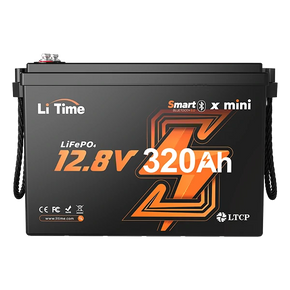


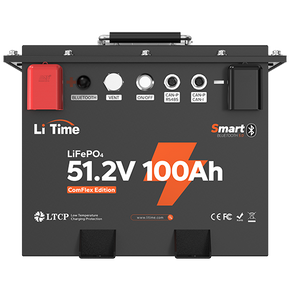

Upgrading from lead-acid to lithium batteries can provide more usable energy, reduce battery weight and space, shorten charging time, extend cycle life, and simplify battery management. LiFePO4 batteries cost more initially, but frequent users may spend less over time by avoiding repeated replacements. However, the new battery must match the system voltage, current demand, charger, installation space, and operating temperature.
Lead-Acid vs. Lithium Battery: Quick Comparison
LiFePO4 batteries generally outperform deep-cycle lead-acid batteries in usable capacity, weight, charging time, cycle life, and monitoring. The following figures summarize the comparisons explained throughout this article.
| Comparison | Deep-Cycle Lead-Acid | LiFePO4 |
|---|---|---|
| Commonly used capacity | About 50% for longer cycle life | Commonly 80–100%, depending on specifications |
| Weight | Typically about 2–3 times heavier | Usually about 50–70% lighter |
| Charging time | Approx. 6–12 hours | Approx. 2–5 hours with a compatible charger |
| Representative cycle life | Approx. 400–800 cycles at 50% DoD | 4,000 cycles at 100% DoD in the LiTime example |
| Routine maintenance | Varies; flooded batteries require the most | Generally maintenance-free |
| Battery monitoring | Often requires an external monitor | BMS and Bluetooth available on smart models |
These figures are representative rather than universal. Performance depends on the individual battery, discharge depth, charger, temperature, load, and manufacturer-defined test conditions.
5 Main Reasons to Upgrade from Lead-Acid to Lithium Batteries

1. Get More Usable Energy from the Same Rated Capacity
A LiFePO4 battery can provide 60–100% more usable capacity than a lead-acid battery with the same Ah rating when the lead-acid battery is limited to 50% depth of discharge and the lithium battery is used to 80–100%.
Usable capacity can be estimated as:
Usable capacity = rated capacity × permitted depth of discharge
For batteries with the same 100Ah rating:
| Battery Example | Rated Capacity | Example DoD | Calculated Usable Capacity |
|---|---|---|---|
| Lead-acid | 100Ah | 50% | 50Ah |
| LiFePO4 | 100Ah | 80% | 80Ah |
| LiFePO4 rated for full discharge | 100Ah | 100% | 100Ah |
At 80% DoD, the lithium example provides 60% more usable capacity than the lead-acid example:
(80Ah − 50Ah) ÷ 50Ah = 60%
At 100% DoD, it provides twice the calculated usable capacity. Lead-acid batteries can be discharged beyond 50%, but repeated deep discharge generally shortens their cycle life.
Higher loads can also reduce the effective capacity of lead-acid batteries. One published 100Ah AGM specification, for example, delivers 100Ah at a 20-hour discharge rate but only 82Ah at a five-hour rate.
This is known as the Peukert effect: the usable capacity of a lead-acid battery decreases as its discharge current increases. Therefore, a reliable lithium vs. lead-acid battery comparison should consider usable energy and load, not only the Ah number printed on the label.
2. Reduce Battery Weight and Simplify the System
A 36V 100Ah LiFePO4 battery can be approximately 65–70% lighter and occupy about 50% less total case volume than a comparable lead-acid battery system. It can also replace a multi-case battery bank with one integrated unit.
Take the LiTime compact 36V 100Ah Battery as an example. It weighs 67.46 lb and measures 15.35 × 7.99 × 10 inches, giving it an approximate case volume of 1,227 cubic inches.
Published specifications for comparable 36V 100Ah lead-acid systems show a total weight of approximately 195–225 lb. Their multiple battery cases have a combined case volume of roughly 2,400–2,600 cubic inches.
| 36V 100Ah Battery System | Lead-Acid | LiTime LiFePO4 |
|---|---|---|
| Approximate system weight | 195–225 lb | 67.46 lb |
| Approximate weight saved | — | 128–158 lb |
| Combined case volume | Approx. 2,400–2,600 in³ | Approx. 1,227 in³ |
| Approximate space reduction | — | About 50% |
| Battery arrangement | Multiple cases | One integrated battery |
| Interconnecting cables | Required | Not required |
The lithium example also consolidates 3,840Wh of rated energy into one enclosure. Fewer battery cases mean fewer terminals, cables, mounting points, and connections that require installation and inspection.
Actual installed-space savings depend on battery orientation, spacing, terminals, trays, and cable routing. Users should therefore verify the dimensions of both the complete lead-acid bank and the proposed lithium replacement.
3. Recharge Faster and Reduce Charging Losses
A LiFePO4 battery can often reduce charging time by approximately 50% compared with a lead-acid battery of the same voltage and rated capacity. A 36V 100Ah lithium battery may recharge in about 2–5 hours, while a comparable lead-acid system commonly requires approximately 6–12 hours.
| 36V 100Ah Charging Comparison | Lead-Acid | LiTime LiFePO4 |
|---|---|---|
| Representative charging current | 10–20A | 20–50A |
| Approximate charging time | 6–12 hours | About 5 hours at 20A |
| Faster-charging example | Limited by approved current and absorption time | About 97% in 2 hours at 50A |
| Charging near full capacity | Longer reduced-current period | Shorter reduced-current period |
With a compatible 36V 15A charger, the battery can reach in about 6 hours. A compatible 36V 25A LiFePO4 charger, it can recharge in approximately four hours. The same approximate time applies when a generator supplies the charger. A 1,200W solar array paired with a 60A MPPT controller can recharge it within one sunny day under suitable sunlight conditions.

The difference mainly comes from charging behavior. Lead-acid batteries require a longer absorption stage, during which the charging current gradually decreases, while LiFePO4 batteries can accept a higher current through more of the charging cycle.
Shorter charging time is particularly useful when charging from limited solar hours, a generator, an alternator, or shore power between trips. Actual results depend on the starting state of charge, temperature, battery condition, and charger output.
4. Gain a Longer Cycle Life and Reduce Repeat Purchases
LiFePO4 batteries can provide approximately five to ten times the cycle life of conventional deep-cycle lead-acid batteries. Current lead-acid specifications commonly list around 400–800 cycles at 50% DoD, while the LiTime 36V 100Ah battery is rated for 4,000 cycles at 100% DoD.
A cycle means discharging and then recharging a specified portion of the battery. Depth of discharge, or DoD, indicates the percentage of capacity used during that cycle.
| Published Cycle-Life Comparison | Deep-Cycle Lead-Acid | LiTime 36V 100Ah LiFePO4 |
|---|---|---|
| Cycle life | Approx. 400–800 cycles | 4,000 cycles |
| Specified DoD | Commonly 50% | 100% |
| Relative cycle life | Baseline | Approx. 5–10 times higher |
| Additional ratings | Varies by model | 6,000 cycles at 80% DoD; 15,000 at 60% DoD |
The comparison is notable because the lead-acid figures are generally based on shallower discharge. The LiTime rating provides 4,000 cycles even at 100% DoD.
Over 4,000 cycles, a lead-acid system rated for 400–800 cycles could theoretically require five to ten battery lifetimes. This may mean purchasing the original bank plus approximately four to nine replacements.
Potential savings = avoided replacements × (battery price + replacement costs)
Replacement costs may include shipping, installation, downtime, replacement connectors, and recycling. Actual battery life still depends on temperature, charging settings, discharge current, storage, and maintenance.
5. Reduce Maintenance and Monitor Battery Status More Accurately
Upgrading to a smart LiFePO4 battery eliminates routine watering and equalization while providing more accurate information about remaining capacity, voltage, current, temperature, and operating status.
Maintenance requirements vary by lead-acid type. Flooded batteries may need water checks, terminal cleaning, ventilation, and periodic equalization. AGM and gel batteries are sealed and require less maintenance, but they normally do not include the integrated monitoring and protection available in a smart LiFePO4 battery.
A built-in battery management system, or BMS, can monitor and protect against:
- Overcharging and over-discharging;
- Excessive current and short circuits;
- High or low temperatures;
- Abnormal cell or battery voltage.
The LiTime 36V 100Ah Bluetooth battery also uses Bluetooth 5.0 to display state of charge, voltage, current, temperature, and battery status through the LiTime App. This helps users estimate available runtime without relying only on battery voltage.

Smart monitoring is particularly useful with LiFePO4 because its voltage remains relatively stable through much of the discharge cycle. The BMS does not replace correct installation, so properly sized cables, fuses, disconnects, and compatible charging equipment are still required.
Are Lithium Batteries Worth It?
Lithium batteries are generally worth the higher upfront cost for systems that are frequently cycled, weight-sensitive, space-limited, or dependent on short charging windows. Lead-acid can remain practical for occasional use and lower initial budgets.
| Consider Upgrading to LiFePO4 When… | Consider Keeping Lead-Acid When… |
|---|---|
| The battery is cycled frequently | It is used only a few times per year |
| More usable runtime is needed | Existing runtime already meets the need |
| Weight and space are limited | Weight is not an important constraint |
| Charging time is limited | The battery remains on grid or shore power |
| Replacement is difficult | Replacement is inexpensive and convenient |
| Smart monitoring is valuable | Basic monitoring is sufficient |
A reliable existing lead-acid bank does not necessarily need immediate replacement. The decision should depend on whether lithium’s measurable benefits solve an actual runtime, weight, charging, maintenance, or replacement problem.
What Should You Check Before Replacing Lead-Acid with Lithium?
Before replacing a lead-acid battery with lithium, verify the complete electrical system rather than matching only voltage and Ah capacity.
Check:
- Nominal and charging voltage;
- Usable energy required;
- Continuous and peak current;
- Charger and controller compatibility;
- Battery dimensions and terminals;
- Cable and fuse ratings;
- Charging and discharging temperatures;
- Starting or deep-cycle application.
Replace batteries with the same compatible system voltage: 12V with 12V, 24V with 24V, 36V with 36V, and 48V with 48V. The LiTime 36V 100Ah battery, for example, is designed for compatible trolling motors and electric outboards, not for starting a combustion engine.
Frequently Asked Questions
Can I directly replace a lead-acid battery with a lithium battery?
Not always. The lithium battery must match the system voltage, load current, installation space, and application. The charger, controller, wiring, fuses, and low-temperature charging requirements must also be checked.
Can I use my existing lead-acid charger for a LiFePO4 battery?
Only if its charging voltage and profile meet the LiFePO4 battery manufacturer’s requirements. Lead-acid equalization or unsuitable float settings may prevent correct charging or trigger the battery’s protection system.
How much longer does a lithium battery last than a lead-acid battery?
Representative deep-cycle lead-acid batteries provide approximately 400–800 cycles at 50% DoD, while selected LiFePO4 batteries provide 4,000 or more cycles. This can equal approximately five to ten times more cycles, although actual service life depends on operating conditions.
Is it worth upgrading to lithium if I use the battery only occasionally?
Possibly not. If the existing lead-acid battery provides enough runtime and weight is unimportant, replacing it early may not produce enough value. Lithium is usually more beneficial in frequently cycled, weight-sensitive, or charging-limited systems.

