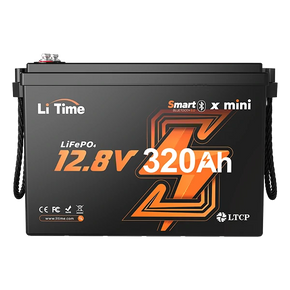


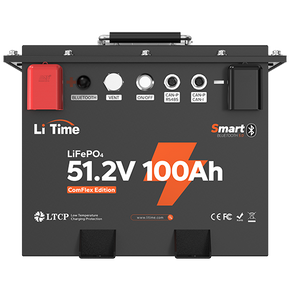

When the temperature drops below freezing, most lithium batteries stop charging entirely — no matter how many watts of solar panels you have, no matter how good your shore power hookup is. If you have ever winter-camped in an RV, run an off-grid cabin on solar, or overland through sub-zero nights, you already know the fix: a self-heating battery.
This guide explains what a self-heating battery actually is, how it works, who genuinely needs one, and how LiTime's patented LiHeat™ dual-mode self-heating technology changes the cold-weather equation — so you can choose the right heated LiFePO4 pack the first time.
Part 1: What is a Self-heating Battery?
A self-heating battery is a deep cycle lithium (almost always LiFePO4) pack with an integrated heating element — usually a thin heating film bonded to the cells — wired into a smart Battery Management System (BMS). Before charging can begin, the BMS measures the cell temperature. If it is below a safe threshold, the heating element turns on and warms the cells up to a charging-friendly range, and only then does charge current start flowing.
This is very different from a standard lithium battery, which has no internal heater and simply refuses to charge when it is cold. The reason lithium batteries are so temperature-picky is chemistry, not engineering sloppiness.
LiFePO4 can safely discharge at fairly low temperatures, but charging below roughly 0°C (32°F) causes lithium ions to plate out as metallic lithium on the anode instead of inserting into it. That "lithium plating" is irreversible: it drops capacity, raises internal resistance, and creates a long-term safety risk. The BMS blocks cold charging specifically to protect the pack. A self-heating battery simply adds the missing step — warming the cells first — so the protection circuit never has to trip.
Part 2: How Does a Self-heating Battery Work?
The principle sounds simple: heat the cells until they are warm enough to charge. In practice, the architecture decides how useful the self-heating battery really is.
The traditional "plug-in heating" approach
Most early heated lithium batteries work like this: when the BMS detects a cold cell and the pack is connected to an external charger (shore power, alternator, or solar), the charger feeds the heating film through the BMS. Once the cells climb into the safe charging window, normal charging begins.
This solves part of the problem, but it has two sharp limitations:
- You must already be plugged in to warm up. If you arrive at camp after a cold drive and want to pre-heat before turning in, you have no way to start the heater until shore power is connected.
- You lose the morning solar window. In an off-grid cabin, panels begin producing at first light when the cells are coldest. The self-heating battery cannot accept that early charge, so the sun's most valuable generation hours are wasted until the pack eventually warms up by ambient temperature.
The smarter dual-mode approach
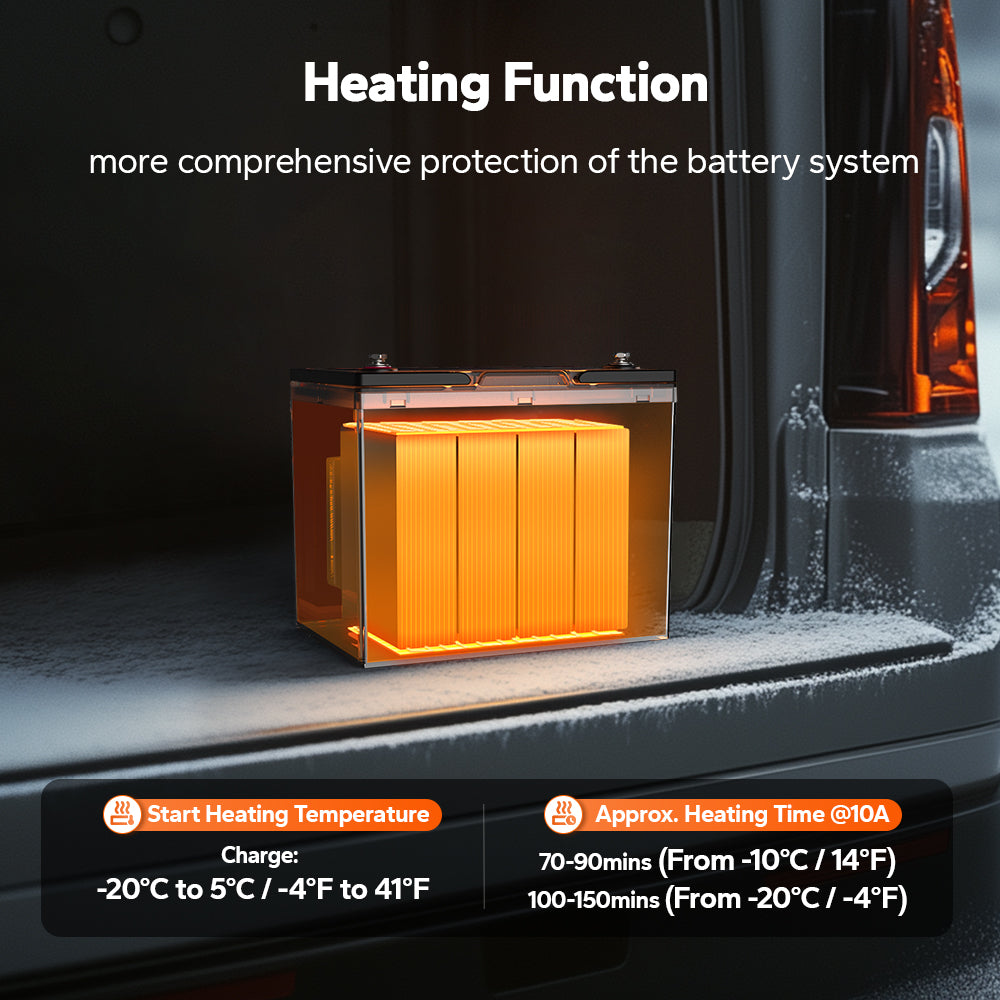
A more advanced design splits heating into two independent modes: heating from the battery's own stored energy, and heating from an external charger. The BMS automatically picks the right source based on what is available, and it can hand off from one mode to the other without the user doing anything. We will look at how LiTime implements this in Part 4.
Behind both modes, the BMS is constantly doing three things in a loop: reading cell temperature through built-in sensors, comparing it against safety thresholds for charging and discharging, and controlling the heating film, charge FETs, and discharge FETs accordingly. A Bluetooth connection to a phone app is what turns this internal loop into something you can actually see and command remotely.
Part 3: Do You Need a Self-heating Battery?
A self-heating battery is not a luxury for everyone, but it is a genuinely upgrade-worthy component for specific lifestyles. Here is who benefits most.
Typical use cases
- Winter RV and camper van travelers. If you camp where nights drop below freezing and you rely on shore power at a random campground, a self-heating lithium battery lets you start charging immediately on arrival instead of waiting hours for passive warm-up.
- Off-grid homes with solar in cold climates. A solar battery that refuses the first two hours of morning sun every winter day is a badly sized system, no matter how many watts of panels you installed. Internal heating directly converts otherwise-wasted solar energy into stored capacity.
- Overlanders and expedition vehicles. A compact deep cycle battery in a 4x4 sees sub-zero nights in deserts, mountain passes, and northern trails. Self-heating means the fridge, fan, and lights keep working without a dead pack in the morning.
- Boats and marine use in shoulder seasons. Cold bilges and overnight frosts are hard on standard lithium house banks; a self-heating LiFePO4 protects both charging and peak loads.
- Backup power in unheated spaces. Emergency power packs in garages, workshops, or cabins that sit idle through winter need to be able to charge themselves safely when you finally plug them in.
What you actually gain
- Safe charging well below freezing, instead of a disabled BMS and a dead bank.
- Shorter turnaround time. Heat the cells while you break camp, and the moment you plug in, charging begins.
- Longer pack life. Avoiding cold-charging abuse is the single biggest thing you can do to preserve LiFePO4 cycle count over a 10-year horizon.
- More reliable output. Keeping cells in a milder temperature range also stabilizes discharge voltage and high-power delivery in cold weather.
- Remote control. App-based pre-heating means the self-heating battery is ready before you are.
If you live and operate consistently in warm environments — southern Florida, tropical cabins, day-use marine applications — a standard lithium deep cycle battery will serve you fine and saves you the heater cost. But once your operating envelope regularly crosses 0°C, a self-heating battery stops being a gimmick and becomes the reason your system works at all.
Part 4: LiTime Dual-Mode Self-heating Technology
LiTime has taken the dual-mode idea and turned it into a patented platform called LiHeat™, described by the company as the industry's first smart dual-mode self-heating system for lithium deep cycle batteries. It is built on a patented battery charging control method and is designed to move cold-weather behavior from "passive protection" to "active thermal management."
Two heating modes, one automatic handoff
Self-Powered Heating Mode
When the cells are cold and no external charger is connected, the self-heating battery uses its own stored energy to drive the heating film. This is the mode that matters most on the trail: you can warm the pack from the driver seat via the LiTime app before you plug into shore power, or while you are still driving to the next stop.

Plug-in Heating Mode
When the battery is connected to a charger, the external supply powers the heating film instead of the battery's own reserve. Once cells reach the safe charging window, the BMS automatically begins charging — no waiting around.
The two modes are not manual switches. If you start self-heating and then plug in before the target temperature is reached, the BMS hands off seamlessly to plug-in heating, protecting your remaining state of charge until charging can begin.

Remote pre-heating from the LiTime app
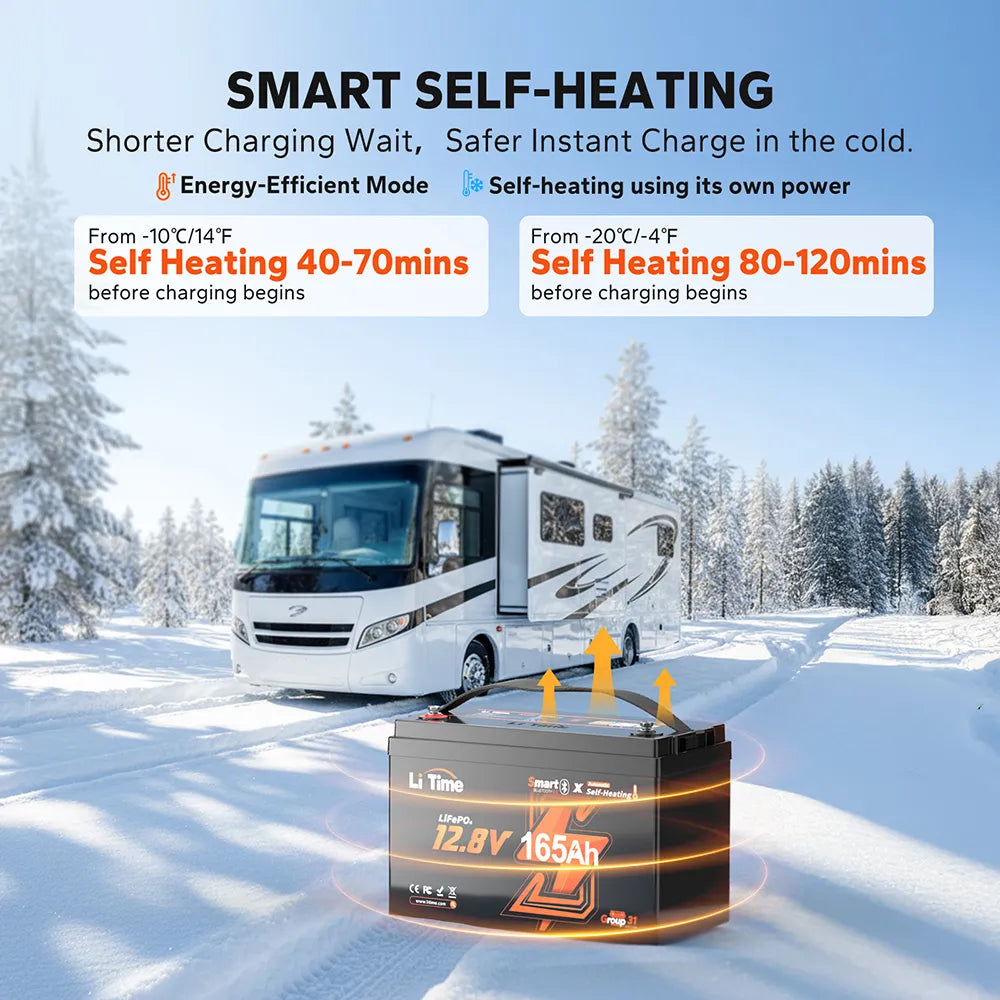
Through Bluetooth and the LiTime app, you can send a pre-heat command remotely. Under the published operating conditions — ambient temperature above -20°C (-4°F) and remaining battery capacity above 20% — the self-heating battery will warm itself toward the safe charging range. By the time you arrive at the charger, charging can start immediately rather than after a long warm-up wait.
For solar users this is a quietly big deal. On a cold winter morning, the panels start producing while the cells are still frosty. A LiHeat-equipped self-heating battery can begin heating itself as soon as there is enough voltage, accept charge earlier in the day, and use more of the available solar window instead of sitting idle.
Stable working temperature, not just charge readiness
LiHeat is not only about charging. By actively maintaining cells closer to their comfortable operating range in cold weather, the self-heating LiFePO4 also delivers more stable discharge voltage and more reliable high-power output — the fridge keeps humming, the inverter keeps kicking in for the coffee maker, and the voltage readout does not sag as aggressively on a frosty night.
Part 5: Best Self-heating Batteries for Cold Weather
If you are shopping for a cold-weather self-heating battery, the LiHeat lineup gives you three well-matched 12V options at different footprints and budgets. The table below summarizes where each one fits.
| Model | Best for | Form factor | Key edge |
|---|---|---|---|
| 12V 100Ah Group 24 | Camper vans, small RVs, compact solar kits | Group 24 footprint | Most affordable entry into LiHeat; tightest fit for small installations |
| 12V 165Ah | Full-time RV living, longer off-grid stretches | Standard 12V deep cycle case | More usable capacity for overnight boondocks without stacking packs |
| 12V 320Ah Mini | Maximum energy in a compact space, overland builds | "Mini" short-case design | High capacity with a small footprint — the standout compact powerhouse |
LiTime 12V 100Ah Self Heating Lithium Battery
The 12V 100Ah Group 24 self-heating battery is the most approachable entry point into LiHeat. Its Group 24 footprint drops into the same battery box that many RVs, boats, and smaller solar setups already use, which makes it a natural upgrade from an old lead-acid Group 24.
With built-in Bluetooth, dual-mode self-heating, and app-based temperature control, it is the right pick for anyone who wants cold-weather charging without redesigning their electrical bay. See the LiTime 12V 100Ah Group 24 Self-Heating Battery.
LiTime 12V 165Ah Self Heating Lithium Battery
For full-time RVers and larger off-grid systems, the 12V 165Ah self-heating battery delivers noticeably more usable energy overnight — enough to run the furnace fan, fridge, lights, and a few accessories through a cold night without dipping into low-voltage territory.
The same LiHeat dual-mode system means it can pre-heat on its own reserve before shore power arrives, or heat and charge simultaneously once plugged in. See the LiTime 12V 165Ah Self-Heating Lithium Battery.
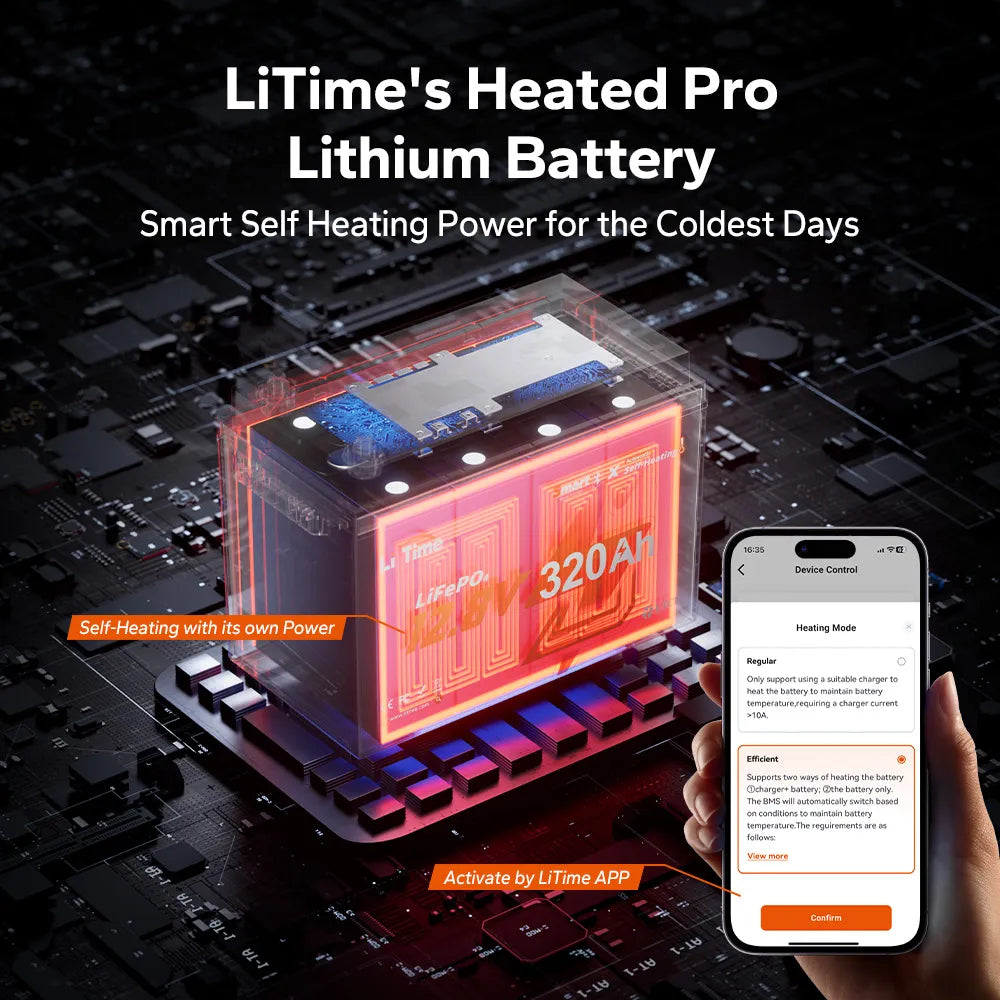
LiTime 12V 320Ah Mini Self Heating Lithium Battery
The 12V 320Ah Mini self-heating battery is the model that best pairs large capacity with a space-saving, shortened case designed for overland trucks, vans, and installations where floor space is at a premium.
Despite the compact footprint, it keeps the full LiHeat treatment — self-powered and plug-in heating, Bluetooth BMS, and app monitoring — so you do not give up cold-weather capability to save space. See the LiTime 12V 320Ah Mini Self-Heating Lithium Battery.
Part 6: FAQs
How much does a self-heating battery cost?
A self-heating LiFePO4 battery carries a modest premium over a standard lithium pack of the same capacity, because it adds a heating element, extra temperature sensors, and more sophisticated BMS logic.
For example, current LiTime self-heating battery prices range from about $209.99 to $1,099.99.
How cold is too cold for lithium battery?
Standard LiFePO4 batteries should not be charged below about 0°C (32°F), because charging colder than that risks lithium plating.
What is the best self-heating lithium battery for an RV?
For RV use, a strong choice is the LiTime self-heating LiFePO4 battery series, especially for campers who travel in cold climates. LiTime batteries combine automatic low-temperature heating, built-in BMS protection, long cycle life, and high usable capacity, making them well suited for winter RV power systems.
Conclusion
Cold weather does not have to mean dead batteries, wasted solar mornings, and long waits at random campgrounds. A self-heating battery turns the cold-temperature problem from a protection-only dead end into an active, managed process: sense the cold, warm the cells, and charge safely. Traditional plug-in heaters only solve half of that loop, because they require shore power you may not yet have.
LiTime's LiHeat™ dual-mode self-heating architecture closes the gap: self-powered heating gets the cells ready when you are off-grid, plug-in heating takes over once you connect, and the app lets you pre-warm remotely before you even arrive.

