


The main outboard motor types are gasoline, electric, propane, and diesel. Gasoline models offer broad power and range, while electric outboards suit quiet cruising and smaller boats. Propane works for selected portable applications, and diesel is mainly used for demanding commercial needs. The right choice depends on your boat’s limits, loaded weight, desired speed, operating range, water conditions, and access to fuel or charging.
Main Outboard Motor Types and Common Uses by Power Source
The principal types of outboard boat motors are classified by their power source. Each type has different advantages, operating requirements, and suitable applications, so the best option depends on how and where the boat will be used.
Main Outboard Motor Types at a Glance
The following table compares the most common types of outboard motors by application, boat type, advantage, and limitation.
| Outboard motor type | Common uses | Common boat types | Main advantage | Main limitation |
|---|---|---|---|---|
| Gasoline | Higher-speed travel and longer trips | Bass boats, pontoons, bowriders, center consoles | Broad power range and fast refueling | Fuel, noise, emissions, and maintenance |
| Electric | Fishing, quiet cruising, and shorter trips | Dinghies, inflatables, jon boats, small fishing boats | Quiet operation and low maintenance | Range depends on battery capacity |
| Propane | Portable and occasional propulsion | Dinghies and small utility boats | Convenient packaged fuel | Limited model and power selection |
| Diesel | Heavy-duty and specialized operation | Commercial and working boats | Durability and torque | Higher cost, weight, and limited availability |
These categories describe the power source, but outboards can also be classified by engine design, horsepower, portability, and control method.
Gasoline Outboard Motors
Gasoline outboards are widely used because they are available in power ratings ranging from portable motors for dinghies to multiple high-horsepower units for large offshore boats.
They are well suited to boaters who need higher speeds, longer operating ranges, or quick refueling. Common boat types using gasoline outboard motors include:
- Bass boats and other high-speed fishing boats
- Pontoon and deck boats
- Bowriders and family runabouts
- Center-console and offshore fishing boats
- Dinghies using small portable outboards
Gasoline outboards fall into two categories: two-stroke and four-stroke engines. A two-stroke engine , while a four-stroke completes intake, compression, combustion, and exhaust over four strokes.
Traditional two-stroke outboards complete its combustion cycle in two piston strokes. They are generally compact and have a strong power-to-weight ratio. However, older designs may consume more fuel and produce more noise and emissions than modern four-stroke engines.
Four-stroke outboards complete intake, compression, combustion, and exhaust over four strokes. They are generally quieter and more fuel-efficient, but they contain additional components and can be heavier.
Marine gasoline engines sold in the United States are subject to EPA marine spark-ignition engine emission regulations. Local lakes and waterways may have additional restrictions.
Electric Outboard Motors
Electric outboards use an electric motor powered by a battery system. Instead of being rated only in horsepower, they may also be described by watts, operating voltage, or thrust.
Their quiet operation makes them suitable for fishing, wildlife observation, recreational cruising, and waters where noise or gasoline engines are restricted. Common applications include dinghies, inflatable boats, jon boats, small fishing boats, sailboat tenders, and compatible motor-ready kayaks.
Electric outboards have fewer routine engine-service requirements because they do not need fuel, engine oil, or spark plugs. However, their usable range varies with several factors:
- Battery capacity and usable energy
- Motor power and throttle setting
- Boat design and loaded weight
- Wind, current, waves, and water conditions
- Propeller condition and installation height
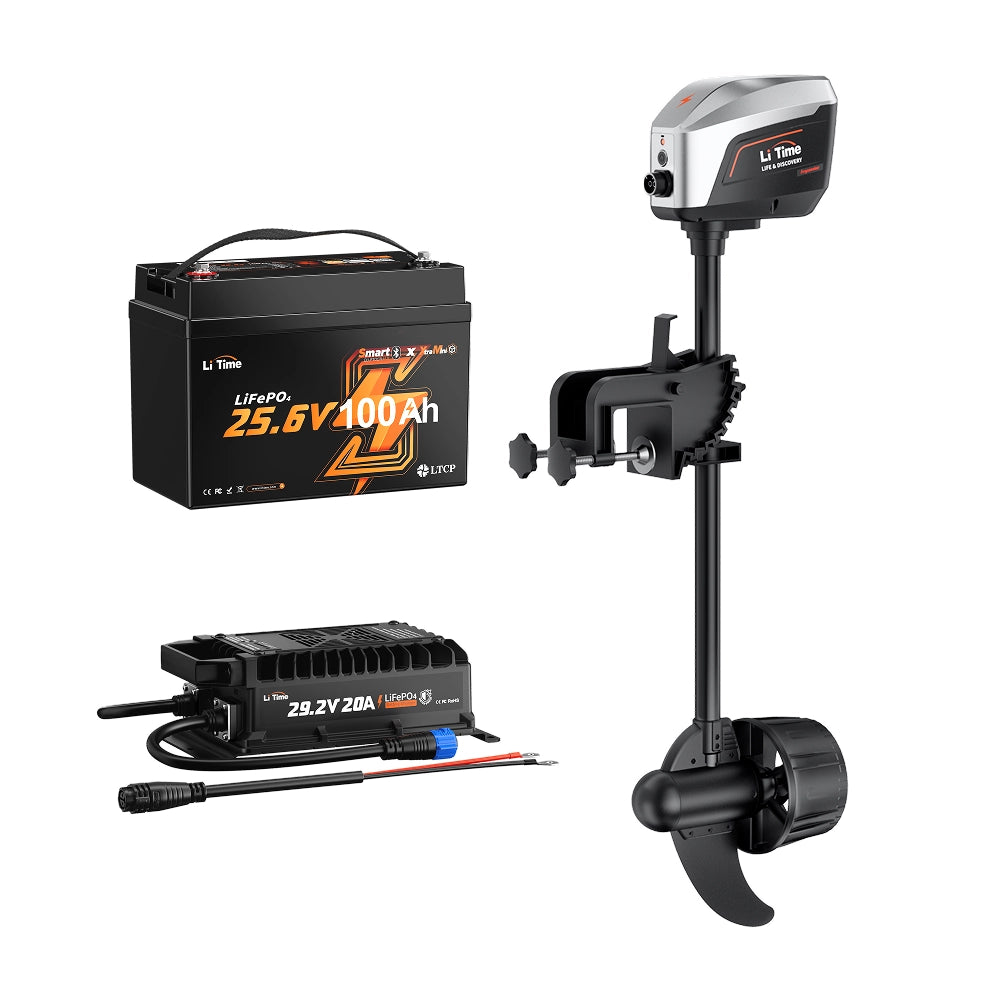
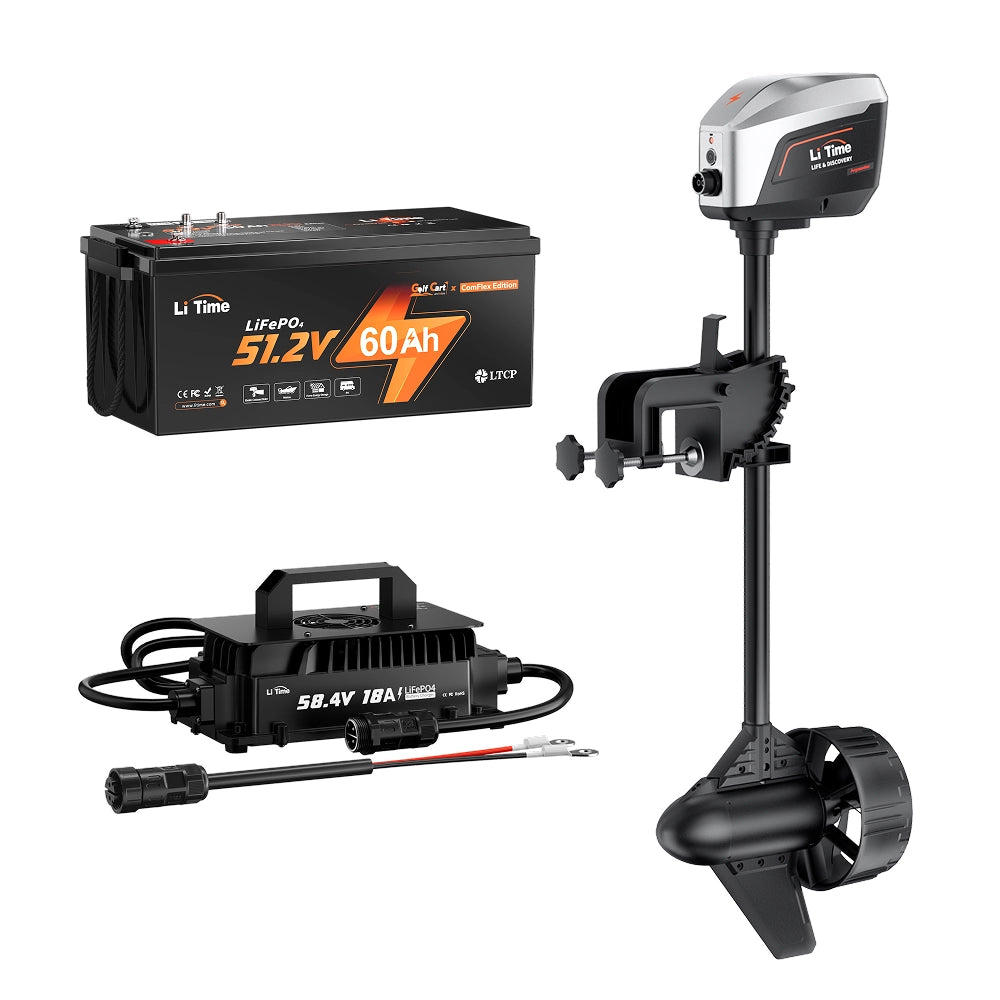
For example, the LiTime Argoseeker remote control series includes a 24V 700W electric outboard with 60 lbs of thrust and a 48V 2000W electric outboard with 120 lbs of thrust. Both provide wireless steering, forward and reverse operation, stepless speed control, and cruise control for small-boat use.
Higher power does not automatically guarantee a specific speed. Actual performance still depends on the hull, load, propeller, water conditions, wind, and installation.
Propane and Diesel Outboards
Propane outboards are mainly available in smaller portable configurations. Packaged propane can be convenient for occasional use and avoids some gasoline-storage concerns, but the selection of motors, power levels, and fuel sources may be limited.
These motors can suit dinghies, small utility boats, and short recreational trips. Before choosing one, boaters should confirm local propane availability and calculate how much fuel the planned trip requires.
Diesel outboards are less common in the recreational market. They are generally aimed at commercial, military, working-boat, or heavy-duty applications where durability, torque, and compatibility with an existing diesel fuel system may justify their greater cost and weight.
Other Key Differences Between Outboard Motors
Outboards also differ in portability, power output, installation, and control method. These differences can matter as much as the choice between gasoline and electric power.
Portable vs. High-Power Outboards
Portable electric outboards are designed for easier installation, removal, transportation, and storage. Electric models can offer useful power without the weight of a conventional gasoline engine.
For example, the LiTime Argoseeker A1 weighs 13.45 lbs (6.1 kg), while the more powerful Argoseeker A2 weighs 16.53 lbs (7.5 kg). Their lightweight designs make them easier to carry, mount, and remove between trips. They are commonly used on dinghies, inflatables, sailboat tenders, and smaller fishing boats.

High-power outboards are intended for heavier boats or applications requiring stronger acceleration and higher speeds. They normally require a reinforced transom, permanent rigging, and a compatible steering and throttle system.
Portability should be evaluated using the total system weight. An electric system includes the motor, battery, cables, and possibly a charger, while a gasoline system includes the motor, fuel tank, fuel line, and fuel.
Tiller, Conventional Remote, and Wireless Remote Controls
A tiller-controlled outboard has a handle attached directly to the motor. The operator steers and controls the throttle from the stern, making this arrangement simple and practical for many smaller boats.
A conventional remote-control outboard uses a steering wheel and a separate throttle-and-shift control. This setup is commonly installed on medium and large recreational boats because the operator can drive from a fixed helm.
A wireless remote-control outboard allows speed and direction to be adjusted from different positions on the boat. This is particularly useful with electric outboards because the complete system can use electronic throttle and steering controls without requiring the operator to remain beside the motor.
The Argoseeker electric outboards, for example, combine a wireless remote with an electric steering bracket. The operator can control steering, forward and reverse movement, speed, and cruise mode remotely, while an emergency control on the steering unit provides a backup option.

Wireless control does not make an outboard autonomous. The operator must continue watching the route, nearby boats, swimmers, water depth, and changing conditions.
How to Choose the Right Outboard Motor Type
Choose an outboard by matching the motor to the boat first, then comparing performance, range, controls, and ownership requirements. A more powerful motor is not automatically safer or more suitable.
1. Check the Boat’s Rated Limits
Follow the boat manufacturer’s limits for engine horsepower, motor weight, transom configuration, and passenger capacity. For many boats, this information appears on the capacity plate or in the owner’s manual.
Exceeding the rated horsepower or hanging too much weight on the transom can affect handling, stability, and safety. The U.S. Coast Guard’s Safe Loading guidance explains how maximum capacity and horsepower ratings are determined for applicable monohull boats.
2. Calculate the Normal Loaded Weight
Consider the weight of passengers, fishing equipment, safety gear, batteries, fuel, and other equipment—not only the empty hull. A motor that performs adequately on an unloaded boat may struggle when the same boat is fully loaded.
As a general reference, the Argoseeker A1 is recommended for boats with a fully loaded weight of up to 350 kg, while the Argoseeker A2 supports boats weighing up to 700 kg when fully loaded.
Loaded weight is a variable, so real-world speed cannot be predicted accurately from horsepower, watts, or thrust alone.
3. Define the Required Speed and Range
Gasoline outboards usually make more sense for higher speeds, long distances, and rapid refueling. Electric outboards can be a better fit for quiet fishing, low-speed cruising, shorter trips, and locations with dependable charging access.
For an electric system, select the motor and battery together. Operating at maximum power uses stored energy much faster than cruising at a moderate setting.
4. Consider the Operating Environment
Check whether the motor will be used in freshwater, saltwater, shallow areas, strong currents, or heavy vegetation. Saltwater compatibility, corrosion protection, propeller clearance, shaft length, and ease of cleaning may all affect the decision.
Water and weather conditions are variables rather than fixed performance specifications. Plan a safety reserve instead of treating a manufacturer’s maximum range or speed as a guaranteed result.
5. Compare Total Ownership Requirements
Compare the purchase price with the ongoing cost of fuel, electricity, maintenance, batteries, chargers, and storage. Also consider whether the motor needs to be removed frequently and whether local service is available.
The best outboard is the one that safely fits the boat and provides sufficient power and range under normal loaded conditions.
FAQs About Outboard Motor Types
What are the main types of outboard motors?
The main outboard motor types are gasoline, electric, propane, and diesel. Gasoline models can be further divided into two-stroke and four-stroke engines, while all outboards may also differ by power, portability, shaft length, and control method.
What type of outboard motor is best for a small boat?
Small gasoline or electric outboards are both common choices. The right type depends on the boat’s rated limits, loaded weight, mounting structure, desired speed, operating range, and access to fuel or charging.
Is an electric outboard better than a gas outboard?
An electric outboard is often better for quiet cruising, fishing, shorter trips, and low-maintenance ownership. A gasoline outboard is generally more practical when the boat needs higher speed, longer range, or quick refueling.
What is the difference between tiller and remote-control outboards?
A tiller outboard is controlled directly from a handle on the motor, usually requiring the operator to sit near the stern. Conventional remote systems use a steering wheel and throttle at a fixed helm, while wireless remote systems can let the operator adjust an electric outboard’s speed and direction from different positions aboard the boat.

